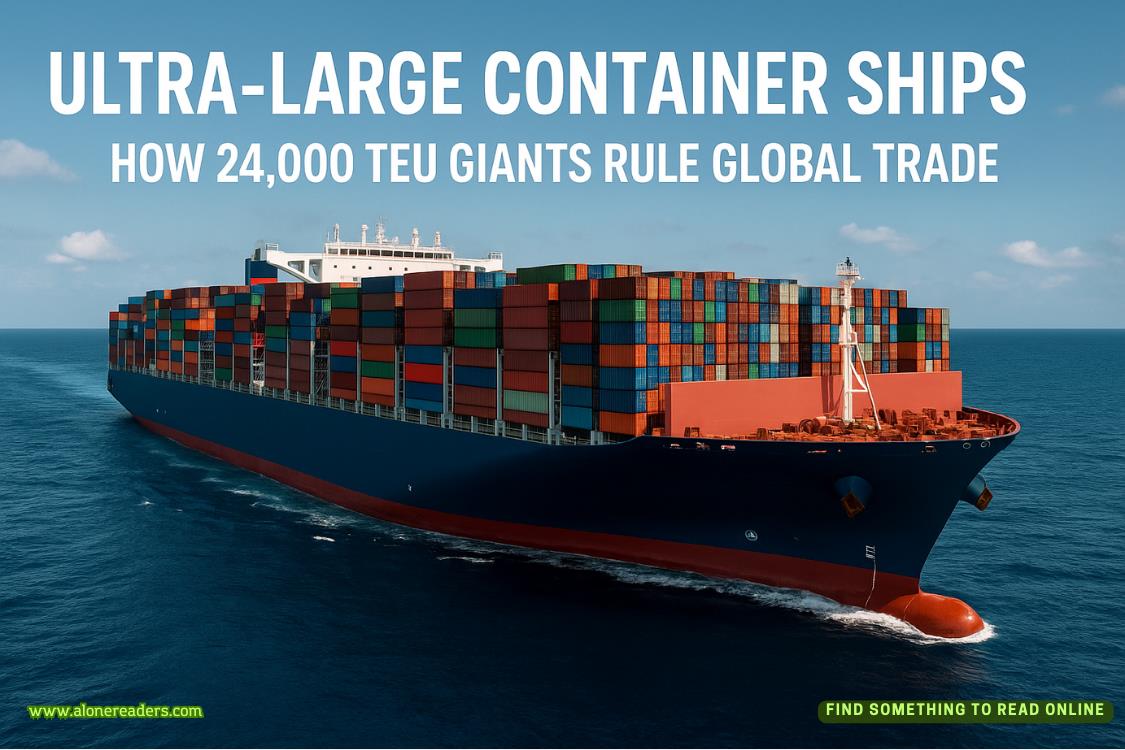
The global shipping industry has always been driven by the pursuit of efficiency, scale, and cost optimization. In recent decades, this pursuit has given rise to the development of ultra-large container ships (ULCS), vessels capable of carrying more than 24,000 twenty-foot equivalent units (TEU). These giants of the sea are not only the largest machines humans have ever put afloat but also the backbone of modern global trade. Their sheer scale reshapes the economics of shipping, the infrastructure of ports, and the flow of goods across continents. Understanding how these ships came to dominate trade, how they operate, and what challenges they bring is crucial for anyone interested in the dynamics of international commerce.
The evolution of container shipping can be traced back to the mid-20th century when standardized containers revolutionized the transport of goods. Early vessels carried a few thousand containers, but as global trade expanded, the shipping industry sought to lower costs through economies of scale. The introduction of ultra-large container ships represented a leap forward. A 24,000 TEU vessel is nearly 400 meters long, over 60 meters wide, and taller than many skyscrapers when fully stacked with containers. Each ship can carry goods worth billions of dollars, transporting everything from electronics and automobiles to raw materials and food products. By concentrating so much cargo on a single vessel, operators reduce the per-container cost of shipping, enabling cheaper goods for consumers worldwide.
These ships are strategically important because they connect major global trade routes. Most 24,000 TEU vessels operate between Asia and Europe, the busiest container corridor in the world. A single journey from Shanghai to Rotterdam can supply entire regions with manufactured goods, feeding industries, retail sectors, and e-commerce. By consolidating cargo into fewer voyages, these giants minimize fuel consumption per container, creating an efficiency advantage that smaller vessels cannot match. For shipping alliances and companies, deploying such ships is a competitive necessity to remain profitable in a market defined by razor-thin margins.
However, the deployment of ultra-large container ships requires specialized infrastructure. Not every port in the world can accommodate a 24,000 TEU titan. To berth such vessels, ports need deep-water access, reinforced quays, and gigantic cranes capable of reaching across 24 container rows. Only a handful of global ports, such as Singapore, Shanghai, Rotterdam, and Hamburg, are equipped to handle them efficiently. Even then, the process of loading and unloading thousands of containers takes days and demands complex logistics coordination. These infrastructure requirements are forcing ports to modernize, invest billions in expansion projects, and adopt digital technologies to optimize container flows. For smaller ports, the arrival of such ships often creates congestion, bottlenecks, and competition with better-prepared hubs.
Operationally, these vessels represent a triumph of engineering. Their propulsion systems are among the largest diesel engines ever built, capable of delivering more than 80,000 horsepower while still meeting modern environmental standards. Many are equipped with advanced hull designs and energy-saving technologies, such as air lubrication systems and optimized propellers, to reduce drag and fuel consumption. Additionally, shipping companies are experimenting with alternative fuels like liquefied natural gas (LNG) and methanol to cut carbon emissions. With global pressure on the maritime industry to decarbonize, ultra-large container ships are often at the forefront of adopting innovations that align with international regulations.
The environmental dimension is both a strength and a challenge for these ships. On one hand, carrying more containers on a single voyage reduces emissions per unit of cargo compared to smaller ships. On the other hand, the reliance on fossil fuels means that each voyage still produces vast amounts of greenhouse gases. A single 24,000 TEU vessel can burn hundreds of tons of fuel per day, raising concerns about sustainability. Regulators and environmental groups are calling for stricter emission standards, which could force operators to invest in cleaner technologies and alternative propulsion systems. The International Maritime Organization (IMO) has already set targets to halve shipping emissions by 2050, making the transition to greener ultra-large ships inevitable.
Economically, these ships are a double-edged sword. While they reduce transportation costs and enable global trade to function at scale, they also concentrate risk. When a 24,000 TEU ship is delayed, stuck, or damaged, the impact on supply chains can be catastrophic. The world witnessed this during the Ever Given incident in 2021, when a 20,000 TEU ship blocked the Suez Canal for days, halting nearly 12% of global trade. With even larger ships now sailing, the consequences of disruptions could be even greater. Ports, insurers, and shipping companies are reassessing risk management strategies, recognizing that the failure of a single vessel can ripple across the entire global economy.
From a geopolitical perspective, ultra-large container ships play a role in global power dynamics. The ability to build, operate, and maintain such ships reflects national industrial strength. Most of these vessels are built in South Korea and China, highlighting the dominance of Asian shipyards in advanced maritime engineering. Their operation is tied to global trade flows, making them symbols of interdependence between exporting nations in Asia and consumer markets in Europe and North America. Any disruption—whether from trade wars, geopolitical conflicts, or logistical breakdowns—can quickly turn these ships into pawns in larger economic struggles.
Beyond economics and geopolitics, there is also a cultural fascination with these giants. Watching a 24,000 TEU vessel enter a harbor is a spectacle. Their size defies comprehension, with containers stacked like Lego bricks into towering walls of steel. For coastal cities, these ships embody globalization in physical form, bringing the distant world closer to local markets. They are floating cities, crewed by a few dozen sailors but carrying the lifeblood of global commerce. Without them, the modern economy, with its reliance on just-in-time supply chains and consumer abundance, would grind to a halt.
The future of ultra-large container ships raises intriguing questions. How much larger can ships realistically become? At some point, physical, economic, and logistical limits will be reached. Ports cannot endlessly deepen their harbors, and insurers may hesitate to cover vessels that carry so much concentrated value. There is also the human factor: managing such complexity requires advanced digital systems, from artificial intelligence optimizing stowage plans to blockchain securing supply chain data. The integration of these technologies will likely define the next generation of ultra-large ships, making them not only bigger but smarter.
In conclusion, ultra-large container ships of 24,000 TEU represent both the pinnacle of modern maritime engineering and the backbone of globalization. They have redefined trade efficiency, reshaped port infrastructure, and symbolized the interconnectedness of the world economy. Yet, they also embody the vulnerabilities of a system dependent on scale, efficiency, and fragile supply chains. As environmental pressures mount and global trade continues to evolve, these ships will remain central to the debate over the future of commerce, logistics, and sustainability. The 24,000 TEU titans are not just ships; they are the floating foundations of global trade in the 21st century.



 Château de Vincennes: France’s Forgotten Royal Fortress and Medieval Stronghold
 Château de Carcassonne: Europe’s Greatest Medieval Citadel and Fortress
 Château de Chenonceau: The Castle Built by Remarkable Women
 Château de Chambord: France’s Magnificent Renaissance Castle and Architectural Wonder
 Tehri Dam: India's Tallest Dam and the Debate Behind It
 Bhakra Nangal Dam: India's Temple of Modern Development