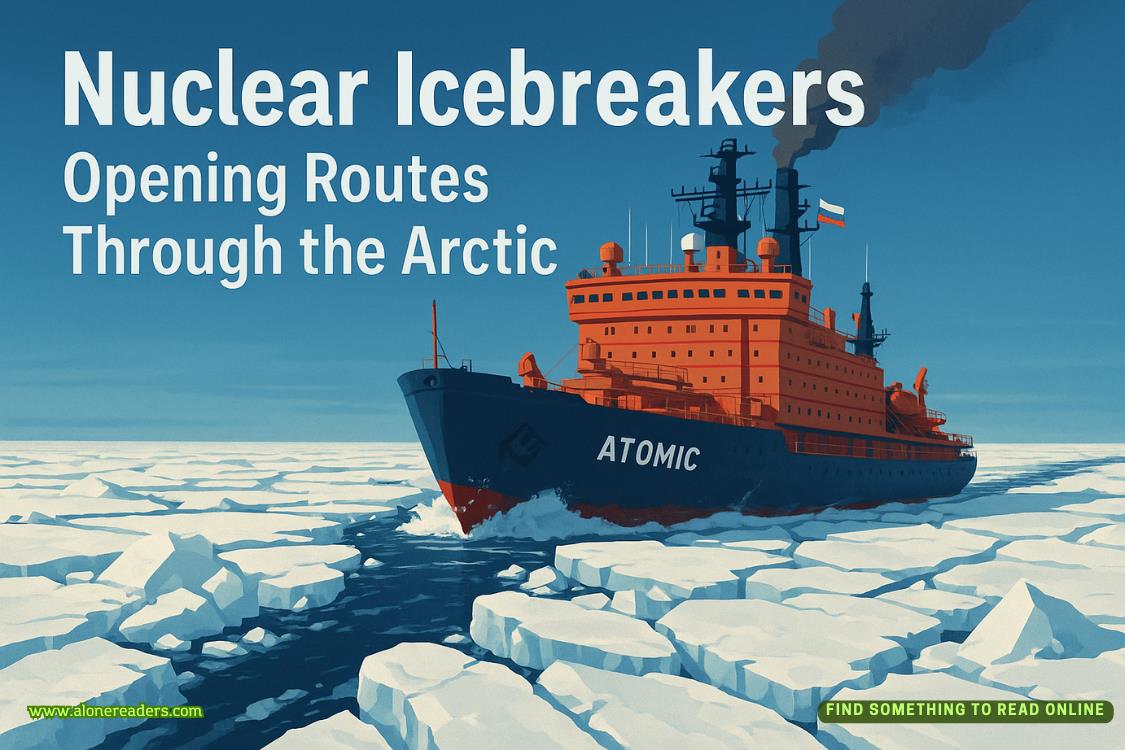
Nuclear icebreakers are some of the most specialized and powerful ships ever built, designed to conquer one of the most challenging environments on Earth—the Arctic Ocean. Unlike conventional vessels that struggle against dense ice fields, nuclear-powered icebreakers rely on immense onboard reactors to generate continuous power, allowing them to break through ice several meters thick. These ships are crucial not only for keeping sea routes open during the harsh Arctic winters but also for shaping the future of international shipping, global trade, scientific exploration, and geopolitics in one of the most contested regions on the planet.
The basic concept of an icebreaker is to push, crush, and fracture sea ice to create navigable channels for other vessels. Traditional diesel-powered icebreakers can achieve this to some extent but are limited by fuel capacity and endurance. Nuclear icebreakers solve this limitation by using compact reactors, often similar in design to those used in submarines, which can operate for years without refueling. This provides an unparalleled level of endurance and makes them particularly effective for long missions in remote polar environments. Their sheer strength is unmatched: some nuclear icebreakers displace more than 30,000 tons, and their reinforced hulls and uniquely shaped bows allow them to ride up onto the ice and crush it with their weight, carving safe passages even in the thickest ice sheets.
The origins of nuclear icebreakers date back to the Cold War era. The Soviet Union was the first to recognize the strategic importance of controlling Arctic shipping routes and launched the NS Lenin in 1959, the world’s first nuclear-powered civilian vessel. It marked the beginning of a fleet that would eventually become a powerful symbol of Russian engineering and geopolitical ambition. Over the decades, Russia has expanded its nuclear icebreaker program, building larger and more advanced ships capable of escorting commercial convoys, supporting scientific research, and even facilitating military logistics in the Arctic. Today, Russia remains the only country operating a fleet of nuclear icebreakers, with vessels such as Arktika, Sibir, and Ural forming the backbone of its Arctic strategy.
The significance of nuclear icebreakers is amplified by climate change, which is reshaping the Arctic landscape. Melting sea ice has opened new opportunities for navigation along the Northern Sea Route, a corridor running along Russia’s northern coastline that connects Europe and Asia. This route can reduce travel distance between major markets by up to 40% compared to the traditional Suez Canal passage. However, even with warming temperatures, large portions of the Arctic remain ice-covered for most of the year, particularly in winter. Nuclear icebreakers provide the assurance that shipping lanes can remain open year-round, making them indispensable for countries and corporations seeking to capitalize on the Arctic’s strategic position.
Beyond commerce, nuclear icebreakers play a vital role in scientific research. These vessels often serve as platforms for multidisciplinary studies on climate, oceanography, and glaciology. Their ability to reach remote and frozen parts of the Arctic provides scientists with opportunities to gather critical data on sea ice dynamics, marine ecosystems, and the long-term impacts of global warming. Some icebreakers are outfitted with laboratories and facilities to support extended scientific expeditions, turning them into mobile research stations capable of sustaining teams of scientists for months at a time.
The economic implications of nuclear icebreakers are substantial. By guaranteeing navigability of the Northern Sea Route, they facilitate the transport of natural resources such as liquefied natural gas, oil, and minerals from Russia’s Arctic territories to international markets. This not only strengthens Russia’s economic position but also reshapes global energy flows, as Asian countries increasingly look to Arctic routes for faster access to European suppliers. The ability to transport resources year-round without reliance on seasonal weather conditions reduces costs and enhances the reliability of supply chains, making Arctic shipping a competitive alternative to traditional maritime corridors.
Geopolitically, nuclear icebreakers are central to Russia’s assertion of dominance in the Arctic. The Arctic is believed to hold vast reserves of untapped oil, gas, and minerals, and as the ice recedes, competition for access intensifies. Russia has invested heavily in modernizing its icebreaker fleet as part of a broader strategy to secure control over the Northern Sea Route and extend its influence in the polar region. Other countries, including the United States, China, and members of the European Union, recognize the strategic importance of the Arctic but lack comparable capabilities. While the United States operates only a small number of conventional icebreakers, Russia commands the world’s largest and most advanced fleet of nuclear-powered variants, giving it a decisive advantage in both commercial and military terms.
The technology behind nuclear icebreakers continues to evolve. The latest generation, including Russia’s Project 22220 class, represents a leap forward in design and functionality. These ships feature dual-draft designs that allow them to operate both in deep Arctic waters and shallower coastal zones, making them highly versatile. They are also equipped with reactors designed for increased efficiency and safety, capable of operating for several decades. Looking further ahead, Russia is developing the Leader-class icebreakers, envisioned as the most powerful ever built, with the capacity to break through ice more than four meters thick at continuous speed. These advancements reflect not just technological progress but also the intensifying race to dominate Arctic waters as global interest in the region grows.
However, nuclear icebreakers are not without challenges and controversies. Operating nuclear reactors in such remote and fragile environments raises concerns about environmental safety. The risk of accidents, though minimal due to rigorous engineering standards, cannot be dismissed, especially given the catastrophic consequences a radiation leak could have in the Arctic ecosystem. Additionally, the high costs of construction and maintenance—each ship costing billions of dollars—limit their accessibility to only the wealthiest nations. Critics also argue that the militarization of the Arctic, with nuclear icebreakers serving dual civilian and military purposes, could escalate tensions in an already sensitive region.
Despite these concerns, nuclear icebreakers remain the only practical solution for maintaining reliable Arctic navigation in the foreseeable future. Their unmatched endurance, power, and capacity to operate independently in extreme conditions make them indispensable tools for countries with Arctic ambitions. As climate change accelerates the transformation of the polar regions, nuclear icebreakers will likely play an even more prominent role in shaping the economic, scientific, and geopolitical future of the Arctic.
In conclusion, nuclear icebreakers are more than just ships designed to break ice; they are strategic assets that open new routes for global trade, enable groundbreaking scientific research, and serve as instruments of geopolitical power. They symbolize humanity’s determination to master the most inhospitable environments and harness them for commerce, exploration, and national interest. With the Arctic emerging as a focal point of opportunity and competition in the 21st century, nuclear icebreakers stand at the forefront, ensuring that frozen barriers no longer limit human ambition. Their role in opening routes through the Arctic is not just about breaking ice—it is about breaking barriers to the future.



 Château de Vincennes: France’s Forgotten Royal Fortress and Medieval Stronghold
 Château de Carcassonne: Europe’s Greatest Medieval Citadel and Fortress
 Château de Chenonceau: The Castle Built by Remarkable Women
 Château de Chambord: France’s Magnificent Renaissance Castle and Architectural Wonder
 Tehri Dam: India's Tallest Dam and the Debate Behind It
 Bhakra Nangal Dam: India's Temple of Modern Development