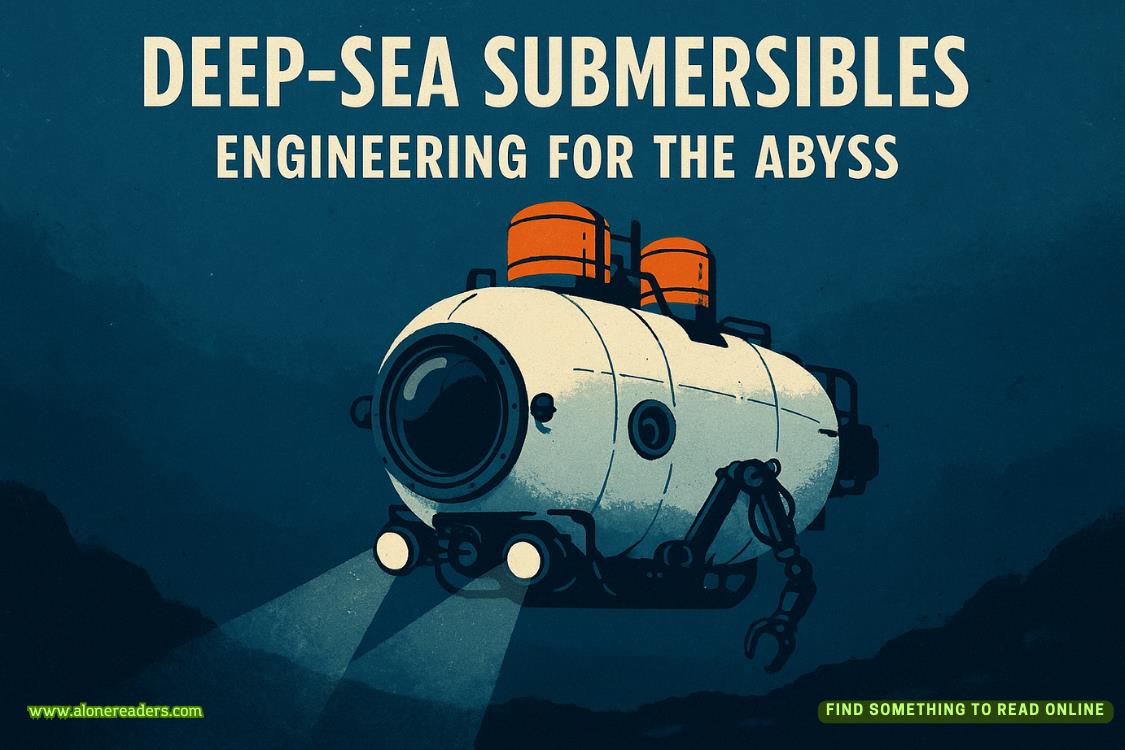
The ocean depths represent one of Earth’s final frontiers, a world less explored than the surface of the moon. To venture into this alien environment requires machines of extraordinary resilience and precision. Deep-sea submersibles are the culmination of decades of engineering ingenuity, designed to withstand pressures thousands of times greater than at sea level, all while providing scientists and explorers the ability to study ecosystems, geological formations, and even resources hidden in the abyss. The story of their development is one of overcoming physical extremes and human curiosity driving technological evolution.
A central challenge in designing a deep-sea submersible lies in its pressure resistance. At depths beyond 10,000 meters, every square inch of surface area experiences more than a thousand times the atmospheric pressure felt on land. Human divers can barely survive beyond a few hundred meters, yet submersibles must remain intact and operable under immense crushing forces. Engineers address this by constructing pressure hulls from ultra-strong materials such as titanium alloys, specialized steels, or syntactic foams. The hulls are spherical in design because a sphere distributes external pressure evenly, minimizing stress points that could cause catastrophic failure. Even a tiny structural imperfection can prove fatal when exposed to the abyss.
Another dimension of engineering submersibles is buoyancy control. Unlike surface ships that rely on displacement, submersibles use finely tuned ballast systems to achieve neutral buoyancy. Traditional ballast tanks can be filled with water for descent and pumped with air for ascent, but at extreme depths, the density of seawater and the strength of the tanks become critical considerations. Many modern designs integrate syntactic foam, a lightweight composite embedded with hollow glass microspheres, which resists compression even under extreme pressures. This material ensures that the vehicle can remain positively buoyant while still being able to sink to the seafloor.
Propulsion and maneuverability are also unique engineering challenges. In the absence of sunlight and with limited space, submersibles rely on compact electric thrusters to move with precision. These thrusters must function without creating significant turbulence, as stirring up sediment on the seabed can obscure cameras and sensors. Efficient power systems are essential, with modern submersibles relying on high-capacity lithium-ion batteries, which must be carefully protected against pressure and potential short-circuiting. Some experimental vehicles even explore the potential of fuel cells for longer endurance missions.
Equally critical is the sensory and data-gathering capability of these machines. Since light cannot penetrate beyond a few hundred meters, deep-sea submersibles are equipped with high-intensity LED arrays to illuminate their surroundings. Cameras with reinforced housings capture both still images and video in near-total darkness. Additionally, sonar systems allow for mapping of the seafloor, detecting geological formations and obstacles in otherwise unseeable terrain. More advanced models carry robotic arms for sample collection, allowing scientists to retrieve rock specimens, deep-sea organisms, and even artifacts from shipwrecks. These arms are marvels of engineering themselves, capable of fine motor control despite the extreme environment.
The human factor is another consideration. Crewed submersibles require life-support systems that regulate oxygen, remove carbon dioxide, and maintain tolerable temperatures in environments often just a few degrees above freezing. Space inside these craft is extremely limited; crew members must endure cramped conditions for hours, sometimes days, while cut off from the surface world. The psychological strain of operating in such isolation and danger is a silent but significant challenge. For this reason, remotely operated vehicles (ROVs) and autonomous underwater vehicles (AUVs) have become increasingly popular. These uncrewed machines eliminate the risk to human life while still offering valuable exploration capabilities, though they often lack the adaptability and real-time decision-making benefits of a human pilot.
Historical milestones in submersible engineering illustrate the gradual conquest of the abyss. The bathyscaphe Trieste, a pioneering craft, made history in 1960 when Jacques Piccard and Don Walsh descended nearly 11,000 meters into the Mariana Trench. Their journey demonstrated that with the right materials and design, humans could reach the deepest points of the ocean. Decades later, filmmaker James Cameron’s Deepsea Challenger revived public interest when he undertook a solo dive into the Mariana Trench in 2012. These achievements reflect not just individual courage but the culmination of meticulous engineering design and decades of refinement in materials science.
Modern submersibles continue to advance in sophistication. Hybrid vehicles combine autonomous navigation with tethered control, allowing operators to intervene when necessary while also enabling extended missions. Machine learning and AI are now being integrated, helping vehicles adapt to complex underwater terrain, identify unusual biological activity, or autonomously select samples of interest. These advancements signal a future where deep-sea exploration becomes not only safer but more efficient, with more data gathered per mission than ever before.
The implications of deep-sea exploration extend far beyond scientific curiosity. Submersibles play a vital role in resource discovery, from locating polymetallic nodules that contain rare earth elements to assessing hydrothermal vents that could harbor untapped energy potential. They are also crucial for monitoring subsea cable networks, the backbone of global internet communication, which lie vulnerable on the ocean floor. Moreover, understanding deep-sea ecosystems is critical as human activity increasingly threatens fragile marine environments. Submersibles provide the only direct window into these habitats, helping guide conservation policies and sustainable management of marine resources.
However, this pursuit is not without ethical and environmental concerns. The potential exploitation of deep-sea resources raises questions about disturbing ecosystems that have existed for millions of years undisturbed. Engineering submersibles for mining operations could inadvertently contribute to ecological harm. Therefore, the balance between exploration, exploitation, and conservation is a central debate in modern ocean engineering.
Deep-sea submersibles embody the fusion of scientific ambition and engineering excellence. They are machines that must be nearly flawless, operating in a domain where even the slightest miscalculation can mean disaster. Yet their contributions to our understanding of the Earth are immeasurable. From discovering new life forms and charting unseen geological landscapes to testing the boundaries of human ingenuity, they serve as both tools of exploration and symbols of resilience. The abyss, once thought unreachable, is steadily becoming more familiar, thanks to these marvels of engineering.
As technology continues to progress, the future promises even more capable vehicles, able to dive deeper, last longer, and gather richer insights into the most mysterious places on our planet. Humanity’s desire to push boundaries ensures that the story of deep-sea submersibles is far from over. They remain engineering’s response to nature’s ultimate challenge, vessels designed to unlock secrets hidden in the ocean’s black depths and to remind us of the vast unknown that still lies beneath our feet.



 Château de Vincennes: France’s Forgotten Royal Fortress and Medieval Stronghold
 Château de Carcassonne: Europe’s Greatest Medieval Citadel and Fortress
 Château de Chenonceau: The Castle Built by Remarkable Women
 Château de Chambord: France’s Magnificent Renaissance Castle and Architectural Wonder
 Tehri Dam: India's Tallest Dam and the Debate Behind It
 Bhakra Nangal Dam: India's Temple of Modern Development










