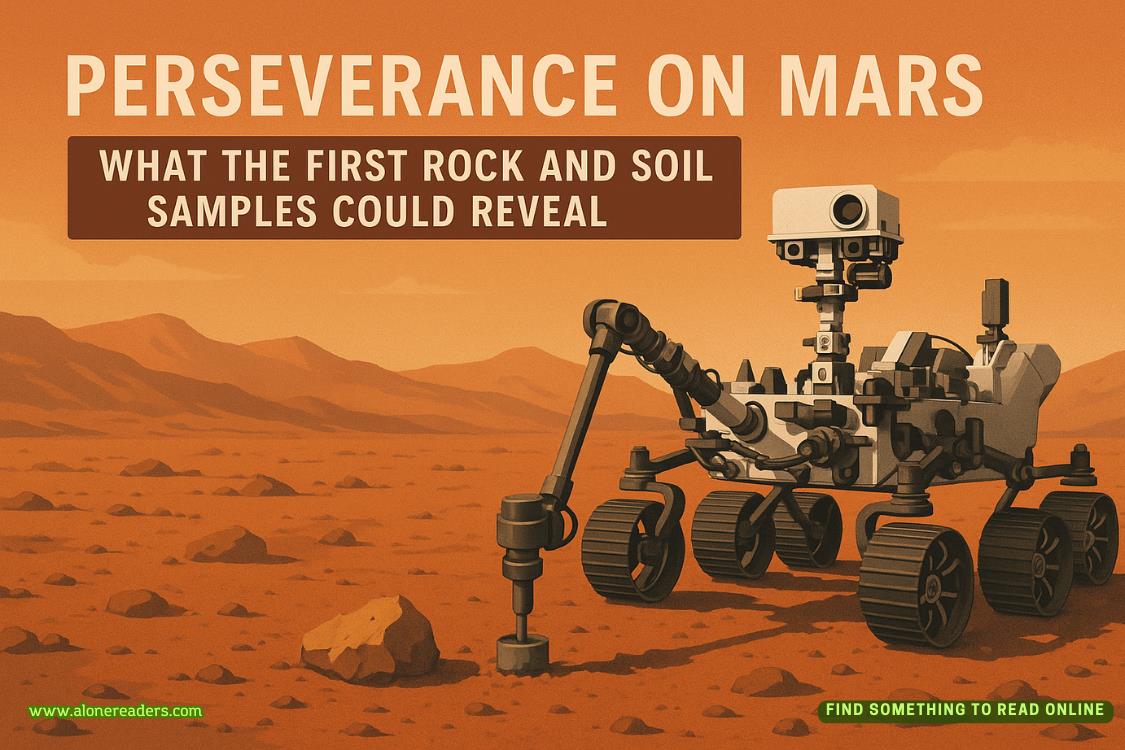
The landing of NASA’s Perseverance rover in Jezero Crater in February 2021 marked the beginning of one of the most ambitious planetary science missions in history. Unlike earlier Mars missions that carried instruments designed to conduct on-site analysis of rocks and soil, Perseverance has a dual role. It not only performs in-situ experiments but also collects and caches carefully selected samples for eventual return to Earth through the Mars Sample Return campaign. These first sealed cores, already stored in titanium tubes, may soon become the most scientifically valuable rocks in the Solar System. Scientists believe they could reveal the history of water on Mars, shed light on the planet’s geologic evolution, and perhaps most significantly, offer the first tangible clues about whether life once emerged on the Red Planet.
The choice of Jezero Crater as Perseverance’s landing site was no coincidence. High-resolution orbital imagery showed a fan-shaped delta formed billions of years ago by an ancient river flowing into a lake. Such deltas on Earth are prime environments for preserving biosignatures, as they trap sediments rich in organics and protect microfossils from erosion. By exploring this terrain, Perseverance has access to layered deposits that may record a detailed history of Mars’ wetter past. The samples collected here could answer critical questions about the duration, stability, and chemistry of liquid water on the Martian surface, factors that directly tie into the planet’s potential for habitability.
One of the most compelling scientific goals of Perseverance is the search for signs of ancient microbial life. While the rover carries state-of-the-art instruments like SHERLOC and PIXL, which can detect organic molecules and fine-scale chemical compositions, their abilities are limited compared to the laboratory techniques available on Earth. With returned samples, scientists could apply advanced methods such as high-resolution isotope analysis, synchrotron imaging, and even nanoscale tomography. These techniques could identify subtle biosignatures such as carbon isotope ratios that distinguish biological from abiotic processes, or mineral textures shaped by microbial activity. Even the absence of biosignatures would provide profound insight into how planets develop differently, making Earth’s biosphere more unique—or more universal—than we currently know.
Equally important is what these samples might reveal about Mars’ geologic and volcanic history. Perseverance has already drilled into igneous rocks that indicate a volcanic origin, allowing researchers to use radiometric dating to establish an absolute timeline for Martian events. For decades, Mars’ chronology has been estimated indirectly, primarily through crater counting. Having actual rock samples that can be dated with laboratory precision could recalibrate the timeline of the entire planet. If scientists can confirm when Jezero Crater’s lake existed, they will narrow down the window during which Mars was habitable. Moreover, understanding the ages of volcanic deposits will reveal how long Mars remained geologically active, a factor influencing its magnetic field, atmosphere retention, and climate evolution.
The chemistry and mineralogy of the samples also hold clues about Mars’ climate history. Alteration minerals such as clays, carbonates, and sulfates, if present in the cores, record interactions between water and rock. On Earth, such minerals provide evidence of past lakes, oceans, and even atmospheric compositions. If carbonates are found, they could suggest Mars once had a thicker carbon dioxide atmosphere capable of supporting liquid water. If sulfates dominate, it may point to acidic conditions less favorable for life. The balance of these minerals will help reconstruct the red planet’s environmental evolution, shedding light on why Mars transitioned from a potentially habitable world to the cold, arid desert we see today.
Another aspect scientists are eager to explore is the preservation of organics. Perseverance has already detected organic molecules in Jezero Crater using its onboard instruments, but determining whether these organics are biological or geological requires far more detailed study. On Earth, organics can be preserved in fine-grained sediments for billions of years, even in harsh conditions. If the Martian samples contain complex organic compounds or structures resembling microfossils, it would revolutionize our understanding of life in the universe. Even if the organics turn out to be non-biological, their chemistry could still illuminate the prebiotic conditions that once existed on Mars, providing a comparative framework for theories of life’s origins on Earth.
The broader implications of these samples extend beyond planetary science. A confirmed discovery of ancient Martian life—or even compelling evidence for its possibility—would fundamentally change humanity’s perspective on our place in the cosmos. It would suggest that life may emerge wherever conditions allow, making the universe potentially teeming with biology. Conversely, if Mars proves sterile despite once having water and energy sources, it would underscore the rarity of life, emphasizing Earth’s uniqueness and the fragility of its ecosystems. Either outcome carries deep philosophical and scientific weight.
Beyond astrobiology, the first samples could inform future human exploration of Mars. Understanding the composition of Martian regolith and potential resources is crucial for designing sustainable habitats and extracting useful materials for construction, life support, and fuel production. Identifying hydrated minerals, for example, could provide a source of water for astronauts. Recognizing potentially hazardous dust chemistry, such as perchlorates, is equally important for ensuring crew safety. Thus, the samples represent not only a scientific treasure but also a practical guide for humanity’s eventual steps onto the Martian surface.
The path to returning these samples to Earth, however, is complex and unprecedented. NASA and the European Space Agency are developing a joint Mars Sample Return program that will involve multiple spacecraft, including a Sample Retrieval Lander, a fetch rover, and an Earth Return Orbiter. The plan calls for Perseverance’s sealed tubes to be collected, loaded into a small rocket launched from Mars’ surface, and captured in orbit for return to Earth in the early 2030s. The technical challenges are immense, ranging from autonomous rendezvous around Mars to ensuring planetary protection protocols that prevent contamination both ways. But the potential rewards are so great that scientists regard it as one of the defining projects of modern planetary science.
Ultimately, the significance of Perseverance’s first samples lies in their ability to answer some of humanity’s oldest questions: Are we alone? How common is life in the universe? Why did Mars, once so similar to Earth, take such a different path? Each core tube sealed by the rover is not just a piece of Martian rock—it is a time capsule, a scientific record waiting to be decoded. Whether they reveal evidence of microbial life, confirm the long-lost lakes of Jezero, or simply provide a more precise geologic clock for Mars’ history, these samples will shape planetary science for decades to come. As scientists await their return, the anticipation grows that within these rocks may lie a story as profound as any ever uncovered by science—a story bridging Earth and Mars, life and its absence, and the universal quest to understand where we come from and whether we are alone.



 Château de Vincennes: France’s Forgotten Royal Fortress and Medieval Stronghold
 Château de Carcassonne: Europe’s Greatest Medieval Citadel and Fortress
 Château de Chenonceau: The Castle Built by Remarkable Women
 Château de Chambord: France’s Magnificent Renaissance Castle and Architectural Wonder
 Tehri Dam: India's Tallest Dam and the Debate Behind It
 Bhakra Nangal Dam: India's Temple of Modern Development