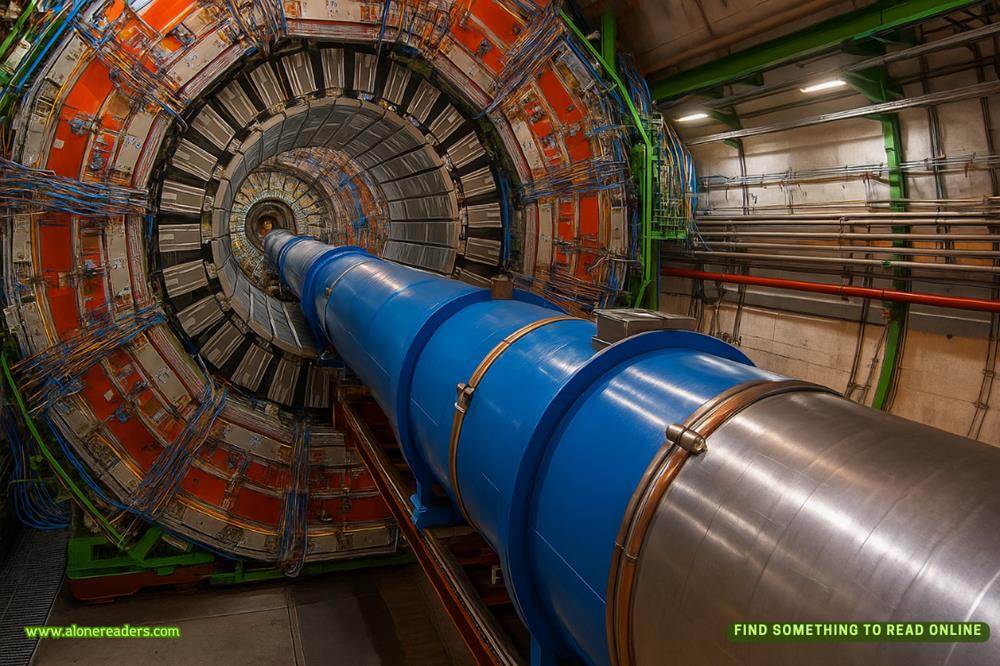
The Large Hadron Collider, more commonly known as the LHC, stands as one of the greatest feats of human engineering and scientific ambition. Located beneath the border of Switzerland and France, it is the largest and most powerful particle accelerator in existence, stretching over 27 kilometers in circumference. Operated by CERN, the European Organization for Nuclear Research, the collider was designed to probe the most fundamental questions about the universe by recreating conditions that existed just fractions of a second after the Big Bang. Its construction, cost, and purpose highlight the lengths humanity will go to in pursuit of knowledge about the building blocks of reality.
The idea for the LHC was born in the late 20th century, as particle physicists realized that previous accelerators, though groundbreaking, had reached their limits in probing deeper into the structure of matter. To move further, humanity needed a machine that could accelerate protons close to the speed of light and then smash them together with unprecedented energy. The result was the LHC, a monumental project that required thousands of scientists and engineers from around the world, billions of dollars in funding, and decades of planning and construction. In 2008, after years of preparation, the collider was finally switched on, opening an entirely new era of physics.
At its core, the LHC works by propelling beams of protons through two parallel tubes, cooled to just above absolute zero with the help of superconducting magnets. These magnets are among the most advanced ever built, allowing the beams to travel in opposite directions and collide at specific points where detectors are stationed. The collisions release bursts of energy, transforming into a cascade of new particles that last for mere instants. Sophisticated detectors such as ATLAS, CMS, ALICE, and LHCb capture these events, generating enormous amounts of data for scientists to analyze. Each collision holds the potential to reveal new insights into the forces and particles that shape the universe.
Perhaps the most famous achievement of the LHC to date is the discovery of the Higgs boson in 2012. This elusive particle, predicted decades earlier, is associated with the Higgs field, which gives mass to fundamental particles. Without the Higgs boson, our understanding of why matter has mass would remain incomplete. Its confirmation was a triumph not just for CERN, but for the entire scientific community, validating one of the last missing pieces of the Standard Model of particle physics. Yet, the discovery was not the end of the story but the beginning of new questions. The Standard Model, though immensely successful, cannot explain everything, including dark matter, dark energy, or the imbalance between matter and antimatter in the universe.
Beyond the Higgs boson, the LHC continues to push boundaries. Scientists hope it might shed light on supersymmetry, a theoretical framework suggesting that every known particle has a heavier partner. If confirmed, supersymmetry could explain mysteries such as dark matter, which makes up a significant portion of the universe but has never been directly detected. Another line of investigation involves searching for evidence of extra dimensions, concepts that go beyond the familiar three dimensions of space and one of time. While no direct proof has been found yet, the LHC remains one of the best tools to test these groundbreaking theories.
The LHC is not only a scientific marvel but also an engineering wonder. To operate, it requires a cooling system that keeps the superconducting magnets at -271.3 degrees Celsius, colder than outer space. This massive cryogenic infrastructure makes the LHC the largest refrigerator on Earth. The machine consumes immense amounts of electricity, comparable to that of a small city, and the detectors themselves are towering structures packed with layers of sensors, cables, and electronics, each designed to capture specific types of particle interactions. The complexity of the entire system is staggering, requiring constant monitoring, maintenance, and upgrades to function at peak efficiency.
One of the remarkable aspects of the LHC is the collaboration it fosters. Thousands of scientists from more than 100 countries work together, contributing expertise, equipment, and ideas. The data generated is shared globally, and researchers across the world participate in analyzing results. This spirit of cooperation reflects the truly international nature of modern science, where collective effort transcends borders in pursuit of answers to humanity’s biggest questions. It also highlights the LHC’s role not just as a machine, but as a symbol of what humanity can achieve when united by curiosity and ambition.
Critics often raise questions about the LHC, ranging from its cost to its supposed dangers. Building and operating the collider has cost billions of dollars, leading some to argue that such resources could be better spent elsewhere. However, defenders point out that the knowledge gained is invaluable and that many technological advancements, such as improvements in computing, medical imaging, and superconducting technologies, emerge from projects like this. As for safety concerns, some speculated before its launch that collisions could produce miniature black holes or strange matter capable of destroying the Earth. Extensive studies, however, showed that the collider poses no danger, and similar high-energy collisions occur naturally in cosmic rays hitting Earth’s atmosphere without catastrophic effects.
Looking forward, the LHC is undergoing upgrades to increase its luminosity, meaning it will produce more collisions and more data for scientists to study. Known as the High-Luminosity LHC project, this next phase will further enhance its ability to explore uncharted territories of physics. The upgraded machine will continue to operate well into the 2030s, ensuring that it remains at the forefront of discovery for decades to come. Meanwhile, discussions about future colliders even larger than the LHC are already underway, underscoring the never-ending quest to peer deeper into the mysteries of matter and energy.
The Large Hadron Collider represents more than just a scientific tool; it is a testament to human ingenuity, determination, and imagination. It embodies our relentless drive to understand the origins of the universe, the forces that govern it, and the invisible frameworks that hold it together. By smashing together the smallest constituents of matter at nearly the speed of light, it opens windows into realms once thought beyond human reach. From confirming the Higgs boson to probing the unknown frontiers of physics, the LHC stands as a beacon of what science can accomplish when vision and collaboration come together on a truly global scale.
In the end, the LHC is both a machine and a metaphor. It is the biggest machine in the world, designed to answer the smallest and most fundamental questions about existence. It is a symbol of unity, demonstrating that the quest for knowledge is a shared human endeavor. And it is a promise, that even as each discovery leads to new mysteries, humanity will continue to push forward, building bigger machines, asking deeper questions, and reaching ever closer to the heart of the universe itself.



 Château de Vincennes: France’s Forgotten Royal Fortress and Medieval Stronghold
 Château de Carcassonne: Europe’s Greatest Medieval Citadel and Fortress
 Château de Chenonceau: The Castle Built by Remarkable Women
 Château de Chambord: France’s Magnificent Renaissance Castle and Architectural Wonder
 Tehri Dam: India's Tallest Dam and the Debate Behind It
 Bhakra Nangal Dam: India's Temple of Modern Development