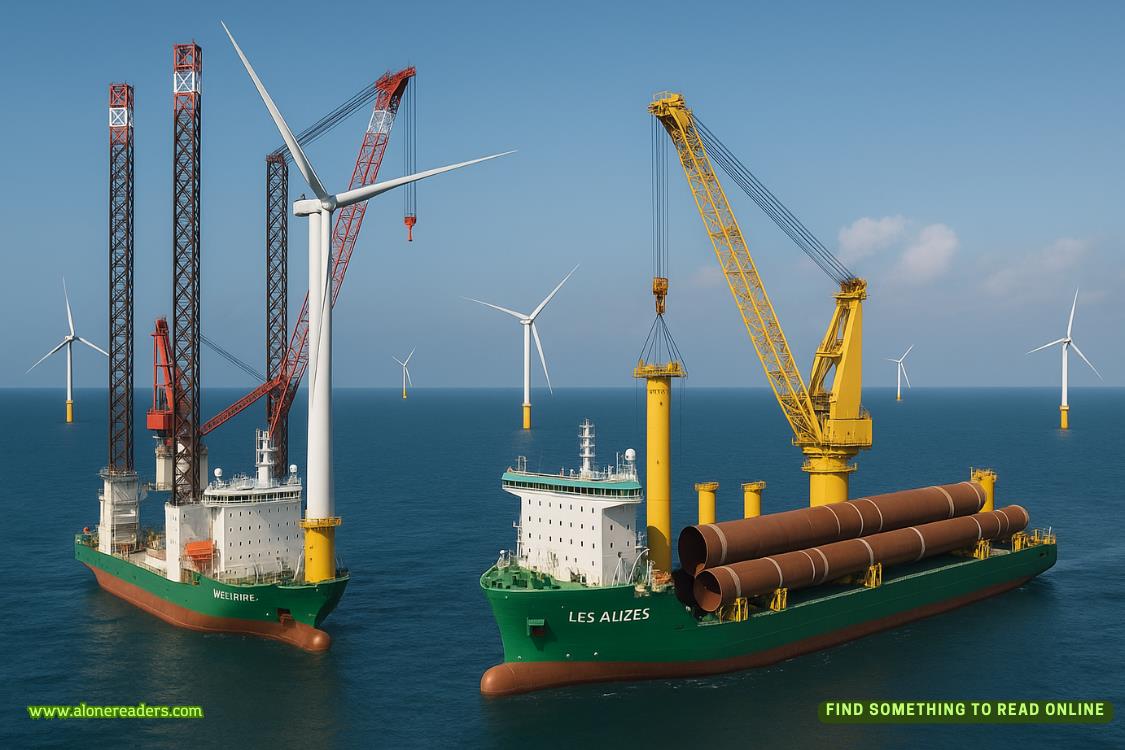
The global push toward renewable energy has demanded engineering solutions on a scale the world has rarely seen. Among the most ambitious and essential contributors to this transformation are two extraordinary vessels—Voltaire and Les Alizés. These ships are not ordinary marine constructions; they are purpose-built offshore installation giants designed to build the biggest wind farms on Earth. Their role is not just logistical but pivotal, bridging the gap between theoretical renewable capacity and practical, large-scale implementation. By enabling the transportation and installation of colossal offshore wind turbines, they have become linchpins in global strategies to expand clean energy infrastructure.
Voltaire, built for Belgian offshore specialist DEME, stands as the largest self-elevating wind turbine installation vessel ever constructed. Its design redefines the limits of offshore engineering. Measuring nearly 169 meters in length with an accommodation capacity for over 100 crew and technicians, it has been engineered to tackle the next generation of offshore wind turbines—those exceeding 270 meters in overall height with blades longer than a football field. The vessel’s defining feature is its four massive legs that allow it to jack up above sea level, creating a stable platform independent of wave motion. This capability is essential when handling fragile yet immense turbine components in the rough waters typical of offshore construction zones.
Les Alizés complements Voltaire by addressing another dimension of offshore construction: floating heavy-lift logistics. Unlike Voltaire, which can jack itself up, Les Alizés is a floating vessel without legs, yet it brings unmatched lifting capacity and deck space. Stretching 215 meters long with a crane capacity of 5,000 tons, it is tailored to handle the largest foundations, such as monopiles and jackets that anchor wind turbines to the seabed. These components are growing to extreme dimensions—monopiles alone can reach 120 meters in length and weigh more than 3,000 tons. Les Alizés can transport multiple such structures in a single voyage, eliminating the need for feeder barges and drastically improving installation efficiency.
The combined deployment of Voltaire and Les Alizés illustrates a sophisticated strategy in offshore wind farm development. The Voltaire excels at lifting and assembling towers, nacelles, and blades into complete turbines, while Les Alizés manages the installation of foundations. Together, they create a seamless construction process, reducing bottlenecks and downtime that would otherwise hamper project schedules. For developers working on multi-gigawatt farms, such as those planned in the North Sea and U.S. East Coast, this synergy is critical. The scale of modern projects—often requiring hundreds of turbines—means that efficiency gains translate directly into billions of dollars saved and faster renewable energy delivery to the grid.
From a technical perspective, the vessels embody cutting-edge green innovation in their own right. Both Voltaire and Les Alizés are designed with fuel efficiency and emissions reduction in mind. They run on dual-fuel engines capable of using LNG (liquefied natural gas) and are equipped with advanced emission control systems that meet the strictest environmental standards. Les Alizés also includes features such as energy recovery systems and heat recycling that minimize environmental impact during operations. By embedding sustainability into their construction and daily use, these vessels reinforce the broader mission of renewable energy deployment.
The significance of these vessels goes beyond their physical attributes. They represent a response to one of the greatest challenges in renewable energy: scale. The offshore wind industry is evolving rapidly, with turbines expanding in size to capture more energy per unit, reducing costs per megawatt. However, the infrastructure required to install such massive machines must grow proportionally. Without vessels like Voltaire and Les Alizés, the industry’s ambitions would hit a logistical ceiling. They are not just tools but enablers of the global clean energy transition, making possible projects that would otherwise be infeasible.
Economically, their role is equally profound. Offshore wind farms are multi-billion-dollar investments, often spanning decades of planning and execution. A delay in turbine installation due to inadequate infrastructure can cascade into cost overruns and lost revenue. By providing reliable, state-of-the-art capacity, Voltaire and Les Alizés give developers confidence that projects can be delivered on time. Their contribution thus extends to stabilizing the financial landscape of renewable energy, attracting investors who demand certainty in complex ventures.
These vessels are also strategic assets in the geopolitical energy race. Europe has long been a leader in offshore wind, and by commissioning such advanced vessels, European companies like DEME solidify their competitive advantage in a global market. As the U.S., China, Japan, and other nations ramp up offshore wind targets, the need for installation infrastructure becomes acute. It is not just about having turbines ready to ship but having the means to deploy them at sea. Voltaire and Les Alizés position Europe as a hub of expertise and capacity, setting the stage for international collaboration and export of both technology and services.
Looking forward, the operational life of these vessels will coincide with a period of unprecedented expansion in offshore wind. Forecasts suggest that global offshore wind capacity will grow nearly tenfold by 2040, requiring thousands of turbines of unprecedented scale. The challenge will be to maintain efficiency, safety, and sustainability while working at such volumes. Vessels like Voltaire and Les Alizés will be indispensable, but they also raise the bar for what future ships must achieve. Their success is likely to inspire a new generation of installation vessels, each pushing the boundaries of lifting capacity, deck space, and environmental performance.
Moreover, the symbolism of these ships should not be underestimated. They embody the marriage of maritime tradition with the frontier of renewable energy. Just as oil rigs once symbolized the fossil fuel era, vessels like Voltaire and Les Alizés symbolize the clean energy revolution. Their towering cranes and expansive decks are not only feats of engineering but also visible commitments to a sustainable future. For coastal communities witnessing their silhouettes against the horizon, they serve as reminders of how human ingenuity can adapt to global challenges.
In conclusion, the Voltaire and Les Alizés are not mere ships but pivotal actors in the drama of the energy transition. They combine scale, innovation, and efficiency in ways that directly shape the feasibility of offshore wind projects. Their presence ensures that the world’s biggest wind farms can move from concept to reality, delivering clean power at a scale that meets both climate goals and energy demands. In doing so, they exemplify how specialized engineering solutions can unlock the full potential of renewable energy, proving that the challenge of bottling the wind is not just possible but well underway.



 Château de Vincennes: France’s Forgotten Royal Fortress and Medieval Stronghold
 Château de Carcassonne: Europe’s Greatest Medieval Citadel and Fortress
 Château de Chenonceau: The Castle Built by Remarkable Women
 Château de Chambord: France’s Magnificent Renaissance Castle and Architectural Wonder
 Tehri Dam: India's Tallest Dam and the Debate Behind It
 Bhakra Nangal Dam: India's Temple of Modern Development










