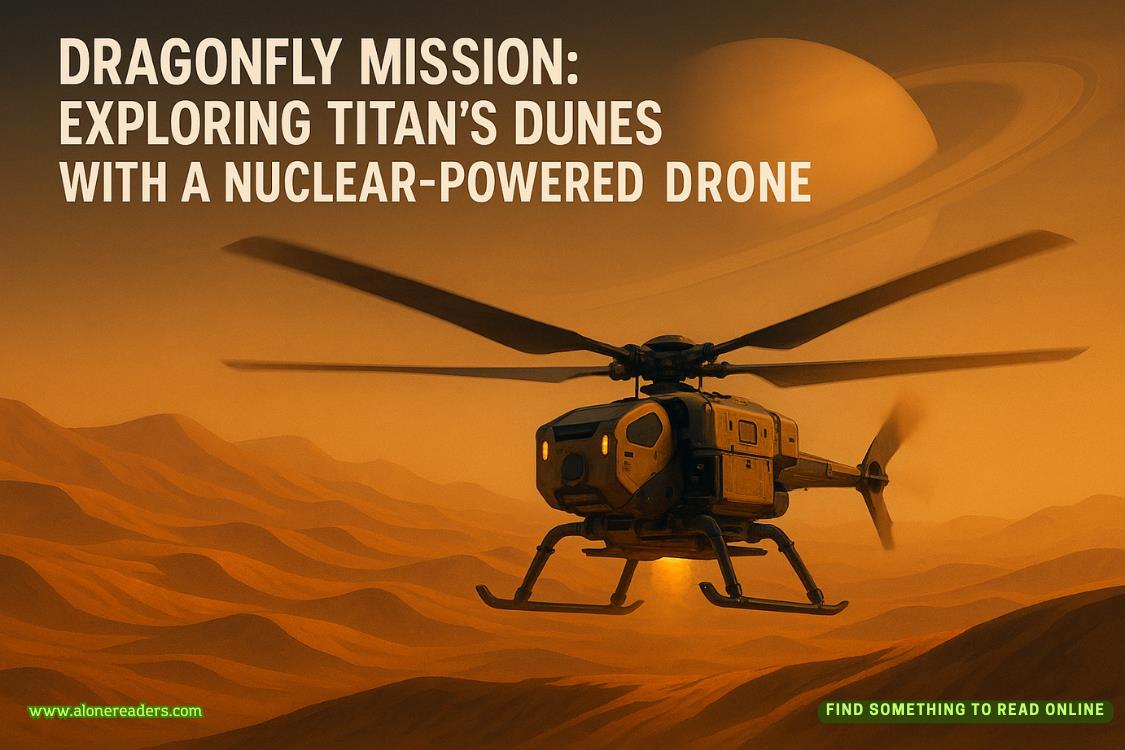
In the vast expanse of the outer Solar System, Saturn’s moon Titan stands out as one of the most mysterious and intriguing destinations for planetary science. With its dense nitrogen-rich atmosphere, methane lakes, and complex organic chemistry, Titan offers an environment both alien and oddly reminiscent of early Earth. NASA’s Dragonfly mission, set to launch in the mid-2020s, promises to revolutionize our understanding of this enigmatic world. Unlike any mission before it, Dragonfly will deploy a nuclear-powered drone to traverse Titan’s dune fields, seeking answers to some of humanity’s most profound questions: Can life exist beyond Earth, and if so, what might it look like?
Titan is no ordinary moon. Larger than Mercury and enveloped in a thick orange haze, it boasts an active weather system fueled not by water but by methane and ethane. Rain falls from its skies, rivers carve its valleys, and seas glisten under a hazy atmosphere. Beneath this alien hydrological cycle lies an icy crust, possibly concealing a global ocean of liquid water mixed with ammonia. This dual environment—organic chemistry on the surface and liquid water below—makes Titan one of the most compelling places in the Solar System to search for prebiotic chemistry and potential life. Yet the challenges of exploring Titan are immense. Its surface pressure is 50% higher than Earth’s, its average temperature is -179°C, and its thick atmosphere makes landing and mobility a daunting task. Traditional rovers, like those used on Mars, would struggle. The solution, NASA engineers realized, was flight.
Dragonfly is not a rover or a stationary lander but a rotorcraft—essentially a drone the size of a small car equipped with eight rotors. This unique design takes advantage of Titan’s thick atmosphere and low gravity, conditions that make flying far more efficient than on Earth. With wings and rotors, Dragonfly will be able to cover tens of kilometers in a single flight, hopping from one scientifically significant site to another. Unlike rovers, which are confined to slow, linear exploration, Dragonfly’s mobility will allow it to conduct a broad survey of Titan’s surface. This capability transforms Titan from a remote curiosity into a world accessible for detailed exploration.
At the heart of Dragonfly’s power system lies a Multi-Mission Radioisotope Thermoelectric Generator (MMRTG), a compact nuclear battery that converts heat from decaying plutonium-238 into electricity. Solar panels, so successful on Mars, are impractical on Titan due to its distance from the Sun and dense, hazy atmosphere. The MMRTG provides a steady, long-lasting power supply, ensuring Dragonfly can operate for years, even through Titan’s long nights, which last the equivalent of eight Earth days. This nuclear heart not only keeps Dragonfly aloft but also powers its sophisticated suite of instruments designed to probe Titan’s secrets.
Dragonfly’s scientific payload is ambitious. It will carry mass spectrometers to analyze the chemical composition of Titan’s surface, searching for complex organic molecules that may resemble the precursors of life. It will also be equipped with cameras, meteorological sensors, and instruments to measure seismic activity, offering insights into Titan’s geology and atmospheric dynamics. By flying across dunes composed of hydrocarbon sand, examining impact craters that expose subsurface material, and perhaps even sampling sites where liquid methane has interacted with organic compounds, Dragonfly will piece together the puzzle of Titan’s chemistry. Each landing site will provide new data, and each flight will bring the mission closer to uncovering whether Titan hosts the raw materials or even the conditions for life.
One of Dragonfly’s most compelling destinations is the Shangri-La dune fields, vast expanses of organic-rich material shaped by Titan’s winds. From there, it is expected to journey toward Selk Crater, a location believed to have once hosted liquid water. Impact craters like Selk may have provided the heat necessary to melt Titan’s icy crust temporarily, creating a habitable environment where complex chemistry could flourish. If life ever had a chance to arise on Titan, places like Selk Crater are prime candidates. Dragonfly’s exploration of this region may provide the closest look yet at processes that resemble the earliest stages of life on Earth billions of years ago.
The mission is not without its risks. Titan is distant, nearly 1.4 billion kilometers from Earth, meaning signals take more than an hour to travel one way. Dragonfly must be semi-autonomous, capable of making flight decisions and navigating Titan’s surface with minimal input from mission control. Its rotors must endure extreme cold, its instruments must withstand abrasive hydrocarbon sands, and its systems must function reliably in a world completely unlike Earth or Mars. Yet NASA’s experience with planetary missions, from the Mars rovers to the Cassini-Huygens mission that first revealed Titan’s surface, provides a foundation of expertise and confidence. Dragonfly builds upon decades of innovation, pushing planetary exploration into a new frontier of aerial mobility.
The broader implications of Dragonfly extend beyond Titan. If successful, it will mark the first time a rotorcraft has explored another world, opening the door for future aerial missions to other planets and moons. Imagine drones soaring through the thin skies of Mars, skimming the icy cliffs of Europa, or diving into the dense atmospheres of Venus. Dragonfly is not just a mission to Titan but a technological pathfinder for the future of space exploration. Its success could redefine how humanity explores environments that are otherwise inaccessible to rovers and landers.
For astrobiology, Dragonfly represents a leap forward. Titan’s chemistry is tantalizingly complex. Laboratory experiments have long suggested that under Titan-like conditions, simple organic molecules can assemble into structures resembling cell membranes. While Titan is far too cold for liquid water-based life to thrive on the surface, the potential for exotic life using methane as a solvent has captured scientific imagination. Alternatively, Titan may simply be a natural laboratory, preserving a record of organic processes similar to those that shaped early Earth before life began. By analyzing Titan’s surface and atmosphere directly, Dragonfly will help determine whether the building blocks of life are universal, or if Earth remains unique in its ability to nurture biology.
The excitement surrounding Dragonfly also reflects humanity’s enduring curiosity about the cosmos. Just as the Mars rovers have transformed our understanding of the Red Planet, Dragonfly is poised to revolutionize how we view Titan. The mission embodies the spirit of exploration: to go where no machine has gone before, to ask questions that have lingered for centuries, and to embrace the unknown. For scientists, engineers, and dreamers alike, Dragonfly is not merely a drone—it is a symbol of humanity’s determination to extend the boundaries of knowledge.
As the countdown to launch continues, the world watches with anticipation. By the 2030s, when Dragonfly touches down on Titan’s dunes and begins its flights, humanity will take a bold step into a realm unlike any other. Through its nuclear-powered wings, we may glimpse the processes that once shaped our own planet, and perhaps even find hints of life in the cold shadows of Saturn’s orbit. The Dragonfly mission is more than a scientific endeavor—it is a testament to human ingenuity, perseverance, and the timeless quest to understand our place in the universe.



 Château de Vincennes: France’s Forgotten Royal Fortress and Medieval Stronghold
 Château de Carcassonne: Europe’s Greatest Medieval Citadel and Fortress
 Château de Chenonceau: The Castle Built by Remarkable Women
 Château de Chambord: France’s Magnificent Renaissance Castle and Architectural Wonder
 Tehri Dam: India's Tallest Dam and the Debate Behind It
 Bhakra Nangal Dam: India's Temple of Modern Development










