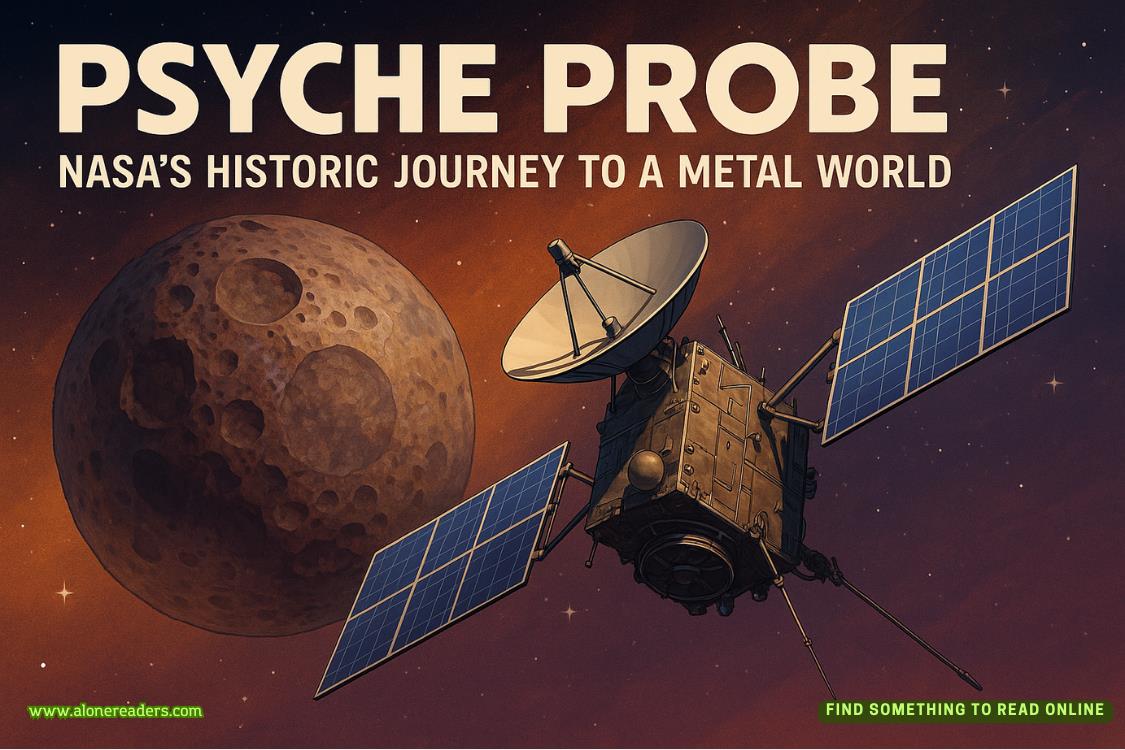
The exploration of the cosmos has always been humanity’s boldest frontier, a pursuit that not only expands our scientific knowledge but also redefines our place in the universe. Among NASA’s latest and most ambitious endeavors is the Psyche mission, a probe designed to explore one of the most unusual objects in our solar system: a massive, metal-rich asteroid named Psyche. Unlike the icy comets or rocky asteroids typically studied, Psyche stands apart as a world thought to be largely composed of metal, offering scientists a unique window into the hidden interiors of planets and the origins of our solar system. This journey to a “metal world” represents a milestone in planetary science and a daring step toward understanding how terrestrial planets like Earth came to be.
The Psyche asteroid, officially designated 16 Psyche, resides in the asteroid belt between Mars and Jupiter. It was discovered in 1852 by Italian astronomer Annibale de Gasparis, but it remained an enigmatic object for over a century. Measuring about 226 kilometers in diameter, Psyche is one of the largest asteroids in the belt. What truly sets it apart is its unusual composition. While most asteroids are rocky or icy, radar and spectral observations suggest Psyche contains large amounts of iron and nickel, materials more commonly associated with the dense cores of planets. This unusual makeup has led to a compelling hypothesis: Psyche might be the exposed core of a failed planet, one whose outer layers were stripped away by colossal collisions during the violent early days of the solar system. If this theory holds true, the Psyche mission will mark humanity’s first direct examination of the metallic heart of a planetary body.
NASA’s Psyche spacecraft was launched to carry out this unprecedented investigation. The spacecraft, roughly the size of a small van with large solar arrays, carries an impressive suite of instruments designed to unravel Psyche’s mysteries. Among these are a multispectral imager to capture high-resolution images, a gamma-ray and neutron spectrometer to analyze surface composition, and a magnetometer to detect any remnants of a magnetic field. The mission also includes an innovative laser communications experiment called Deep Space Optical Communications, a technology demonstration that could revolutionize how spacecraft transmit data across vast distances by using laser light instead of traditional radio waves. This not only promises faster data rates but also lays the groundwork for future deep-space exploration.
The scientific objectives of the Psyche mission are as profound as they are ambitious. By closely studying the asteroid’s surface and composition, scientists aim to confirm whether Psyche is truly a planetary core remnant. If it is, the probe will provide an unprecedented look into the type of material that lies deep beneath the crust and mantle of planets like Earth, Mars, and Venus—regions that are otherwise inaccessible to direct study. On Earth, our core is buried nearly 3,000 kilometers below our feet, unreachable by any drilling effort. But Psyche, potentially a stripped core, offers the rare chance to study such material directly. This could shed light on planetary differentiation, the process by which dense metals sink to form cores while lighter materials rise to form mantles and crusts. In essence, Psyche could reveal the hidden blueprint of planet formation.
Beyond planetary science, the Psyche mission also touches on intriguing questions of cosmic history and resource potential. If Psyche is indeed composed largely of metal, it could be unimaginably valuable in terms of raw materials. Estimates of its iron and nickel content suggest it could be worth quadrillions of dollars if mined, dwarfing Earth’s global economy many times over. While commercial asteroid mining remains speculative and technologically distant, the Psyche mission underscores the broader conversation about the future of humanity’s resource use beyond Earth. The mission is not about exploitation, but the tantalizing notion that such resources exist inspires visions of a future where space exploration and industry intersect in transformative ways.
The journey to Psyche is itself a technological achievement. The spacecraft employs a solar-electric propulsion system, an ion drive powered by electricity from its solar panels. This system allows for gradual but highly efficient thrust, ideal for the long journey through the solar system. Over several years, the spacecraft will spiral outward, assisted by gravitational maneuvers, before finally rendezvousing with the asteroid. Once in orbit, Psyche will undergo a series of increasingly close orbital phases, each designed to provide progressively detailed data. These careful maneuvers reflect the precision and patience required for deep-space missions, where every step must be meticulously planned to maximize scientific return.
The mission also carries deep philosophical weight. By probing Psyche, humanity is peering into its own origins. The early solar system was a turbulent place, filled with collisions, accretions, and destructions. Psyche may be a survivor of this chaotic era, a remnant that holds the scars and secrets of processes that shaped the terrestrial planets. To study Psyche is to step back four and a half billion years in time, to glimpse the raw ingredients and violent forces that sculpted Earth itself. This is science at its most profound—not merely cataloging another celestial object but connecting the story of a distant asteroid to the story of our own existence.
Furthermore, the mission exemplifies the spirit of collaboration and innovation that defines modern space exploration. The Psyche spacecraft was built by Maxar Technologies, with mission management and science operations handled by Arizona State University in partnership with NASA’s Jet Propulsion Laboratory. This integration of academic, governmental, and commercial expertise highlights the increasingly interconnected landscape of space exploration. It also underscores the role of missions like Psyche in inspiring the next generation of scientists, engineers, and dreamers who will carry humanity even further into the cosmos.
As Psyche’s journey unfolds, it captures public imagination not only with its scientific goals but also with its symbolic resonance. The idea of a “metal world,” glittering in the dark expanse of space, evokes visions of strange alien landscapes—mountains of solid iron, craters rimmed with nickel, and plains of metallic regolith. While the reality may be more complex, the very prospect ignites curiosity about what lies beyond our familiar Earth. Just as the Moon landing once redefined the boundaries of human achievement, missions like Psyche remind us that exploration remains our species’ most powerful tool for growth and discovery.
Ultimately, the Psyche probe represents far more than a journey to a single asteroid. It is a quest for knowledge about how worlds are born, how they evolve, and why they matter. It is an attempt to see beneath the surface, both literally and metaphorically, into the hidden workings of planetary bodies. It is a reminder that even in the vastness of the solar system, a small probe traveling to a distant rock can teach us profound lessons about ourselves and our place in the cosmos. As Psyche begins its exploration of the metal world that bears its name, it carries with it the hopes of scientists, the dreams of explorers, and the boundless curiosity of humanity itself.
The voyage to Psyche may not yield all the answers, but it will unquestionably raise new questions—questions that will drive further exploration and deeper understanding. In that sense, the journey to a metal world is also a journey into the unknown, a reminder that the universe is not just something we inhabit but something we are still learning to comprehend. Psyche, silent and gleaming in the asteroid belt, awaits the touch of human curiosity. And with NASA’s probe drawing ever closer, that curiosity is about to illuminate one of the most mysterious worlds we have ever encountered.



 Château de Vincennes: France’s Forgotten Royal Fortress and Medieval Stronghold
 Château de Carcassonne: Europe’s Greatest Medieval Citadel and Fortress
 Château de Chenonceau: The Castle Built by Remarkable Women
 Château de Chambord: France’s Magnificent Renaissance Castle and Architectural Wonder
 Tehri Dam: India's Tallest Dam and the Debate Behind It
 Bhakra Nangal Dam: India's Temple of Modern Development










