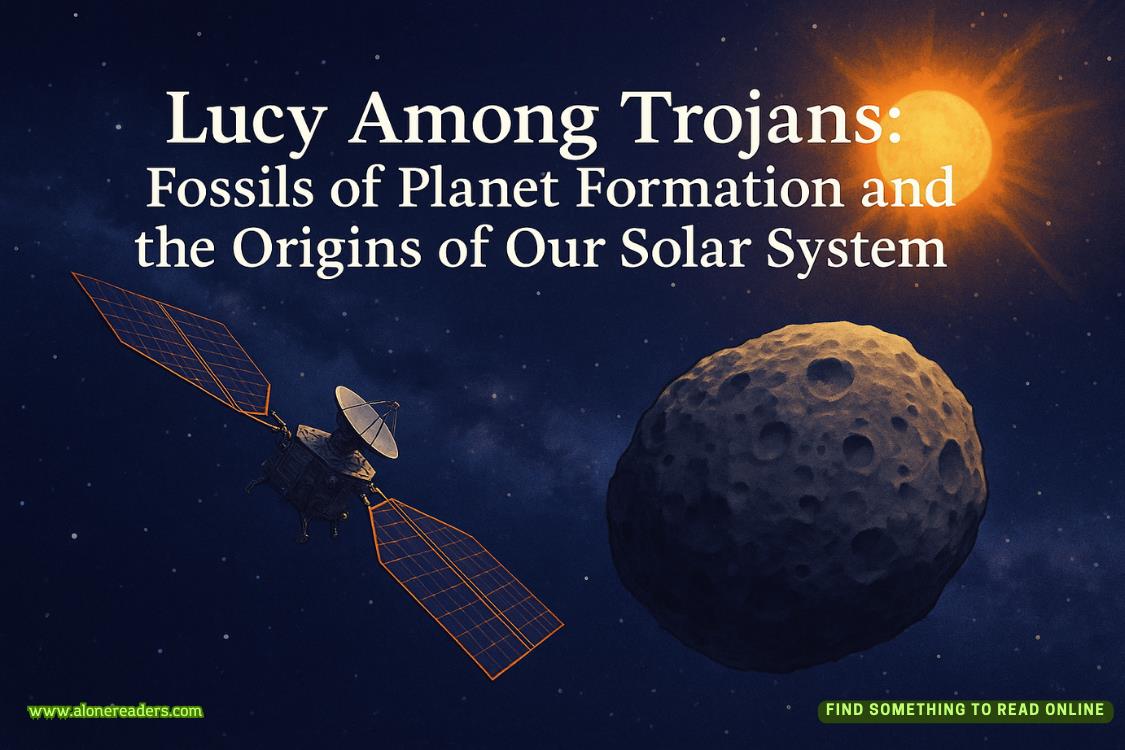
The quest to understand the origins of our solar system has always been one of humanity’s deepest scientific pursuits. While telescopes and theoretical models provide insight, direct exploration offers an unmatched window into cosmic history. This is precisely what NASA’s Lucy mission aims to accomplish. Launched in October 2021, Lucy represents the first spacecraft dedicated to studying the Trojan asteroids, a group of ancient bodies that orbit the Sun along the same path as Jupiter. Often described as “fossils of planet formation,” these objects preserve clues about the solar system’s earliest moments, when dust and gas coalesced into the planets we know today. The title “Lucy Among Trojans” is a deliberate nod to both human prehistory and cosmic evolution: just as the famous hominin fossil Lucy provided critical evidence for understanding human ancestry, the Lucy spacecraft is poised to reveal the ancestral record of planetary formation.
The Trojan asteroids occupy two stable regions, known as Lagrange points, that lead and trail Jupiter in its orbit around the Sun. These swarms have remained gravitationally tethered for billions of years, largely undisturbed since the solar system’s violent youth. For planetary scientists, this makes them invaluable time capsules. Unlike planets or moons that have been reshaped by volcanism, tectonics, or atmospheric erosion, the Trojans remain primitive. Their surfaces and compositions reflect the building blocks of the early solar nebula, the same materials that once assembled into Earth, Mars, and the outer giants. By flying past and studying multiple Trojans, Lucy will provide comparative data on their shapes, geology, densities, and chemistry, painting a detailed picture of what conditions were like over four billion years ago.
The scientific goals of Lucy extend far beyond cataloging asteroid features. One of the central questions concerns the origins of the Trojans themselves. There are competing hypotheses: some scientists suggest they formed in situ near Jupiter, while others argue they migrated from more distant regions of the solar system, captured during a chaotic reshuffling known as the Nice model. If the Trojans originated in the outer regions beyond Neptune, they may share characteristics with Kuiper Belt objects, offering a unique bridge between the giant planet zone and the frozen frontier. Understanding this migration is crucial, because it relates to the broader story of how the planets moved from their birthplaces, scattering smaller bodies and shaping the architecture of the modern solar system.
Lucy’s trajectory is ambitious, reflecting the importance of these questions. Over a 12-year journey, the spacecraft will visit eight different asteroids, including seven Trojans and one main-belt asteroid. This flyby tour requires complex navigation, exploiting orbital mechanics and gravitational assists to efficiently reach targets millions of kilometers apart. Each encounter will allow Lucy’s instruments to map surface geology, analyze composition, and measure physical properties. The spacecraft is equipped with high-resolution cameras, spectrometers, and thermal sensors, designed to extract maximum information from fleeting flybys that last only hours. These instruments will enable scientists to identify surface minerals, measure subsurface ice, and detect signs of organic compounds that may have played roles in prebiotic chemistry.
The significance of these investigations extends to the broader theme of planet formation and the emergence of habitable worlds. By studying how primitive bodies differ in composition, scientists can refine models of how materials were distributed across the young solar system. Did water and organics form locally on Earth, or were they delivered by planetesimals from beyond the frost line? If the Trojans contain a diverse mixture of rocky and icy compositions, they could provide evidence that migration and mixing were fundamental processes, scattering vital ingredients for life across multiple worlds. In this sense, Lucy is not just a mission to asteroids; it is an expedition to the origins of habitability itself.
The cultural symbolism of Lucy is also worth noting. The mission was named after the famous Australopithecus afarensis skeleton “Lucy,” discovered in Ethiopia in 1974. Just as that fossil revealed profound truths about human evolution, NASA’s Lucy is intended to reveal the evolutionary history of the solar system. The parallel underscores the notion that exploration, whether of Earth’s ancient past or the solar system’s beginnings, is fundamentally about uncovering who we are and where we come from. The Trojans, frozen relics of cosmic time, are planetary fossils in the truest sense, waiting to be read like bones embedded in stone.
Technically, Lucy represents an engineering milestone. It is the first spacecraft powered entirely by solar arrays to venture so far from the Sun, a necessity given the prohibitive costs of carrying nuclear power sources. To accomplish this, Lucy employs massive solar panels spanning more than seven meters each, capable of generating sufficient energy even at Jupiter’s distance. The spacecraft also incorporates autonomous navigation, advanced communication systems, and long-duration operational reliability, given that its prime mission extends well into the 2030s. These engineering feats highlight the growing sophistication of NASA’s planetary exploration program, pushing the limits of how far and how long solar-powered craft can operate.
As with any mission, Lucy carries risks and uncertainties. Flybys allow only brief windows of observation, and data must be collected in real-time at high precision. The spacecraft must maintain flawless navigation to pass within hundreds of kilometers of its targets at relative speeds exceeding 20,000 kilometers per hour. Even minor errors could reduce the quality of scientific return. Furthermore, the physical nature of the Trojans remains largely unknown—some may be rubble piles, loosely bound collections of rock, while others may be monolithic. Unexpected surface conditions could challenge assumptions about instrumentation or data interpretation. Yet this unpredictability is precisely why Lucy’s mission is so valuable: it is exploring the frontier, where surprises often hold the key to breakthroughs.
The broader implications of Lucy’s discoveries will ripple into multiple areas of planetary science. Insights into the Trojans will inform theories about exoplanetary systems as well. Observations of distant star systems have revealed planets migrating and scattering debris in ways reminiscent of our own solar system’s early history. By studying the Trojans, scientists gain a concrete example of how migration preserves small-body populations. This, in turn, helps astronomers interpret the debris disks observed around young stars and estimate the likelihood of habitable planet formation elsewhere. In this way, Lucy connects the intimate story of our own origins to the universal narrative of planetary systems across the galaxy.
Looking ahead, Lucy is not the end but the beginning of Trojan exploration. Its reconnaissance will likely identify compelling targets for future missions, perhaps even landers or sample-return spacecraft. Just as earlier flyby missions to Jupiter and Saturn eventually led to orbiters and probes, Lucy may pave the way for more ambitious efforts. Its results will refine our sense of where to look, what instruments to design, and how best to capture the untold story of solar system formation.
Ultimately, Lucy Among Trojans is more than a scientific mission; it is a philosophical endeavor. By probing these planetary fossils, humanity seeks not only to decode the physics of formation but to connect with the narrative of cosmic ancestry. In every rocky crater, icy deposit, and chemical spectrum, there lies a chapter of the solar system’s autobiography. Like the Lucy fossil that reshaped anthropology, the Lucy spacecraft will reshape our understanding of planetary evolution. It reminds us that exploration is a continuum: from bones in the Earth to rocks among the stars, the search for origins defines the human spirit.
The Lucy mission is thus a testament to both curiosity and continuity. It bridges past and future, science and symbolism, human evolution and planetary evolution. As the spacecraft continues its odyssey through the dark corridors of Jupiter’s orbit, each asteroid encounter will illuminate a little more of the solar system’s forgotten dawn. These Trojan fossils, silent witnesses of planetary birth, will finally tell their story, carried back to Earth by a messenger named Lucy.



 Château de Vincennes: France’s Forgotten Royal Fortress and Medieval Stronghold
 Château de Carcassonne: Europe’s Greatest Medieval Citadel and Fortress
 Château de Chenonceau: The Castle Built by Remarkable Women
 Château de Chambord: France’s Magnificent Renaissance Castle and Architectural Wonder
 Tehri Dam: India's Tallest Dam and the Debate Behind It
 Bhakra Nangal Dam: India's Temple of Modern Development