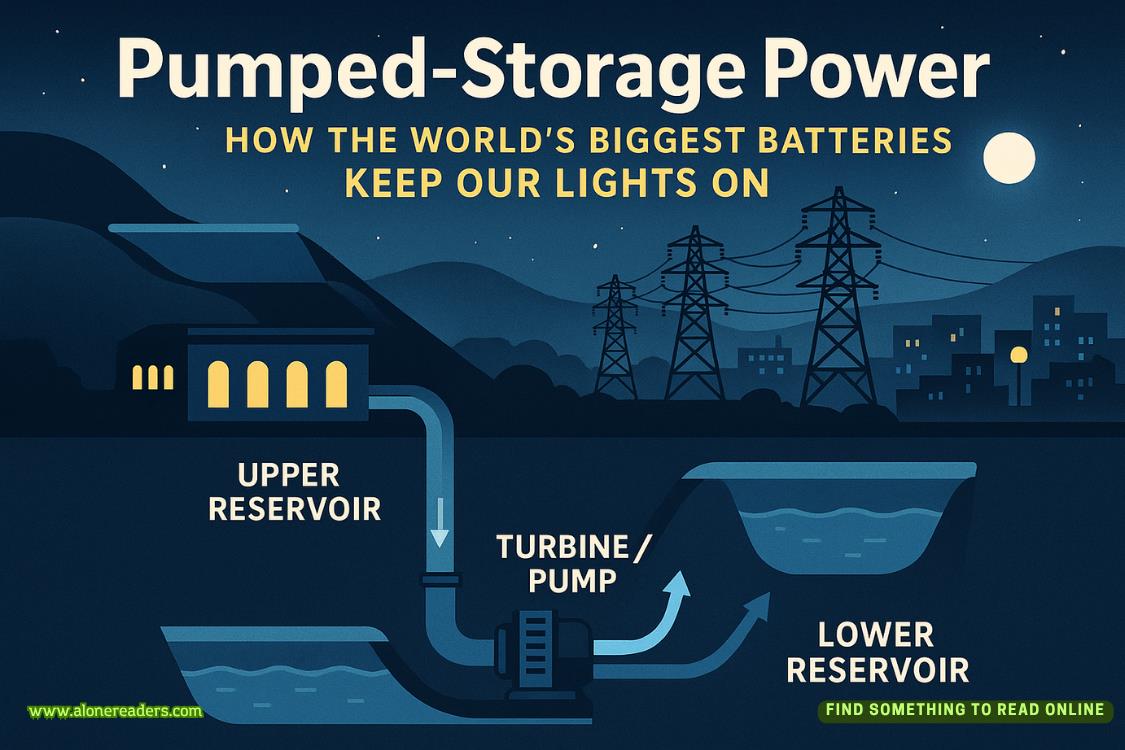
Pumped-storage power, often described as the world’s biggest battery, is one of the most effective and time-tested technologies for storing electricity on a massive scale. Unlike chemical batteries that rely on electrochemical reactions, pumped-storage systems use the power of water and gravity to store and release energy. This form of hydroelectric storage has been in use for decades and is becoming increasingly critical as the world transitions toward renewable energy sources like wind and solar, which produce electricity intermittently. The ability to store excess energy when demand is low and release it when demand peaks makes pumped-storage a cornerstone of modern energy infrastructure.
The principle behind pumped-storage power is relatively simple but highly effective. Two reservoirs are built at different elevations, typically in mountainous terrain or areas with natural elevation differences. During times of surplus electricity production, usually when renewable sources like wind and solar generate more power than the grid requires, electric pumps push water from the lower reservoir to the upper one. This process essentially stores energy in the form of gravitational potential. When demand for electricity increases or when renewable output falls short, the stored water is released back down through turbines, converting its potential energy into electricity much like a conventional hydropower plant. This cycle can be repeated indefinitely, making it one of the most reliable forms of large-scale energy storage.
The efficiency of pumped-storage systems is another reason why they are so highly valued. Modern plants can achieve round-trip efficiencies of 70 to 85 percent, meaning that most of the energy used to pump water uphill can be recovered during generation. This is significantly higher than many other large-scale energy storage technologies, and unlike chemical batteries, pumped-storage facilities can operate for decades—sometimes a century or more—with relatively low degradation. Their lifespan and reliability make them an attractive investment for grid operators seeking long-term solutions to balance electricity supply and demand.
Globally, pumped-storage power dominates the energy storage landscape. According to the International Hydropower Association, over 90 percent of the world’s utility-scale energy storage is provided by pumped-storage hydro. Countries with mountainous terrain such as China, the United States, Japan, Switzerland, and Austria have invested heavily in this technology. China leads the way, with ambitious expansion plans to integrate pumped-storage into its rapidly growing renewable energy grid. The United States also relies on significant facilities like the Bath County Pumped Storage Station in Virginia, often called the “world’s largest battery,” with a storage capacity of more than 3,000 megawatts. These massive projects highlight the unparalleled scale at which pumped-storage can operate compared to even the largest lithium-ion battery installations.
One of the primary advantages of pumped-storage is its ability to provide grid stability. Electricity grids must maintain a constant balance between supply and demand, and renewable energy can create sudden fluctuations due to changes in weather or sunlight. Pumped-storage plants respond almost instantly to shifts in demand, ramping up generation within seconds. This fast-response capability makes them invaluable for frequency regulation and grid reliability. In times of unexpected outages or surges in demand, pumped-storage ensures that electricity continues to flow smoothly, preventing blackouts and maintaining stability.
Beyond grid balancing, pumped-storage also plays a vital role in enabling deeper penetration of renewable energy sources. As nations aim to achieve net-zero emissions, reliance on wind and solar will only grow. These renewable sources are abundant but variable, producing more energy at some times and less at others. Without adequate storage, much of this energy would go to waste when production exceeds demand. Pumped-storage effectively acts as a renewable energy companion, capturing excess electricity that might otherwise be curtailed and releasing it later to smooth out supply. This capability allows renewable energy to replace fossil fuels more effectively and at greater scale.
Despite its many benefits, pumped-storage power does face challenges. One of the biggest barriers is the need for suitable geography. Projects require two reservoirs at different elevations, which limits their feasibility to specific regions. Building such facilities also demands significant upfront investment, long construction timelines, and complex environmental assessments. Reservoir construction can disrupt ecosystems, alter water flow, and impact wildlife, making environmental considerations critical in project planning. Additionally, while the operational carbon footprint of pumped-storage is extremely low, the construction phase can be resource-intensive. These challenges have slowed the expansion of pumped-storage in some areas, but technological and engineering innovations continue to make projects more adaptable.
Newer pumped-storage designs, such as underground or modular systems, are helping to overcome geographical and environmental constraints. Some proposals involve using abandoned mines as reservoirs, taking advantage of existing vertical space to reduce environmental impact. Coastal pumped-storage projects are also being explored, where seawater could serve as the lower reservoir. These innovative designs open new possibilities for expanding pumped-storage in areas where traditional projects might not be feasible.
When comparing pumped-storage to modern battery technologies, the differences are stark. Lithium-ion batteries, for instance, are well-suited for short-term energy storage and distributed applications like electric vehicles and household backup systems. They are flexible, scalable, and becoming increasingly affordable. However, they struggle with long-duration storage on the scale required for national grids. Pumped-storage, by contrast, can provide sustained output for hours or even days, making it far more effective for handling prolonged fluctuations in renewable energy generation. The complementary use of both technologies—batteries for short-term needs and pumped-storage for long-term, large-scale balancing—will likely form the backbone of future energy storage strategies.
Economically, pumped-storage offers distinct advantages. While the upfront costs are high, the long lifespan and large capacity make it one of the most cost-effective energy storage options over decades of operation. Unlike chemical batteries, which require replacement and recycling after a limited number of cycles, pumped-storage facilities can be maintained and upgraded without replacing core infrastructure. For governments and energy companies aiming to stabilize electricity prices and avoid costly blackouts, the long-term economic case for pumped-storage is strong.
Looking ahead, the role of pumped-storage power will only grow as the global energy system undergoes transformation. With rising demand for clean energy, electrification of industries, and the phase-out of coal and gas plants, storage capacity will be critical. Pumped-storage is already the most mature and widely deployed solution, and ongoing innovation will make it even more versatile. Its ability to integrate seamlessly with renewable generation, provide instantaneous backup, and operate sustainably over decades ensures that it will remain central to the clean energy transition.
In many ways, calling pumped-storage the world’s biggest battery captures both its function and its importance. It stores vast amounts of energy not in chemical cells but in the simple power of water and gravity. It supports entire nations in balancing their electricity grids, enables greater reliance on renewable energy, and stands as a proven technology that complements newer innovations. As humanity moves toward a cleaner and more resilient energy future, pumped-storage power will continue to be one of the unsung heroes—quietly working in the background, ensuring that lights stay on, hospitals stay powered, and societies keep moving.



 Château de Vincennes: France’s Forgotten Royal Fortress and Medieval Stronghold
 Château de Carcassonne: Europe’s Greatest Medieval Citadel and Fortress
 Château de Chenonceau: The Castle Built by Remarkable Women
 Château de Chambord: France’s Magnificent Renaissance Castle and Architectural Wonder
 Tehri Dam: India's Tallest Dam and the Debate Behind It
 Bhakra Nangal Dam: India's Temple of Modern Development










