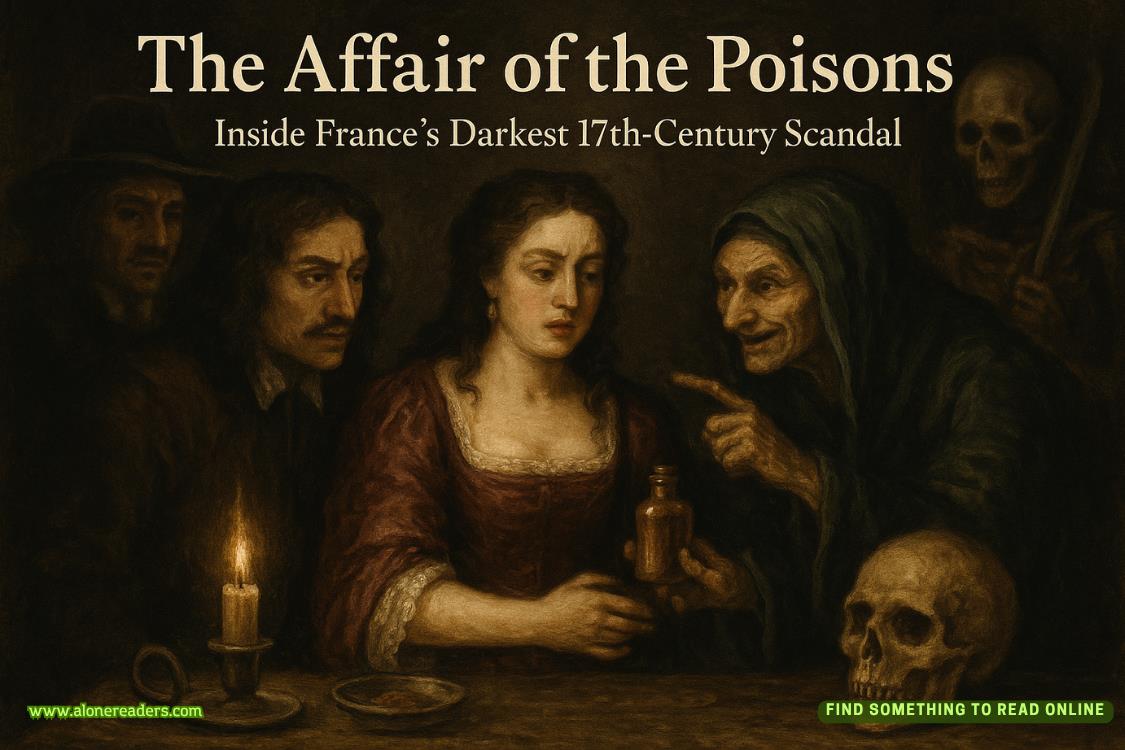
The Affair of the Poisons stands as one of the most infamous and chilling scandals in French history, exposing the dark undercurrents of murder, sorcery, and corruption that coursed through Parisian society during the reign of Louis XIV. Between 1677 and 1682, this sprawling web of crime and conspiracy revealed a hidden world where noblewomen, alchemists, priests, and poisoners mingled in pursuit of power, love, and vengeance. The scandal began as a series of isolated poisonings but soon grew into a massive investigation that reached the highest levels of the French court, shaking the foundations of Louis XIV’s supposedly divine monarchy.
The roots of the affair lay in the decadent and secretive social climate of 17th-century Paris. The court of Louis XIV at Versailles was dazzling but cutthroat; ambition and jealousy thrived beneath its glittering surface. Court politics were as deadly as any battlefield, and women—often denied legitimate means of influence—turned to forbidden arts to secure love or eliminate rivals. In this environment, magic, astrology, and fortune-telling became fashionable among the elite, giving rise to an underground trade in potions, poisons, and dark rituals.
At the center of this shadowy world was a woman known as Catherine Deshayes, or La Voisin. A midwife, fortune-teller, and alleged sorceress, La Voisin catered to Paris’s upper classes, offering love charms, horoscopes, and more sinister services. Her clientele included some of the most powerful women in France, who came to her not only for potions but also for poisons. Many were motivated by desperation—seeking to reignite waning affections, remove abusive husbands, or secure inheritances. What began as the sale of love potions soon escalated into an epidemic of poisonings that would horrify Europe.
The first hints of the scandal emerged when investigators began to notice an alarming number of sudden deaths among the aristocracy. In 1675, the death of the Duke of Savoy raised suspicions, followed by a string of mysterious fatalities across Paris. By 1677, a fortune-teller named Magdelaine de La Grange was arrested for poisoning, and her testimony pointed toward a vast criminal network. This led authorities to La Voisin, whose house on the Rue Beauregard became the epicenter of the investigation. When police raided her property, they discovered vials of poison, occult paraphernalia, and evidence of Black Masses allegedly performed for wealthy clients.
The scope of the investigation, directed by Gabriel Nicolas de La Reynie, the first Lieutenant General of Police of Paris, expanded rapidly. La Reynie established the Chambre Ardente—the “Burning Court”—a special tribunal dedicated to investigating crimes of poisoning and witchcraft. Over the next several years, more than 400 suspects were interrogated, and 36 were executed. The testimonies uncovered a horrifying network of apothecaries, alchemists, and priests who provided poisons, charms, and even performed satanic rituals. Witnesses claimed that La Voisin and her associates conducted Black Masses where infants were sacrificed and noblewomen prayed for the deaths of their husbands or lovers.
Among those implicated was Madame de Montespan, Louis XIV’s own mistress and the mother of several of his children. Though never formally charged, her name appeared repeatedly in testimonies. Witnesses alleged that she had purchased love potions and attended dark rituals to maintain the king’s affection. The idea that the King’s favorite could be connected to witchcraft and murder threatened the very legitimacy of the monarchy, which rested on divine authority. Louis XIV, alarmed by the political danger, ordered the suppression of certain testimonies and later dissolved the Chambre Ardente in 1682. Many documents were destroyed or sealed, ensuring that the full extent of the scandal would remain shrouded in mystery.
The poisons themselves were sophisticated for their time. Common ingredients included arsenic, mercury, and belladonna, often mixed into cosmetics, perfumes, or food. Apothecaries and alchemists experimented with combinations that could kill swiftly or mimic natural illness. Some victims died within hours, while others suffered slow, agonizing declines that baffled physicians. This period became known as the “Golden Age of Poison,” reflecting both the frequency of toxic crimes and the growing public fear of invisible killers lurking among the nobility.
La Voisin was eventually arrested in 1679 and subjected to interrogation and torture. Despite her efforts to protect her clients, she was convicted and burned at the stake in February 1680. Her execution did not end the affair; in fact, it only deepened the intrigue. Her daughter, Marguerite Monvoisin, later provided additional testimony that implicated members of the royal court. Other figures, such as the alchemist Lesage and the defrocked priest Étienne Guibourg, were also executed or imprisoned. The scandal’s reach extended far beyond Paris, influencing neighboring kingdoms that viewed France’s royal court with both fascination and disgust.
The Affair of the Poisons also marked a turning point in the development of modern criminal investigation in France. Gabriel de La Reynie’s methods—systematic interrogations, chemical analyses, and record-keeping—laid the groundwork for organized policing and forensic procedures. Yet the affair revealed the limits of justice when it came to the powerful. Many of those most culpable escaped punishment due to their social status, while lesser figures were executed as scapegoats. The case became a dark mirror of 17th-century French society, exposing how superstition, greed, and ambition coexisted with the age of reason and absolutism.
The impact of the scandal on Louis XIV’s reign was profound. Though he survived politically, the King’s image as the Sun King—radiant, just, and divinely ordained—was tarnished. He distanced himself from occult practices and enforced stricter moral codes at court. The episode also intensified his resolve to control public morality, leading to greater censorship and the persecution of fortune-tellers, midwives, and suspected witches. Ironically, this crackdown also silenced many innocent women, as superstition became intertwined with misogyny and fear.
Beyond its immediate political consequences, the Affair of the Poisons captured the European imagination for centuries. It inspired numerous plays, novels, and historical studies that blended fact with legend. Writers such as Victor Hugo and Alexandre Dumas revisited the affair as a symbol of corruption and decadence hidden behind royal splendor. Modern historians continue to debate how much of the affair was a genuine criminal conspiracy and how much was hysteria fueled by rumor and misogyny. While the Black Masses and satanic rituals remain difficult to verify, the documented poisonings and the vast scale of the investigations leave little doubt that Paris in the late 17th century was haunted by fear, death, and suspicion.
In retrospect, the Affair of the Poisons serves as both a cautionary tale and a historical window into a society where science and superstition were locked in uneasy coexistence. It revealed how desperation could drive people—especially women confined by rigid hierarchies—to seek forbidden power in a world that denied them agency. It also demonstrated how the structures of authority, even at their most absolute, were vulnerable to corruption from within. In the gleaming court of the Sun King, behind the mirrors and gold of Versailles, a darker reality pulsed through the veins of France: one of fear, secrecy, and the deadly allure of power.
By the time the final embers of the Chambre Ardente died out in 1682, more than a hundred lives had been ruined or lost, and an entire society had glimpsed the abyss beneath its own grandeur. The Affair of the Poisons was not merely a criminal investigation—it was a revelation of human weakness in an age that prided itself on glory. The scandal’s echoes endured long after the flames faded, whispering of a time when death could be purchased with a vial of perfume, and the most dangerous enemies of the crown were not foreign powers, but those who dined at its own table.



 Château de Vincennes: France’s Forgotten Royal Fortress and Medieval Stronghold
 Château de Carcassonne: Europe’s Greatest Medieval Citadel and Fortress
 Château de Chenonceau: The Castle Built by Remarkable Women
 Château de Chambord: France’s Magnificent Renaissance Castle and Architectural Wonder
 Tehri Dam: India's Tallest Dam and the Debate Behind It
 Bhakra Nangal Dam: India's Temple of Modern Development