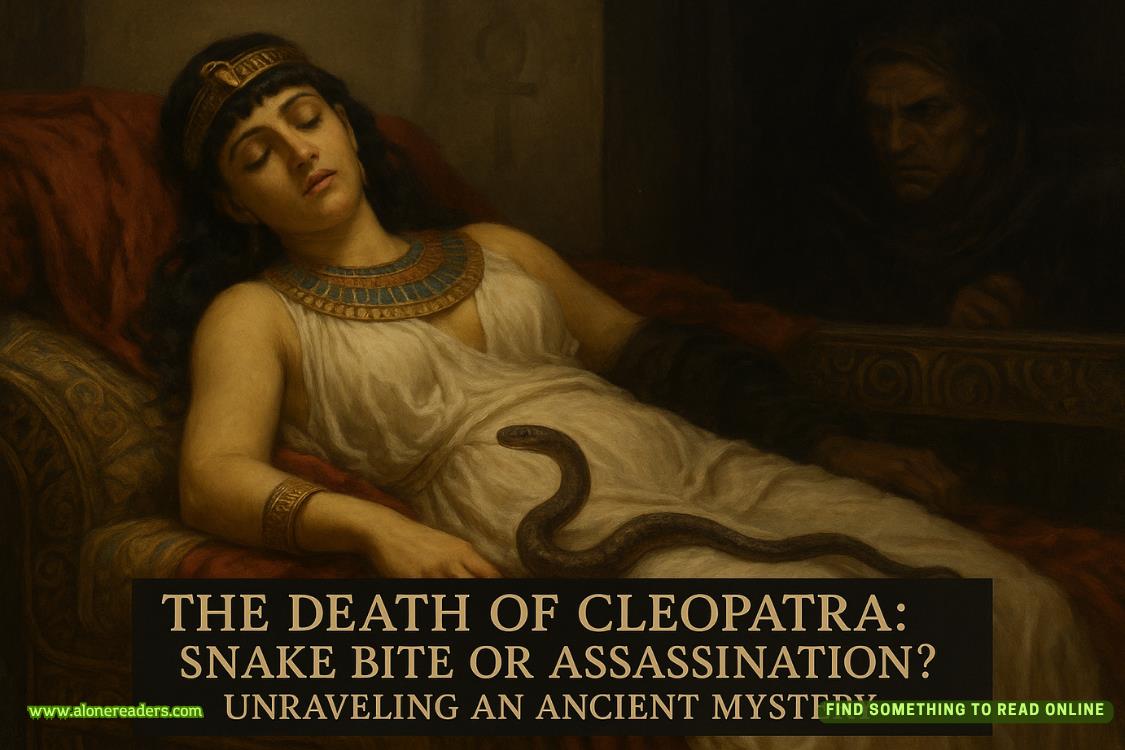
The death of Cleopatra VII, the last active ruler of the Ptolemaic Kingdom of Egypt, remains one of the most fascinating and debated mysteries of ancient history. Her dramatic demise in 30 BCE marked not only the end of her reign but also the fall of Egypt as an independent kingdom, paving the way for Roman domination. According to traditional accounts, Cleopatra took her own life by allowing a venomous Egyptian cobra—an asp—to bite her arm. Yet, over two thousand years later, historians and scientists continue to question whether her death was truly a suicide or a carefully orchestrated assassination disguised as one. The answer lies buried beneath layers of political intrigue, propaganda, and lost evidence.
When Cleopatra came to power, Egypt stood at the crossroads of decline and ambition. The young queen, a descendant of Macedonian Greeks who had ruled Egypt since Alexander the Great’s conquest, was both shrewd and multilingual. She ruled alongside her brother Ptolemy XIII before aligning with Julius Caesar during the Alexandrian War. Her charm and intellect secured Egypt’s independence temporarily and produced a son, Caesarion, believed to be Caesar’s heir. After Caesar’s assassination in 44 BCE, Cleopatra forged another powerful alliance—this time with Mark Antony, Caesar’s trusted general. Their political and romantic partnership alarmed Rome, particularly Octavian, Caesar’s adopted son and future emperor Augustus. By 31 BCE, Octavian’s forces had defeated Antony and Cleopatra at the Battle of Actium, sealing their fate.
Historical records tell us that after Antony’s defeat and subsequent suicide, Cleopatra retreated to her mausoleum in Alexandria. Ancient sources such as Plutarch, Dio Cassius, and Suetonius—writing decades or even centuries later—claimed she ended her life by an asp bite, perhaps hidden in a basket of figs. When Octavian’s soldiers broke into her chamber, they found her lying lifeless on a golden couch, dressed in her royal robes, with two of her loyal handmaidens dying beside her. The image of the proud queen choosing death over humiliation became one of antiquity’s most enduring legends. However, this romanticized version has been challenged by many scholars who find inconsistencies in the narrative.
The central issue is the implausibility of the snake bite itself. Egypt’s native cobra is large, aggressive, and difficult to conceal in a small basket. A single bite may not have caused instantaneous death, and the notion of Cleopatra calmly allowing such a dangerous creature to bite her seems questionable. Moreover, both ancient and modern toxicology studies suggest that a cobra’s venom can take hours to kill, accompanied by convulsions and pain—far from the serene image of Cleopatra’s peaceful passing described by Roman authors. This raises doubts about whether the asp story was a symbolic fabrication, crafted to fit Egyptian mythology rather than fact.
Cleopatra’s association with divine imagery provides another dimension. As the living embodiment of the goddess Isis, she may have chosen a death method with religious significance. The asp, symbol of royalty and divine power, was sacred in Egypt and often worn on the pharaoh’s crown. In that sense, the asp could have been a deliberate emblem—a poetic statement of sovereignty in death. Yet, the very perfection of this symbolism has led many to suspect it was invented later by Roman propagandists seeking to portray her as a tragic, exotic queen rather than a political threat.
Octavian’s role in shaping the story cannot be ignored. After Cleopatra’s death, he swiftly consolidated his power and had her image tightly controlled in Roman accounts. His regime had every reason to depict her as a defeated monarch who chose suicide rather than face justice—this conveniently removed the stain of political execution and preserved his image as a merciful ruler. However, several inconsistencies remain. Cleopatra had attempted to negotiate with Octavian after Antony’s death, allegedly offering her crown and wealth in exchange for her son Caesarion’s survival. But shortly afterward, both she and Caesarion were dead—Caesarion reportedly strangled on Octavian’s orders. If Octavian had agreed to spare her, why would she kill herself? And if he had refused, might her death have been ensured by his men to prevent any further resistance?
Some scholars propose that Cleopatra’s death was not suicide at all, but a covert assassination disguised as one. They argue that Octavian may have ordered her execution to eliminate a potential rallying symbol for Egyptians and supporters of Antony. Allowing her to die “by her own hand” would serve his political narrative, avoiding the optics of murdering a queen. Roman accounts may have been edited or censored to conceal such involvement. After all, Octavian later paraded her effigy in his triumph in Rome—her death had become a propaganda victory, transforming her into a cautionary tale of defiance against Roman order.
Modern forensic interpretations have added further skepticism to the snake theory. Historians and toxicologists suggest the possibility of a fast-acting poison—a mixture of opium, hemlock, and aconite—administered in a controlled dose to ensure a peaceful death. Ancient Egypt had a long tradition of using herbal poisons, and Cleopatra, well-versed in pharmacology, could have crafted such a lethal concoction herself. Plutarch’s account even mentions that she tested various poisons on prisoners to study their effects, favoring those that caused minimal suffering. This evidence aligns more closely with a planned, self-administered poisoning than an unpredictable snake bite.
Another layer of intrigue lies in the aftermath. Cleopatra’s body was reportedly embalmed quickly and buried beside Antony in a tomb whose location remains unknown. Octavian allowed this act of dignity, which suggests he wanted closure and control over her narrative. No physical evidence—no preserved remains, no definitive artifacts—has ever been found to confirm how she died. The mystery persists because nearly every contemporary account came from Roman sources, written under Octavian’s political influence. Egyptian records that could have provided an alternative version were lost in the centuries following the Roman annexation of Egypt.
The romanticization of Cleopatra’s death through art, literature, and film has further blurred the line between myth and history. From Shakespeare’s Antony and Cleopatra to Renaissance paintings and Hollywood’s grand portrayals, the image of the queen clutching a serpent to her breast has become iconic. Yet these depictions tell us more about the cultural imagination of later eras than about historical truth. They echo themes of beauty, seduction, and tragic defiance, reducing a brilliant and politically astute monarch to the role of doomed lover. Modern historians, reexamining archaeological and textual evidence, emphasize that Cleopatra was far more than a femme fatale—she was a strategist who held her kingdom against Rome for nearly two decades.
In the absence of physical proof, the debate over whether Cleopatra died by snake bite or assassination remains unresolved. What is clear is that her death symbolized the end of an era. With her passing, the Hellenistic age gave way to Roman imperial dominance, and Egypt became a province of the new empire. Octavian, now Augustus, emerged as Rome’s first emperor, using Cleopatra’s downfall as part of his rise to power. Whether she chose death to avoid humiliation or was silenced by her conqueror, Cleopatra’s final act ensured her immortality. The mystery surrounding her death—part tragedy, part political intrigue—continues to captivate scholars and storytellers alike, reminding us that history’s greatest enigmas often lie where power and myth intertwine.



 Château de Vincennes: France’s Forgotten Royal Fortress and Medieval Stronghold
 Château de Carcassonne: Europe’s Greatest Medieval Citadel and Fortress
 Château de Chenonceau: The Castle Built by Remarkable Women
 Château de Chambord: France’s Magnificent Renaissance Castle and Architectural Wonder
 Tehri Dam: India's Tallest Dam and the Debate Behind It
 Bhakra Nangal Dam: India's Temple of Modern Development










