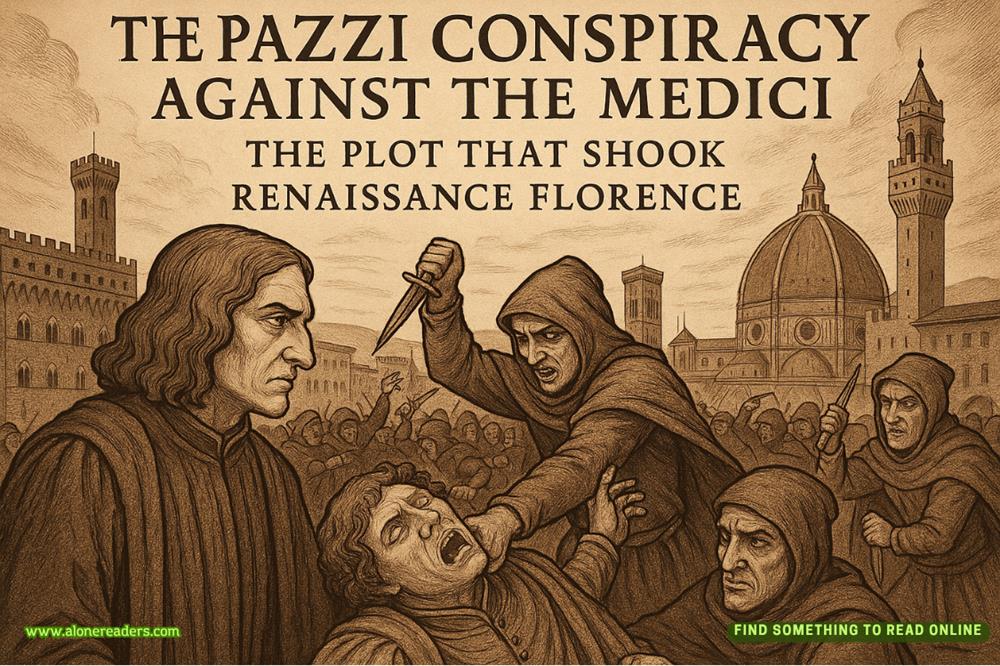
The Pazzi Conspiracy stands as one of the most infamous political intrigues of the Italian Renaissance—a dramatic episode of ambition, betrayal, and bloodshed that altered the course of Florentine history. Centered around the powerful Medici family, this conspiracy was born out of envy and opposition, fueled by rival families and political factions who sought to dismantle Medici dominance over Florence. The story of the Pazzi Conspiracy reveals the volatile blend of politics, religion, and revenge that defined 15th-century Italy.
In the late 1400s, Florence was at the height of its cultural and economic influence, a city-state thriving under the de facto leadership of the Medici family. Lorenzo de’ Medici, known as “Lorenzo the Magnificent,” and his brother Giuliano had inherited not only the family’s vast banking empire but also its political supremacy. The Medici were not official rulers but held power through patronage, wealth, and diplomacy. Their ability to control the republic’s internal affairs, foreign policy, and even papal relations earned them both admiration and resentment. Among their rivals, none were more determined or dangerous than the Pazzi family, another wealthy banking dynasty of Florence.
The Pazzi family had long competed with the Medici for financial and political influence. Although both families were involved in banking, the Medici’s close ties with the Papacy—particularly through their management of the Vatican’s finances—had given them immense leverage across Italy. This naturally placed the Pazzi in an inferior position, breeding deep resentment. The Medici’s exclusion of the Pazzi from important government roles and commercial opportunities added further insult. When Pope Sixtus IV decided to consolidate his own power in central Italy, tensions between Florence and Rome intensified. Lorenzo’s refusal to grant the Pope a significant loan through the Medici Bank, and his opposition to papal territorial expansion, infuriated Sixtus IV. The Pope retaliated by transferring papal banking privileges from the Medici to the Pazzi—a political and financial blow that would ignite a deadly alliance.
The conspiracy’s principal architects included Francesco de’ Pazzi and Jacopo de’ Pazzi, alongside powerful figures like Archbishop Francesco Salviati of Pisa and Girolamo Riario, the Pope’s nephew. Their ultimate aim was to eliminate both Lorenzo and Giuliano de’ Medici, seizing control of Florence in the aftermath. The plot’s success relied on meticulous coordination and the element of surprise. Crucially, the conspiracy also had tacit papal approval. Although Sixtus IV never publicly endorsed assassination, his ambitions aligned perfectly with the downfall of the Medici, whom he regarded as a political obstacle.
The conspirators chose a moment of profound symbolism and vulnerability: a Sunday mass inside Florence’s grand cathedral, the Duomo of Santa Maria del Fiore, on April 26, 1478. Both Lorenzo and Giuliano were expected to attend the service, along with much of the city’s elite. The plan was ruthless in its simplicity—strike in a holy place, during a sacred ceremony, when the victims would least expect violence. Francesco de’ Pazzi and Bernardo Baroncelli were tasked with killing Giuliano, while others would attack Lorenzo simultaneously. Archbishop Salviati would seize the Palazzo della Signoria, the seat of Florentine government, ensuring the coup succeeded both militarily and politically.
As the bells tolled and the Eucharist began, the conspirators struck. Giuliano, caught off guard, was stabbed repeatedly—reportedly nineteen times—before collapsing at the foot of the altar. Lorenzo managed to defend himself, suffering only a superficial wound to the neck before escaping to the safety of the sacristy. The assassination of one Medici brother and the survival of the other marked the turning point of the entire plot. The conspirators’ failure to kill Lorenzo doomed the conspiracy from that very moment.
Outside the cathedral, chaos erupted across Florence. Archbishop Salviati’s attempt to seize control of the government failed spectacularly. The citizens of Florence, fiercely loyal to the Medici, quickly retaliated. Within hours, the city descended into violent retribution. Francesco de’ Pazzi was captured and hanged from the windows of the Palazzo della Signoria alongside Archbishop Salviati. Their bodies were left dangling as a public warning against treachery. The Florentine populace hunted down other conspirators, executing many without trial. Jacopo de’ Pazzi tried to flee the city but was caught, tortured, and ultimately hanged as well. The Pazzi family name itself was banned; their property confiscated, their coat of arms erased, and their memory damned. Florence’s vengeance was absolute and uncompromising.
The aftermath of the Pazzi Conspiracy reverberated far beyond Florence. Pope Sixtus IV, enraged by the execution of Archbishop Salviati, excommunicated Lorenzo and placed Florence under interdict, suspending all religious services. He also formed an alliance with the Kingdom of Naples to wage war against the Florentine Republic. This “War of the Pazzi Conspiracy” dragged on for two years, threatening to devastate Tuscany. However, Lorenzo’s political brilliance emerged once again. He traveled personally to Naples in 1479, risking his life to negotiate directly with King Ferrante I. Through sheer diplomacy and courage, Lorenzo secured peace and restored Florence’s position among the Italian states. By 1480, the war ended in the Medici’s favor, solidifying Lorenzo’s reputation as not just a patron of the arts but a master statesman.
In the years that followed, the Pazzi name faded into disgrace, while the Medici dynasty reached new heights of glory. Lorenzo continued to rule Florence with a blend of charisma and caution, maintaining a delicate balance between artistic patronage and political pragmatism. Under his leadership, Florence flourished culturally, becoming the cradle of the Renaissance—a city of painters, architects, and thinkers like Leonardo da Vinci, Botticelli, and Michelangelo. Ironically, the conspiracy intended to destroy Medici influence only strengthened it. The failed assassination turned Lorenzo into a hero, uniting Florence under his leadership and ensuring his family’s dominance for another generation.
The Pazzi Conspiracy remains one of history’s most compelling tales of ambition and downfall. It illustrates how greed and rivalry can ignite violence even in an age of enlightenment, and how charisma and intellect can turn catastrophe into triumph. Beyond its immediate bloodshed, the event exposed the fragile equilibrium of Renaissance politics, where wealth and religion intertwined with personal vendetta. It also revealed the extent to which the Medici had become synonymous with Florence itself—so deeply entwined with the city’s destiny that any attack on them was perceived as an attack on the republic.
Today, the scars of that April morning in 1478 still echo through Florence. The Duomo stands serene, yet visitors who look closely may sense the shadows of betrayal that once stained its sacred ground. The Palazzo della Signoria, where the conspirators were hanged, continues to symbolize civic power and justice. The Medici legacy endures in art, architecture, and history, while the Pazzi name serves as a warning—a symbol of the perils of envy and the consequences of daring to challenge a dynasty that defined an era.
The Pazzi Conspiracy was more than a failed coup; it was the collision of power, pride, and destiny that cemented the Medici’s place in history. Through the blood spilled that day, Lorenzo de’ Medici emerged not merely as a ruler, but as a legend whose influence would shape the cultural and political landscape of Renaissance Italy for centuries to come.



 Château de Vincennes: France’s Forgotten Royal Fortress and Medieval Stronghold
 Château de Carcassonne: Europe’s Greatest Medieval Citadel and Fortress
 Château de Chenonceau: The Castle Built by Remarkable Women
 Château de Chambord: France’s Magnificent Renaissance Castle and Architectural Wonder
 Tehri Dam: India's Tallest Dam and the Debate Behind It
 Bhakra Nangal Dam: India's Temple of Modern Development










