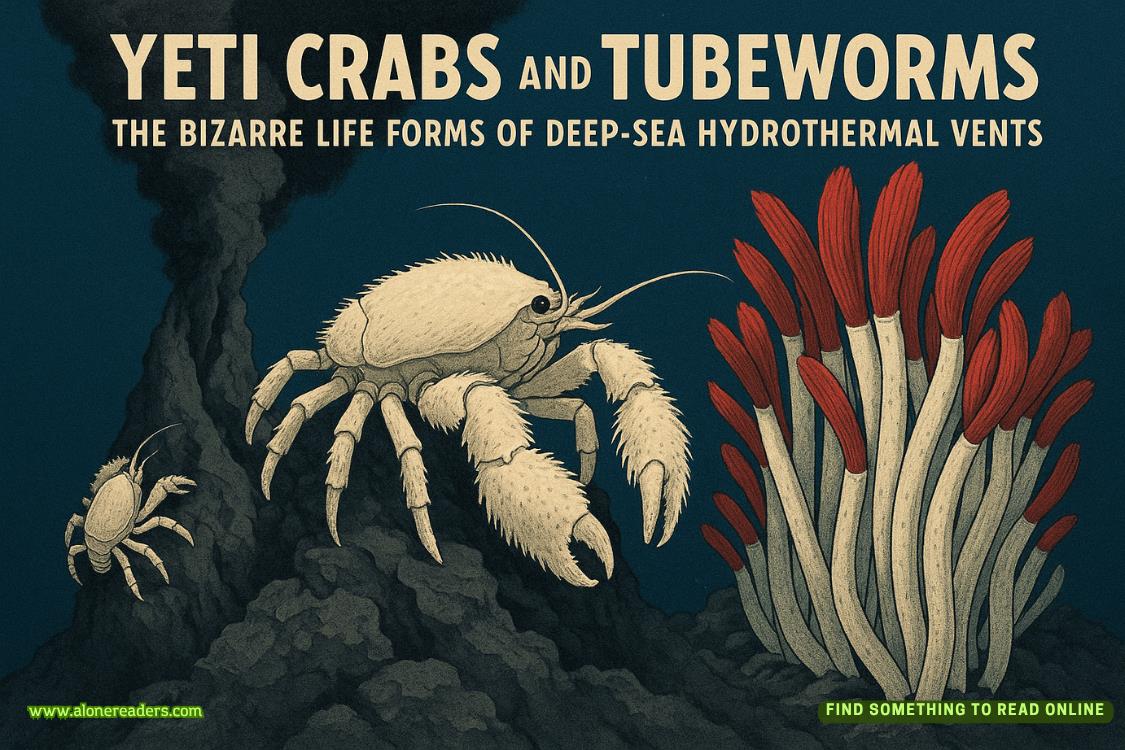
Far below the ocean’s surface, where sunlight has never penetrated and pressure could crush a submarine, life flourishes in ways that defy expectation. In this silent, alien world around hydrothermal vents, creatures like yeti crabs and tubeworms thrive in complete darkness, drawing energy not from the sun, but from the Earth itself. These life forms are among the most remarkable discoveries in marine biology, reshaping our understanding of where and how life can exist.
The story of the vent world begins along mid-ocean ridges—massive underwater mountain chains where tectonic plates diverge. Seawater seeps into the cracks of the ocean floor, heats up as it contacts magma below, and shoots back out through fissures as superheated, mineral-rich water. These hydrothermal vents, often called “black smokers,” create plumes of scalding, chemical-laden water that seem utterly hostile to life. Yet around them exists one of the most densely populated ecosystems on the planet, sustained entirely by chemical energy rather than sunlight.
In 2005, marine biologists exploring the South Pacific’s hydrothermal vents encountered a creature unlike any seen before—a ghostly-white crab covered in silky hair-like filaments. Dubbed the “yeti crab” (Kiwa hirsuta), it instantly became a symbol of the ocean’s unexplored mysteries. Measuring about 15 centimeters across, the yeti crab inhabits an environment where temperatures can fluctuate wildly and toxins like hydrogen sulfide are abundant. What makes it especially extraordinary is how it survives: the hairs on its claws are covered in bacteria that convert toxic chemicals from the vents into food. In essence, the crab “farms” its own meals by waving its claws in the nutrient-rich vent plumes to feed its symbiotic bacteria.
This strange form of survival—chemosynthesis—is the cornerstone of all life around hydrothermal vents. While surface-dwelling organisms rely on photosynthesis, these deep-sea creatures depend on bacteria that use chemicals like hydrogen sulfide and methane to create energy. This discovery challenged the long-held belief that sunlight was essential for life, opening new doors in biology, ecology, and even astrobiology, as scientists began to imagine similar ecosystems on other planets or moons.
Equally fascinating are the giant tubeworms, or Riftia pachyptila, towering up to two meters high around vent chimneys. Their crimson plumes, resembling delicate feathers, conceal an astonishing adaptation: they have no mouth, no stomach, and no digestive system. Instead, they house billions of chemosynthetic bacteria within a specialized organ called the trophosome. These bacteria convert vent chemicals into organic molecules that sustain the worm. In return, the worm provides the bacteria with the oxygen, carbon dioxide, and hydrogen sulfide they need to function. This tightly coupled relationship is one of nature’s most elegant symbioses—a complete dependence of two distinct species that thrive together in one of Earth’s most extreme habitats.
The ecosystem surrounding these vents is an intricate web of relationships. Yeti crabs often share their environment with tubeworms, mussels, shrimp, and various other extremophiles. Each species fills a specific role in a delicate balance that can be destroyed if vent activity ceases. When a vent becomes inactive and its chemical output stops, the entire community may collapse, forcing mobile species like crabs to seek out new vents while sessile organisms like tubeworms perish. These cycles of birth and death mirror volcanic activity itself—continuous renewal and destruction driven by the planet’s restless geology.
Despite the harshness of their habitat, yeti crabs display remarkable social behavior. Some species, such as Kiwa puravida found off Costa Rica, gather in dense groups around vent openings, performing synchronized claw movements that resemble a strange underwater dance. These actions are not random; by rhythmically moving their hairy claws, the crabs maximize the exposure of their symbiotic bacteria to vent chemicals, boosting their “crop” of food-producing microbes. It’s a fascinating example of behavioral adaptation born out of necessity.
Scientists studying these animals face extraordinary challenges. The vents lie thousands of meters below the surface, requiring robotic submersibles capable of withstanding immense pressure and capturing delicate specimens without damaging them. Each expedition yields new surprises—new crab species, shrimp that detect infrared light instead of visible light, or worms that build mineral tubes harder than bone. Every discovery adds another piece to the puzzle of how life can adapt to seemingly uninhabitable environments.
The implications of studying yeti crabs and tubeworms extend far beyond marine biology. Their reliance on chemosynthetic bacteria mirrors what might occur in extraterrestrial oceans, such as those beneath the icy crusts of Jupiter’s moon Europa or Saturn’s moon Enceladus. Both worlds show evidence of hydrothermal activity beneath their frozen exteriors, suggesting that similar microbial ecosystems could exist elsewhere in the solar system. Understanding how life endures in Earth’s vents offers a blueprint for detecting life beyond our planet.
The chemistry of vent environments also fascinates biochemists and ecologists alike. The high concentrations of metals, sulfides, and carbon compounds mirror the conditions thought to exist on early Earth. Many researchers now believe that hydrothermal vents could have been the cradle of life itself. The constant flow of minerals and heat might have fueled the formation of the first organic molecules, giving rise to self-replicating systems long before photosynthesis evolved. If that theory holds true, then creatures like yeti crabs and tubeworms are not just biological curiosities—they are living echoes of our planet’s earliest biosphere.
However, these fragile ecosystems face increasing threats. As deep-sea mining operations expand, hydrothermal vent fields rich in copper, gold, and rare earth metals are becoming targets for exploitation. The destruction of even a single vent field could mean the loss of unique species that exist nowhere else on Earth. Conservationists are calling for international agreements to protect these underwater oases before human activity irreversibly damages them. Unlike coral reefs or rainforests, vent ecosystems cannot easily recover once destroyed, since their survival depends entirely on the geological activity of the ocean floor.
Despite these dangers, hope remains in the growing recognition of the deep sea’s value—not for its minerals, but for its knowledge. Each discovery made at a vent site expands our understanding of evolution, adaptation, and resilience. Yeti crabs, tubeworms, and their microbial partners demonstrate that life does not merely endure adversity—it transforms it into opportunity. In their world, poison becomes sustenance, darkness becomes energy, and isolation becomes community.
In the end, the tale of yeti crabs and tubeworms is more than a story of biological oddities—it’s a reminder of life’s extraordinary versatility. Beneath kilometers of crushing water and perpetual night, they reveal that the boundaries of life are far wider than we ever imagined. As scientists continue to explore these hidden realms, we are continually reminded that Earth still holds places where the unknown reigns supreme. And in the shimmering glow of hydrothermal vents, the dance of the yeti crab and the still grace of the tubeworm remain powerful symbols of life’s tenacity in even the most impossible corners of existence.



 Château de Vincennes: France’s Forgotten Royal Fortress and Medieval Stronghold
 Château de Carcassonne: Europe’s Greatest Medieval Citadel and Fortress
 Château de Chenonceau: The Castle Built by Remarkable Women
 Château de Chambord: France’s Magnificent Renaissance Castle and Architectural Wonder
 Tehri Dam: India's Tallest Dam and the Debate Behind It
 Bhakra Nangal Dam: India's Temple of Modern Development










