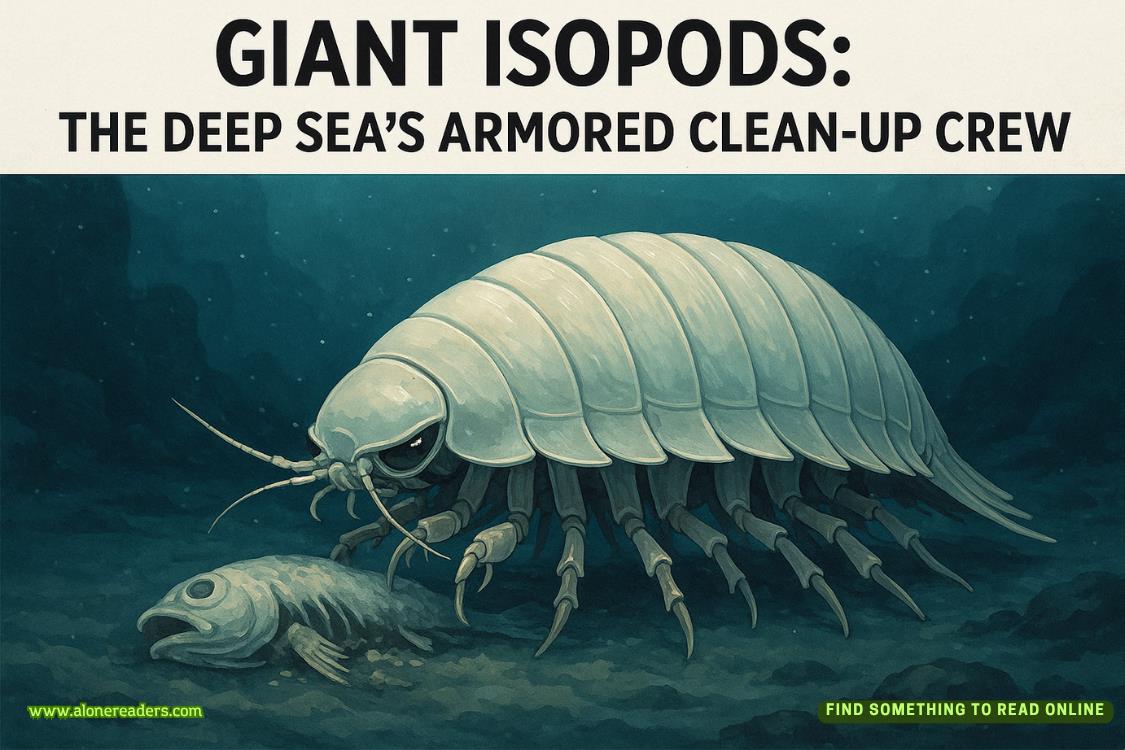
Hidden beneath the crushing pressure and icy darkness of the deep ocean lies one of Earth’s most peculiar and fascinating creatures — the giant isopod. Resembling something between an oversized pill bug and an alien tank, these enormous crustaceans are among the most efficient scavengers of the deep sea. Though they might appear menacing with their armored shells and spiny legs, giant isopods perform an essential ecological role: they are the ocean’s clean-up crew, ensuring the seafloor remains balanced and free from decay.
Giant isopods belong to the genus Bathynomus, and there are more than twenty recognized species. The largest, Bathynomus giganteus, can grow up to 50 centimeters in length, making it one of the biggest crustaceans found at such depths. They inhabit cold, dark environments ranging from 500 to over 2,000 meters below the ocean surface, where sunlight never penetrates. The deep-sea ecosystem is one of scarcity, where food is a rare commodity and survival requires both patience and adaptation. For the giant isopod, its body and behavior have evolved perfectly to thrive in these conditions.
The most striking feature of a giant isopod is its armored exoskeleton, which consists of overlapping plates that give it the appearance of a prehistoric relic. This tough exterior not only protects it from predators but also withstands the immense pressure of the deep ocean. Its pale, sometimes pinkish or lavender coloration is a result of its dark habitat, where pigmentation provides no evolutionary advantage. The large, compound eyes — each with thousands of facets — allow it to detect even the faintest glimmers of light, a crucial skill when scavenging in near-total darkness.
Diet plays a central role in understanding why giant isopods are vital to marine ecosystems. These creatures are detritivores — animals that feed on decaying organic matter. When a large sea creature, such as a whale, shark, or fish, dies and sinks to the ocean floor, giant isopods are often among the first responders. They swarm the carcass, using their strong mandibles to tear into the flesh and feast. This process recycles nutrients back into the ecosystem, preventing the accumulation of decomposing matter and sustaining the delicate balance of the deep-sea environment. In this way, giant isopods function as nature’s recyclers, maintaining the health of one of Earth’s least explored frontiers.
Their feeding behavior, however, is as fascinating as it is extreme. Because food is scarce at such depths, giant isopods have adapted to survive on very little. When they do find a substantial meal, they gorge themselves to the point of immobility, storing energy that may have to last them for weeks or even months. Researchers have observed individuals in captivity going for five years without food, an astonishing testament to their metabolic efficiency. This feast-or-famine lifestyle defines much of the deep-sea existence, where survival depends not on abundance, but endurance.
Giant isopods are slow-moving and deliberate, conserving energy wherever possible. Their antennae help them sense vibrations and chemical cues in the water, leading them to food sources that may be miles away. Though scavenging is their primary occupation, they have been known to hunt smaller prey such as slow-moving sea cucumbers, sponges, and other benthic organisms. Their hunting method is opportunistic — more like an ambush than a chase — reflecting the lethargic rhythm of life in the abyss.
The reproductive habits of giant isopods add another layer of intrigue. Females produce eggs that are among the largest in the crustacean world, sometimes up to 1.3 centimeters in diameter. Unlike many shallow-water species that release larvae into the planktonic realm, giant isopods’ young are born as miniature adults, known as “mancas.” This adaptation ensures their offspring can survive in the extreme depths without needing to ascend into dangerous, predator-filled waters. The mother carries her eggs in a brood pouch called a marsupium, providing protection until the young are ready to emerge, fully equipped to face life in the deep.
Despite their importance to marine ecosystems, much about giant isopods remains a mystery. Because they inhabit such inaccessible depths, studying them is a technological and logistical challenge. Most specimens known to science have been retrieved accidentally by deep-sea trawlers. In recent years, the use of remotely operated vehicles (ROVs) has allowed marine biologists to observe these creatures in their natural habitat, revealing behaviors previously unknown. For instance, they are often found resting motionlessly for long periods, conserving energy — a necessity in an environment where every movement carries a metabolic cost.
Their bizarre, almost robotic appearance has also captured public imagination. Photos of giant isopods have gone viral online, inspiring everything from internet memes to video game monsters. Yet beneath the fascination lies a reminder of how little humans truly understand about the deep ocean. These creatures, while alien in form, are integral parts of an interconnected ecosystem that sustains life on our planet. Every whale fall they consume, every decaying fish they strip clean, contributes to the recycling of carbon and nutrients that ultimately affects the entire oceanic food chain.
In captivity, giant isopods are notoriously difficult to maintain. Aquariums in Japan and the United States have managed to house them, but their mysterious biology poses challenges. One famous specimen at the Toba Aquarium in Japan gained worldwide attention for reportedly refusing to eat for over five years, surviving purely on stored energy. Researchers used this as a case study to better understand the species’ metabolism and resilience, which may offer insights into how deep-sea organisms manage energy at extreme pressures and low temperatures.
Giant isopods are also a symbol of evolution’s power to adapt life to even the harshest environments. While their distant relatives — the small woodlice that scurry under rocks on land — are well known, the giant isopod represents a dramatic divergence. Both share a common ancestor, yet while one evolved for life in humid forests and gardens, the other ventured into the abyssal plains, developing armor, bulk, and patience in exchange for survival in perpetual darkness.
As humans expand exploration of the deep sea, giant isopods remind us that this alien world is not barren but thriving with specialized life forms perfectly suited to their environment. They play an unseen yet indispensable role in maintaining the health of our oceans. Without scavengers like them, the seafloor would become a graveyard of decay, disrupting nutrient cycles and affecting the entire marine biosphere above.
In essence, the giant isopod is more than just a curiosity of nature; it is a guardian of the deep. Its existence underscores the complex and often invisible systems that keep our planet’s largest ecosystem functioning. As scientists continue to uncover the secrets of these armored custodians, one thing is clear — in the silent, crushing depths of the ocean, the giant isopod reigns not as a predator or a monster, but as an unsung hero of balance and renewal.



 Château de Vincennes: France’s Forgotten Royal Fortress and Medieval Stronghold
 Château de Carcassonne: Europe’s Greatest Medieval Citadel and Fortress
 Château de Chenonceau: The Castle Built by Remarkable Women
 Château de Chambord: France’s Magnificent Renaissance Castle and Architectural Wonder
 Tehri Dam: India's Tallest Dam and the Debate Behind It
 Bhakra Nangal Dam: India's Temple of Modern Development










