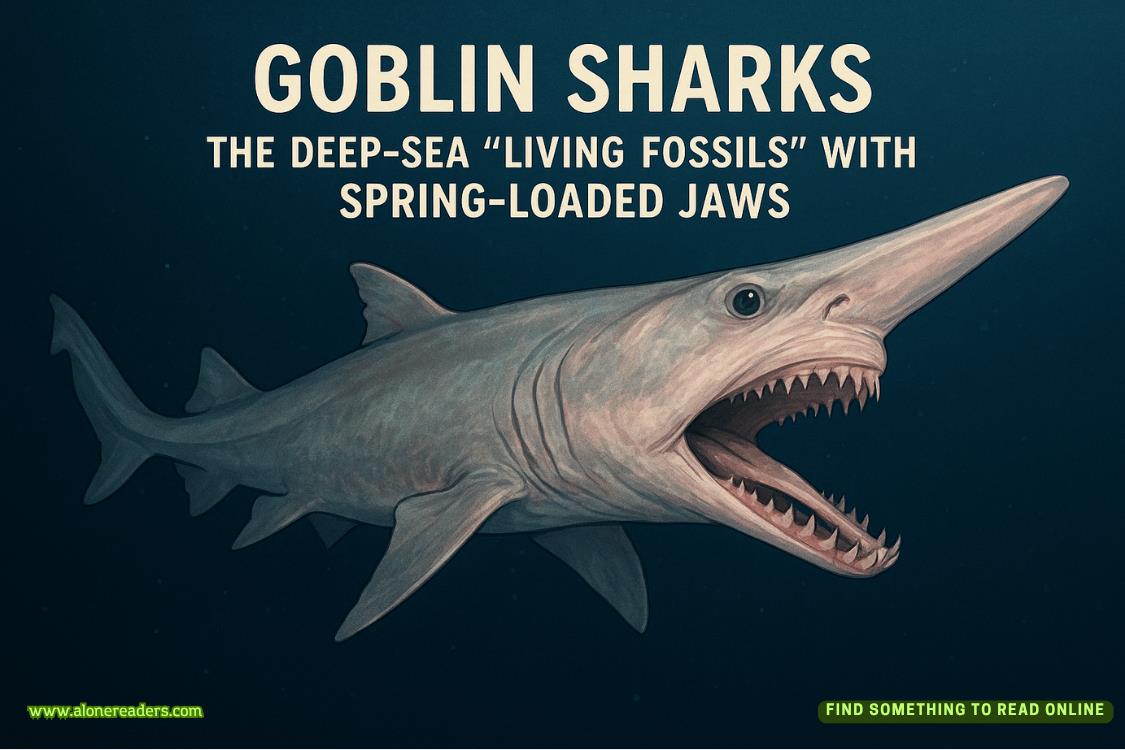
Goblin sharks are among the most mysterious and ancient creatures still swimming in the depths of the ocean. Often described as “living fossils,” these bizarre predators belong to a lineage that dates back more than 125 million years. With their protruding jaws, translucent pinkish skin, and deep-sea habitat, goblin sharks (Mitsukurina owstoni) offer a haunting glimpse into the distant evolutionary past. Unlike the fierce and streamlined predators familiar from shallower waters, goblin sharks are slow-moving, elusive, and highly adapted to the extreme environment of the deep ocean. Their unusual anatomy—especially their spring-loaded jaws—has fascinated marine biologists and inspired countless myths among deep-sea explorers.
The goblin shark’s distinct appearance immediately sets it apart from any other shark species. Its most striking feature is the elongated, flattened snout—often called a rostrum—packed with electroreceptors known as ampullae of Lorenzini. These specialized organs allow the shark to detect even the faintest electrical signals produced by the muscle contractions of nearby prey. In the perpetual darkness of the deep ocean, this electrosensory system is vital for hunting. The rest of its body, soft and flabby, suggests that the goblin shark is not built for speed but for stealth. Its skin often appears pinkish or grayish because of visible blood vessels beneath a semi-translucent epidermis, giving it a ghostly appearance that contributes to its nickname, “the ghost shark.”
What truly makes the goblin shark a marvel of evolution is its extraordinary jaw mechanism. When prey comes within range, the shark’s jaws can snap forward at lightning speed—up to 3.1 meters per second—propelled by elastic ligaments that store potential energy when the jaws are retracted. This spring-loaded action allows the jaws to extend far beyond the mouth, almost like a slingshot, grabbing unsuspecting prey in an instant. High-speed footage of this movement reveals a mechanism unlike that of any other living shark species. Once the prey is caught, the jaws retract, pulling the meal deep into the mouth. The goblin shark’s teeth are another evolutionary masterpiece—long, thin, and needle-sharp, perfect for impaling slippery fish and squid that make up most of its diet.
Goblin sharks are primarily found in deep waters off continental slopes and submarine canyons, typically at depths between 100 to 1,300 meters, though some have been recorded as deep as 1,500 meters. They have been sighted in various parts of the world, including the waters off Japan, the Gulf of Mexico, the Atlantic coasts of Europe and Africa, and around Australia. Because of their elusive nature, most specimens are captured accidentally in deep-sea trawls rather than through targeted research. The first known specimen was discovered off Japan in 1898 by American ichthyologist David Starr Jordan, who named it in honor of Alan Owston, the British naturalist who provided the specimen. Japan remains one of the most common locations for sightings and research, making the goblin shark a rare but important part of local marine biodiversity.
Despite its fearsome appearance, the goblin shark poses no threat to humans. It lives far below the depths accessible to divers and rarely comes to the surface. When brought up accidentally, most goblin sharks do not survive long due to the sudden pressure change and temperature difference. Their bodies are adapted to the cold, high-pressure environment of the deep sea, where light barely penetrates. Because of this, their muscles are soft and gelatinous, helping them conserve energy while floating motionlessly in search of prey. They rely on stealth and surprise rather than speed, using their highly sensitive snout to locate prey before unleashing their rapid, slingshot-like jaws.
The reproductive habits of goblin sharks remain largely unknown. Like many deep-sea species, they are believed to be ovoviviparous, meaning embryos develop inside eggs that remain within the mother’s body until hatching. Females likely give birth to a small number of well-developed pups, each equipped with the same eerie features as adults. However, because no pregnant females have been studied in detail and observations of juveniles are extremely rare, much of their reproductive biology remains speculative. This scarcity of information underscores how little we know about life in the deep ocean and how many secrets are still hidden beneath its surface.
Goblin sharks play a subtle but important role in their ecosystem. As mid-level predators, they help maintain the balance of deep-sea food webs by preying on bottom-dwelling fish, cephalopods, and crustaceans. They also serve as indicators of deep-sea health and biodiversity. Studying such ancient species offers valuable insights into evolutionary resilience—how some lineages have survived mass extinctions and drastic climate changes that wiped out countless others. Because goblin sharks have changed very little since the early Cretaceous period, they serve as living evidence of how ancient lifeforms can persist through adaptation to stable, extreme environments.
The evolutionary history of the goblin shark is a story of survival through stability. Fossil records show that their ancestors thrived in the same ecological niche millions of years ago. While many surface-dwelling sharks evolved new body shapes and hunting strategies, the goblin shark’s deep-sea environment remained relatively unchanged. This lack of environmental pressure may explain why the species has retained so many primitive features, earning its title as a “living fossil.” In evolutionary biology, living fossils like the goblin shark, coelacanth, and horseshoe crab are invaluable because they reveal how certain lifeforms can remain virtually unchanged over geological time scales.
Modern technology is finally allowing scientists to study goblin sharks more effectively. Deep-sea submersibles, remote-operated vehicles (ROVs), and high-resolution cameras have captured live footage of these elusive creatures in their natural habitat, revealing details about their movement and feeding behavior. Genetic studies are also providing clues about their relationship to other shark families and the adaptations that allow them to survive at such depths. However, given how rarely goblin sharks are encountered, every new sighting adds significantly to our understanding. Some researchers hope that future tagging and tracking studies might uncover migration patterns, breeding grounds, and population structures.
From a conservation perspective, goblin sharks are not currently considered endangered, but their status is still uncertain due to the lack of data. The International Union for Conservation of Nature (IUCN) lists them as “Least Concern,” primarily because they are widely distributed and rarely targeted by fisheries. However, as deep-sea fishing expands and ocean temperatures change due to global warming, their habitats could face increasing disruption. Deep-sea ecosystems are among the least understood and most vulnerable to human activities, and protecting them means safeguarding ancient species like the goblin shark.
Public fascination with goblin sharks continues to grow as more photos and videos surface online. Their alien-like appearance and ancient origins make them a popular subject for documentaries, scientific articles, and even horror fiction. Yet beyond their eerie look lies a deeper scientific significance. The goblin shark embodies evolution’s patience—its ability to produce a design so efficient for a specific environment that it hardly needs to change for over a hundred million years. In a world where most species evolve rapidly to survive changing conditions, the goblin shark remains a silent reminder of nature’s endurance and mystery.
In the end, the goblin shark is not a monster of the deep but a masterpiece of adaptation. It is a living relic from a time when dinosaurs roamed the Earth, its survival a quiet triumph of stability in a turbulent planet’s history. With its pink skin, retractable jaws, and ancient lineage, this elusive creature bridges past and present, reminding us that the ocean’s darkest depths still hold secrets beyond imagination—secrets that have endured for over a hundred million years.



 Château de Vincennes: France’s Forgotten Royal Fortress and Medieval Stronghold
 Château de Carcassonne: Europe’s Greatest Medieval Citadel and Fortress
 Château de Chenonceau: The Castle Built by Remarkable Women
 Château de Chambord: France’s Magnificent Renaissance Castle and Architectural Wonder
 Tehri Dam: India's Tallest Dam and the Debate Behind It
 Bhakra Nangal Dam: India's Temple of Modern Development