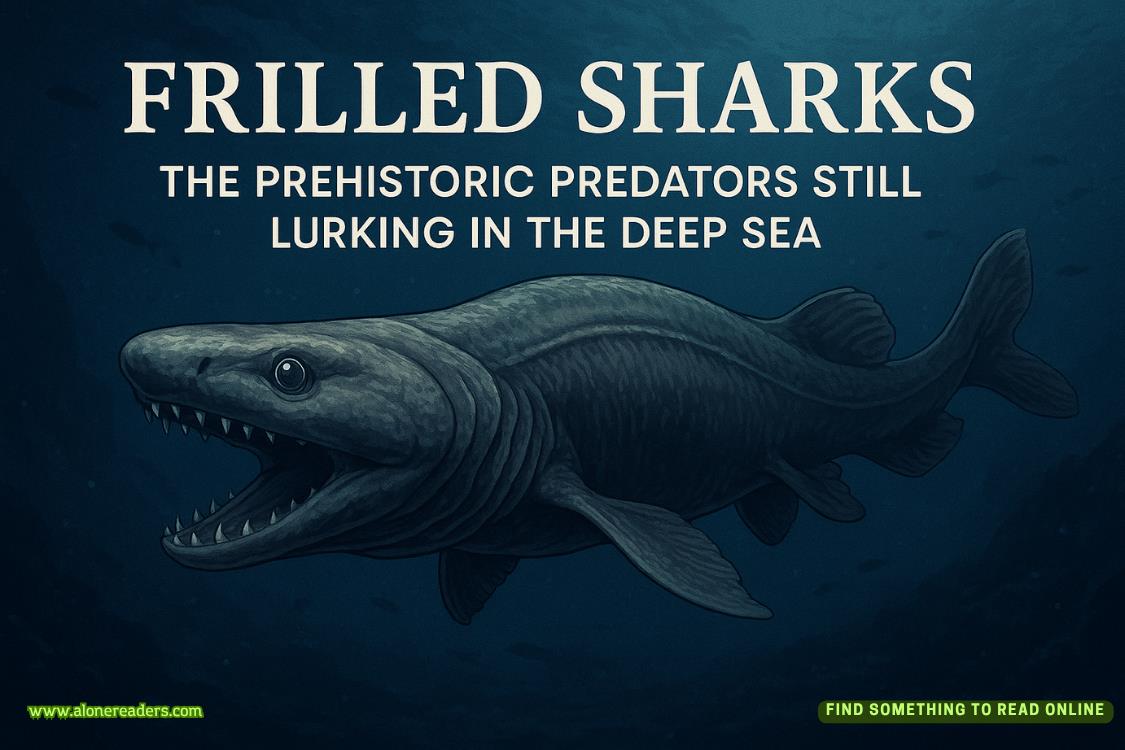
Hidden deep beneath the surface of the ocean lies a creature that seems more myth than reality—the frilled shark. Often called a “living fossil,” this remarkable species has remained almost unchanged for millions of years, surviving in the dark abyss where evolution slows and time itself appears to stand still. With its eel-like body, eerie gaping jaws, and primeval design, the frilled shark offers a haunting glimpse into the prehistoric oceans that once ruled the Earth long before humans existed.
The frilled shark’s scientific name, Chlamydoselachus anguineus, captures its most distinct features. “Chlamydo” refers to the frilly, fringed gill slits that line its throat, while “anguineus” describes its snake-like body. Measuring between 1.5 and 2 meters on average, though occasionally longer specimens have been recorded, this shark’s body undulates through the water like an eel. Its six pairs of gill slits, each edged with frilly margins, give it the name that has fascinated biologists and deep-sea explorers for over a century.
First described in 1884 by German ichthyologist Ludwig Döderlein, the frilled shark was a mystery even then—and remains one today. It is rarely seen alive, as it inhabits depths ranging from 200 to over 1,500 meters, far below the reach of sunlight. Most of what we know about this creature comes from specimens accidentally caught in deep-sea trawling nets or captured by deep submersible cameras. Each new encounter adds only a fragment to our understanding of this enigmatic predator.
One of the most striking features of the frilled shark is its jaw structure. Unlike most modern sharks that have short, triangular teeth arranged in multiple rows, the frilled shark possesses more than 300 needle-like teeth arranged in 25 rows. Each tooth is shaped like a trident, perfect for gripping slippery prey. Its mouth extends far back beneath the skull, allowing it to engulf prey whole. Scientists believe the shark lunges forward like a snake, using sudden bursts of energy to ambush prey such as squid, cuttlefish, smaller sharks, and deep-sea fish. Once prey is caught in its jaw, escape is almost impossible; the inward-facing teeth act like barbed hooks, drawing the victim deeper into the mouth with every movement.
Another fascinating aspect is the frilled shark’s method of hunting. In the lightless depths, visibility is almost zero, so the shark relies heavily on its highly sensitive lateral line system to detect vibrations and movement in the water. It swims with a slow, serpentine motion, conserving energy while scanning for the faintest signals of nearby prey. When opportunity strikes, it can suddenly spring forward with surprising speed. This ambush-style hunting makes it a formidable predator despite its ancient physiology.
What makes the frilled shark so extraordinary, however, is its lineage. Fossil evidence suggests that its ancestors date back more than 80 million years to the Late Cretaceous period—a time when dinosaurs still roamed the land. While many prehistoric sharks evolved or went extinct as ocean conditions changed, the frilled shark remained relatively the same. This evolutionary stability indicates that its anatomy and hunting strategy were already highly successful, allowing it to persist virtually unchanged through countless geological epochs. It’s not often that we encounter a living species that can be traced back to the age of the dinosaurs.
Equally remarkable is the frilled shark’s reproductive strategy. Unlike most sharks that lay eggs (oviparous) or give birth after a short gestation period (viviparous), the frilled shark exhibits an extremely slow and unique form of live birth known as aplacental viviparity. Females carry their developing young inside their bodies for up to three and a half years—the longest known gestation period of any vertebrate. The embryos feed on yolk sacs within the mother until they are fully developed and born as miniature adults, typically six to twelve at a time. This prolonged gestation may be an adaptation to the cold, stable environment of the deep sea, where metabolic rates are lower and survival demands are different from those near the surface.
The frilled shark’s slow reproduction, however, also makes it highly vulnerable. Because females give birth so rarely and mature slowly, populations cannot quickly recover from disturbances. Overfishing, deep-sea mining, and habitat disruption could easily threaten this ancient species. Although not currently classified as endangered, it is listed as “Near Threatened” by the International Union for Conservation of Nature (IUCN), and scientists warn that its rarity and low reproduction rate make it particularly susceptible to ecological change.
Encounters with the frilled shark are exceedingly rare, but when they do happen, they often spark global fascination. In 2007, a live specimen was captured off the coast of Japan in relatively shallow water—about 600 meters deep. It was weak and disoriented, likely due to illness or being forced out of its natural depth range. The footage of this creature, with its serpentine movements and prehistoric appearance, went viral and renewed interest in this elusive species. To many viewers, it looked less like a fish and more like a creature straight out of a science fiction film.
In many ways, the frilled shark embodies the mysteries of the deep sea—an ecosystem largely unexplored and poorly understood. The ocean’s depths are often compared to outer space in terms of how little we know, and creatures like the frilled shark remind us how ancient and alien life on our own planet can be. Its existence challenges assumptions about evolution, survival, and adaptability. Unlike the fast-evolving species of coral reefs or tropical shallows, the frilled shark’s success lies in its constancy. The dark, high-pressure world it inhabits has changed little over millions of years, providing a stable environment where this ancient predator could endure unchanged.
From a biological perspective, the frilled shark is a marvel of primitive design meeting modern survival. Its cartilaginous skeleton is lighter and more flexible than bone, allowing it to withstand the crushing pressure of deep waters. Its dark brown coloration helps it blend into the surrounding void, rendering it almost invisible to prey. Meanwhile, its low metabolic rate enables it to survive on infrequent meals, a critical advantage in a world where food is scarce.
The more we learn about the frilled shark, the more it underscores the need to protect deep-sea ecosystems. These environments, though remote, are integral to the health of our planet. They regulate carbon storage, support diverse forms of life, and offer clues to evolutionary history that cannot be found anywhere else. The frilled shark, as one of the ocean’s oldest living species, represents a fragile thread connecting us to Earth’s distant past—a reminder that the story of life is far older and stranger than we often realize.
In an age where climate change and industrialization threaten marine biodiversity, preserving creatures like the frilled shark is not just about saving one species—it’s about maintaining a window into evolution itself. This ancient predator has survived meteor strikes, ice ages, and mass extinctions. Its continued existence in the twilight zones of the ocean is both humbling and awe-inspiring, a testament to nature’s resilience and mystery. As science ventures deeper into the ocean with new technology, we may one day unlock more secrets of this ghost from prehistory. Until then, the frilled shark remains an emblem of Earth’s primeval oceans—a living echo of an age when monsters ruled the deep.



 Château de Vincennes: France’s Forgotten Royal Fortress and Medieval Stronghold
 Château de Carcassonne: Europe’s Greatest Medieval Citadel and Fortress
 Château de Chenonceau: The Castle Built by Remarkable Women
 Château de Chambord: France’s Magnificent Renaissance Castle and Architectural Wonder
 Tehri Dam: India's Tallest Dam and the Debate Behind It
 Bhakra Nangal Dam: India's Temple of Modern Development