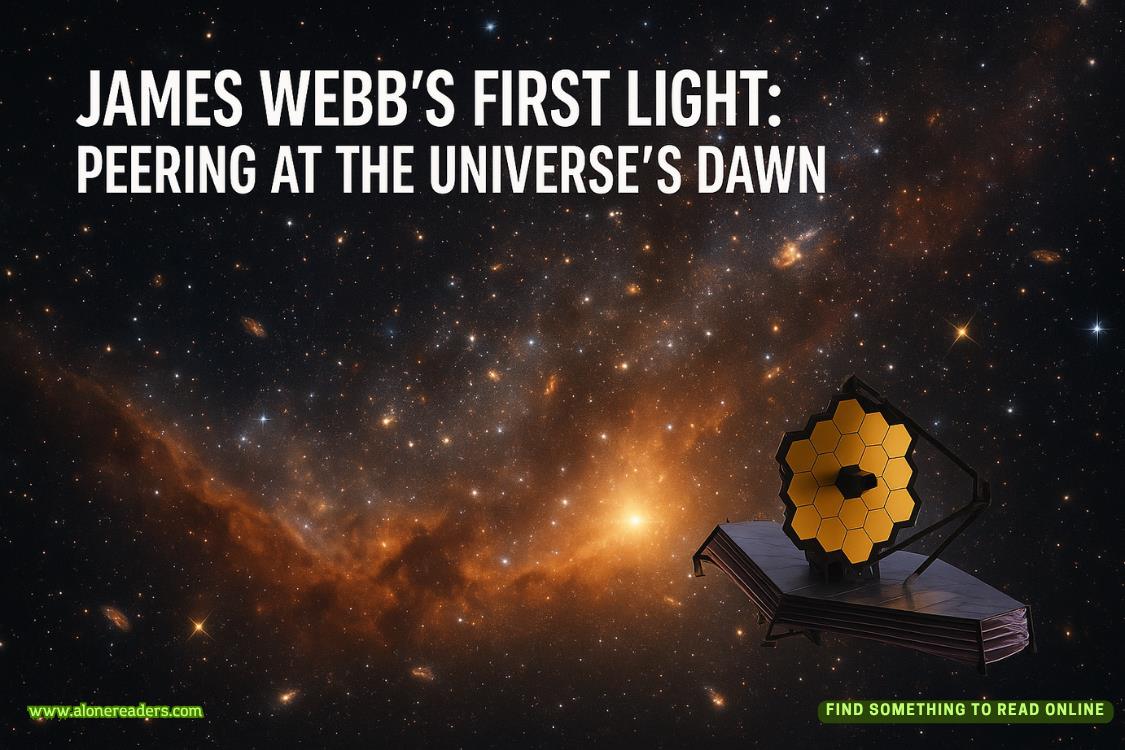
When the James Webb Space Telescope (JWST) captured its “first light,” humanity witnessed something extraordinary — the deepest, clearest look into the origins of our universe ever achieved. This was not just another scientific milestone; it was a moment that redefined our understanding of cosmic history. After decades of planning, engineering, and global collaboration, Webb’s instruments revealed the faint light of galaxies formed more than 13.5 billion years ago — mere hundreds of millions of years after the Big Bang. These early photons, traveling across the vastness of space and time, became a window into an era that had previously been invisible to us.
The concept of “first light” in astronomy refers to the first time a telescope successfully gathers data and produces usable images after launch. For the James Webb Space Telescope, this wasn’t just a test image — it was a transformative unveiling. Positioned 1.5 million kilometers from Earth at the second Lagrange point (L2), the telescope had to unfold and calibrate its massive 6.5-meter gold-coated mirror and sophisticated instruments in the freezing vacuum of space. Every component had to work flawlessly for Webb to achieve the precision necessary to detect faint infrared light from the earliest galaxies. The success of this process marked one of the most complex deployments in the history of space exploration.
The images from Webb’s first light were breathtaking — a kaleidoscope of galaxies, nebulae, and cosmic structures shimmering in infrared wavelengths. One of the most iconic early captures, known as SMACS 0723, revealed thousands of galaxies clustered together, many of which had never been seen before. Some of these galaxies existed when the universe was less than 500 million years old. The gravitational lensing effect — where the mass of closer galaxies bends light from those farther away — allowed Webb to magnify these distant cosmic objects, effectively letting us peer back through 13.5 billion years of time.
What makes Webb’s “first light” so remarkable is not only its visual impact but also its scientific depth. The telescope’s Near Infrared Camera (NIRCam) and Near Infrared Spectrograph (NIRSpec) instruments can capture data far beyond the visible spectrum, detecting wavelengths of light stretched by cosmic expansion. This means astronomers can measure redshifts — the stretching of light waves due to the expansion of the universe — with unprecedented accuracy. Such data allow scientists to pinpoint when certain galaxies formed and how they evolved. In essence, Webb’s early observations became a time machine, transporting our scientific vision to an age when the first stars ignited and cosmic structures began to take shape.
Before Webb, the Hubble Space Telescope had given us the most profound views of the universe, such as the Hubble Deep Field — an image that transformed astronomy by revealing thousands of galaxies in what appeared to be an empty patch of sky. However, Hubble was limited to optical and ultraviolet light. The James Webb Telescope was designed to extend this reach into the infrared spectrum, which allows it to see through dust clouds and detect objects that are too faint or too old for Hubble to capture. The first light images thus surpassed anything Hubble could produce in depth, clarity, and scale. Where Hubble saw the outlines of ancient galaxies, Webb unveiled their internal structures, star formation regions, and even chemical signatures.
The implications of these findings are immense. For decades, cosmologists have theorized about the “cosmic dawn” — the era when the first stars and galaxies emerged from the dark ages that followed the Big Bang. Webb’s first images provided empirical evidence of this epoch. Early results hinted that galaxies might have formed sooner and more efficiently than models had predicted. Some of the faint red smudges detected by Webb turned out to be surprisingly massive and mature, suggesting that the processes that built the first galaxies were more rapid and complex than previously thought. This discovery has forced scientists to re-evaluate existing cosmological theories and adjust simulations of early galaxy formation.
The telescope’s capabilities go far beyond observing distant galaxies. Its sensitivity in the infrared spectrum also makes it ideal for studying exoplanet atmospheres — detecting signatures of water vapor, methane, and carbon dioxide in alien worlds orbiting distant stars. Even in its early stages, Webb demonstrated its potential to revolutionize planetary science. The first light marked not only the beginning of cosmic archaeology but also the dawn of a new era in the search for life beyond Earth.
The technological marvel behind Webb’s success is equally awe-inspiring. Its segmented mirror, composed of 18 hexagonal beryllium pieces coated in gold, allows for extreme precision and light-gathering power. The telescope must operate at cryogenic temperatures — around -233°C — to prevent its own heat from interfering with infrared observations. A five-layer sunshield, each layer as thin as a human hair and as large as a tennis court, protects it from solar radiation. The successful deployment of this shield during the early mission phase was one of the most nerve-wracking moments for NASA engineers. One wrong fold or tension failure could have ended the mission before it even began.
The first light also represented the culmination of international cooperation. NASA, the European Space Agency (ESA), and the Canadian Space Agency (CSA) jointly developed Webb, pooling expertise and resources over two decades. The telescope’s journey from conception to operation involved more than 10,000 people across 14 countries. Every nation involved saw Webb’s first light as a shared triumph — proof that humanity can work together to explore the most profound questions of existence.
The release of Webb’s early images sparked a cultural moment as well. Across the world, people paused to marvel at the colors and complexity of the universe. Social media platforms flooded with side-by-side comparisons of Hubble’s and Webb’s images, underscoring just how far technology — and our perspective — had evolved. For many, Webb’s first light became a reminder of the power of curiosity and collaboration. In an age defined by divisions, it symbolized a rare moment of unity through science.
Yet, beyond the awe, there is a deeper philosophical resonance. Looking at Webb’s first images is, in a sense, looking at ourselves — at the origins of the atoms that make up every living thing on Earth. The hydrogen and helium forged in the Big Bang gave birth to the first stars, which, through nuclear fusion, created the heavier elements that later formed planets, oceans, and life. When we peer at the universe’s dawn, we are glimpsing our own beginnings written in light billions of years old.
In the years since its first light, the James Webb Space Telescope continues to deliver discoveries that challenge and inspire. It has found galaxies that appear older than theory permits, mapped star nurseries hidden within nebulae, and analyzed exoplanet atmospheres with extraordinary precision. But none of these achievements would have been possible without that first successful glimpse into the ancient cosmos. The first light was more than a technical milestone — it was the awakening of a new age of astronomy.
As we continue to explore the universe through Webb’s golden eyes, each image brings us closer to answering the timeless questions: How did the cosmos begin? What is our place in it? And what other worlds might be out there, waiting for their own first light? The answers may not come quickly, but with every pixel of light gathered from the edge of time, humanity steps a little closer to understanding the vast and beautiful mystery that surrounds us.



 Château de Vincennes: France’s Forgotten Royal Fortress and Medieval Stronghold
 Château de Carcassonne: Europe’s Greatest Medieval Citadel and Fortress
 Château de Chenonceau: The Castle Built by Remarkable Women
 Château de Chambord: France’s Magnificent Renaissance Castle and Architectural Wonder
 Tehri Dam: India's Tallest Dam and the Debate Behind It
 Bhakra Nangal Dam: India's Temple of Modern Development