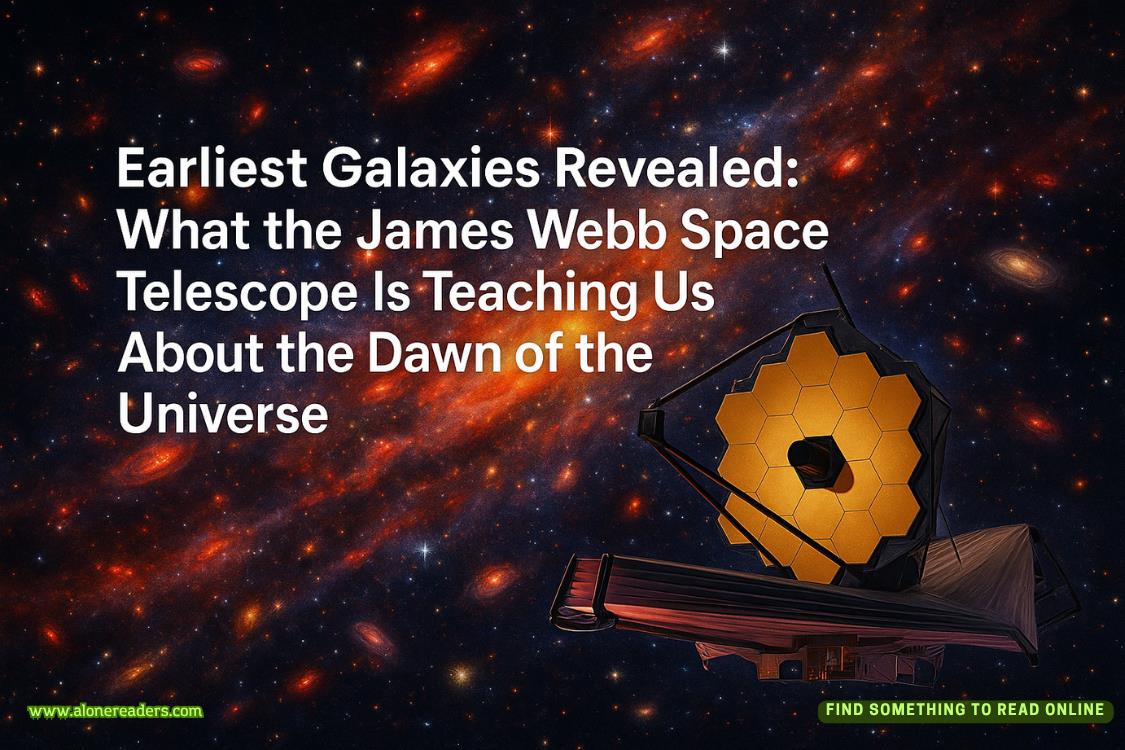
When the James Webb Space Telescope (JWST) unfolded its golden mirrors in 2021 and began peering into the depths of the universe, astronomers expected it to refine our understanding of the cosmos. Instead, it revolutionized it. Within months of its first light, JWST began revealing galaxies so distant—and therefore so ancient—that they seemed to challenge the very timelines established by decades of cosmology. These observations pushed the boundaries of how early massive galaxies could have formed and raised profound questions about the birth of structure in the universe.
The JWST’s unprecedented infrared sensitivity has opened a window into an epoch known as the Cosmic Dawn, roughly 200–400 million years after the Big Bang. During this time, the first stars ignited, galaxies began to form, and the universe transitioned from a dark, opaque state to one filled with light. The Hubble Space Telescope had already captured glimpses of this early era, but its capabilities in the near-infrared range were limited. JWST’s instruments—especially the Near Infrared Camera (NIRCam) and Near Infrared Spectrograph (NIRSpec)—allow it to detect light stretched by cosmic expansion for more than 13 billion years, making it the first telescope capable of directly observing galaxies that formed shortly after the universe’s birth.
Among JWST’s early discoveries were galaxies identified with redshifts greater than 10—meaning the light we see from them has been stretched to more than 10 times its original wavelength by the universe’s expansion. Some of these galaxies, such as GLASS-z13 and CEERS-93316, appear to have formed when the universe was only about 300–400 million years old. These detections startled cosmologists because the galaxies seemed surprisingly massive and well-developed for such an early stage. Models of cosmic evolution predicted smaller, less organized structures at that time, suggesting that star formation and galactic assembly might have occurred much faster than previously thought.
The implications of these discoveries go far beyond identifying ancient light sources. They challenge the core assumptions of how dark matter and baryonic matter interact to form the first cosmic structures. If galaxies this large existed so early, then the processes of gas cooling, star formation, and black hole growth must have been far more efficient—or began far earlier—than theoretical models suggested. This has prompted astrophysicists to reconsider how the first stars (known as Population III stars) seeded the universe with heavy elements, influencing subsequent generations of stars and galaxies.
JWST’s detailed spectra of early galaxies are also revealing the chemical fingerprints of cosmic evolution. By analyzing the light dispersed by NIRSpec, scientists can determine the composition of these galaxies—the presence of hydrogen, helium, oxygen, carbon, and even metals forged in the hearts of the first stars. Some galaxies already show traces of chemical enrichment, indicating that at least one or two generations of stars had lived and died within a few hundred million years after the Big Bang. This suggests that stellar birth and death cycles were occurring much faster than previously believed, reshaping our understanding of how quickly the cosmos became chemically complex.
Another groundbreaking aspect of JWST’s work is its contribution to understanding cosmic reionization—the period when ultraviolet light from the first stars and galaxies ionized the neutral hydrogen that filled the universe after the Big Bang. Before this reionization, the universe was essentially opaque to light. JWST’s ability to identify faint, distant galaxies from this period is helping scientists map out when and how reionization occurred. Preliminary findings suggest that galaxies played a major role in this process, providing the ultraviolet photons necessary to ionize intergalactic gas. The telescope’s deep-field observations are beginning to fill in the timeline of when the universe became transparent, offering clues to one of cosmology’s most elusive transitions.
These achievements are not without controversy. Some early claims about extremely high-redshift galaxies have been revised after more detailed spectroscopic analysis. Photometric redshifts—estimates based on color and brightness—can sometimes misidentify closer galaxies as more distant ones. Yet even with these corrections, JWST continues to find galaxies well beyond Hubble’s reach, solidifying its reputation as the most powerful time machine ever built.
Beyond redshift measurements, JWST’s precision imaging is revealing the intricate structure of early galaxies. Some appear clumpy and irregular, as expected from young systems in the throes of formation. Others show surprisingly smooth, disk-like shapes, indicating that the physics of galactic assembly might have been operating in more organized ways than once thought possible. The telescope’s ability to resolve these details at cosmic distances allows scientists to trace how galaxies grow—from chaotic assemblages of gas and stars into the elegant spirals and ellipticals we see in the modern universe.
Equally fascinating is JWST’s exploration of supermassive black holes in the early universe. Observations have uncovered quasars—galaxies powered by rapidly accreting black holes—existing less than a billion years after the Big Bang. The existence of such enormous black holes at such an early time defies explanation within current models. How could something so massive form so quickly? Some researchers propose that black holes may have originated from the direct collapse of massive gas clouds rather than the remnants of the first stars. JWST’s infrared vision is now gathering critical evidence to test these competing theories, possibly revealing the birth mechanisms of the universe’s first black holes.
JWST is not working alone in this cosmic quest. Its observations are complemented by data from ground-based observatories like ALMA (the Atacama Large Millimeter/submillimeter Array) and future missions such as the Nancy Grace Roman Space Telescope. Together, they are building a multi-wavelength picture of early galaxy formation, allowing astronomers to correlate the properties of stars, dust, and gas across the electromagnetic spectrum. This synergy is painting the most comprehensive portrait yet of how the cosmos evolved from simplicity to complexity.
Perhaps the most profound outcome of JWST’s discoveries is philosophical rather than purely scientific. The telescope is not merely confirming what we thought we knew—it is humbling us by exposing how much we still don’t. The universe appears to be more dynamic, more rapid in its creativity, and more unpredictable than our most sophisticated theories had assumed. Each image from JWST is a snapshot not just of distant space, but of ancient time—a message from when the universe was a fraction of its current age.
As the telescope continues its mission, with years of observations ahead, astronomers anticipate even deeper revelations. The upcoming surveys aim to peer beyond redshift 15, possibly glimpsing the very first generation of stars and protogalaxies. JWST may ultimately help pinpoint when the first light truly dawned—a cosmic sunrise that defined everything that followed.
In the end, the James Webb Space Telescope is more than an instrument of observation; it is a bridge to our cosmic origins. It has transformed the abstract theories of the early universe into tangible data—images and spectra that speak of creation itself. What it teaches us is not only about galaxies, but about the resilience of human curiosity. We have built a machine capable of seeing back nearly to the beginning of time, and in doing so, we have reaffirmed our oldest instinct: to look up, to question, and to understand.
Through JWST’s eyes, we are witnessing the universe remembering its own birth, one galaxy at a time.



 Château de Vincennes: France’s Forgotten Royal Fortress and Medieval Stronghold
 Château de Carcassonne: Europe’s Greatest Medieval Citadel and Fortress
 Château de Chenonceau: The Castle Built by Remarkable Women
 Château de Chambord: France’s Magnificent Renaissance Castle and Architectural Wonder
 Tehri Dam: India's Tallest Dam and the Debate Behind It
 Bhakra Nangal Dam: India's Temple of Modern Development