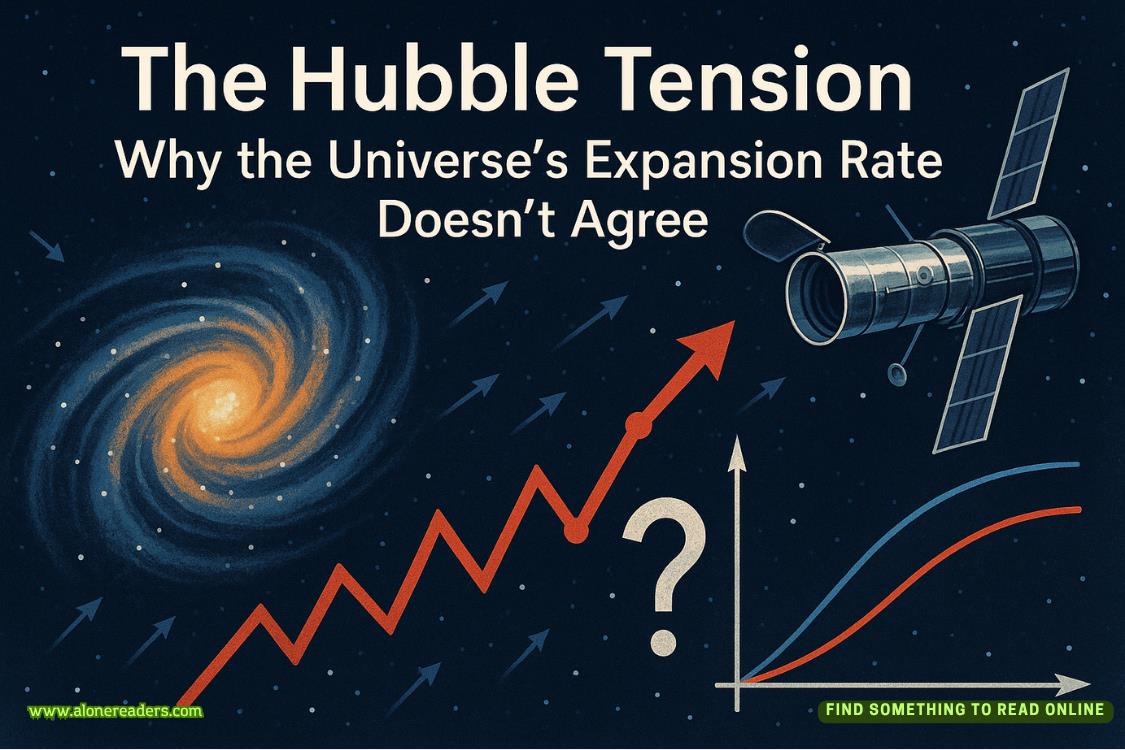
The Hubble tension is one of the most puzzling mysteries in modern cosmology. It revolves around a simple but profound question: how fast is the universe expanding? The value that defines this rate is called the Hubble constant, named after Edwin Hubble, who first discovered that galaxies are receding from each other. However, the more scientists try to measure it with modern instruments, the more the numbers refuse to agree. This discrepancy—known as the Hubble tension—challenges our understanding of the cosmos and may even suggest that new physics lies beyond our current models.
To understand the Hubble tension, one must first understand the Hubble constant itself. In the 1920s, Edwin Hubble discovered that distant galaxies move away from us at speeds proportional to their distance, implying that the universe is expanding. The constant that links the velocity of recession and distance is called the Hubble constant (H₀), expressed in kilometers per second per megaparsec (km/s/Mpc). This means that for every megaparsec (about 3.26 million light-years) of distance, a galaxy appears to move away faster by a certain number of kilometers per second. The higher the constant, the faster the universe expands.
The trouble begins with how this value is measured. Scientists have two main approaches, and both yield precise but incompatible results. The first approach measures the expansion rate directly from relatively nearby objects—stars, supernovae, and galaxies—whose distances can be independently verified. This is often referred to as the “cosmic distance ladder” method. Astronomers use Cepheid variable stars, whose brightness fluctuates predictably, as standard candles to gauge distances. They then calibrate these measurements with Type Ia supernovae, which have consistent intrinsic brightness. From this, the local expansion rate is determined to be around 73–74 km/s/Mpc.
The second approach comes from the early universe, using observations of the cosmic microwave background (CMB)—the afterglow of the Big Bang. The European Space Agency’s Planck satellite has provided the most precise measurements of the CMB to date. These measurements allow cosmologists to infer the expansion rate based on the physical conditions of the universe about 380,000 years after the Big Bang, using the standard model of cosmology (ΛCDM). The result from Planck data gives a smaller value: about 67–68 km/s/Mpc. Both methods claim uncertainties of less than 2%, yet they differ by nearly 10%, far beyond statistical error. This gap is what scientists call the Hubble tension.
The disagreement isn’t merely a technical issue—it has profound implications. If both sets of measurements are correct, it means that our current understanding of cosmology is incomplete. The universe may not be behaving according to the assumptions of the ΛCDM model, which has long been the cornerstone of modern cosmology. This model includes dark matter, dark energy, and the cosmological constant (Λ), providing an elegant fit for much of what we observe. But the Hubble tension implies that something crucial might be missing or misunderstood.
Researchers have explored numerous possible explanations. One idea is that the local measurements may be skewed by systematic errors—perhaps our calibration of Cepheid variables or supernova brightness is slightly off. However, multiple independent teams using different instruments and calibration techniques, such as the SH0ES collaboration led by Adam Riess, have confirmed the higher local value. This makes it unlikely that simple measurement errors are responsible.
On the other side, perhaps the discrepancy lies in the cosmological model itself. The CMB-derived value assumes that the universe’s expansion history follows the ΛCDM framework from the Big Bang to today. If something changed during that evolution—like a new form of energy or particle that influenced early expansion—it could shift the inferred Hubble constant. Several theoretical proposals attempt to account for this. One is early dark energy, a hypothesized form of energy that briefly accelerated the universe’s expansion before fading away. This would reconcile the CMB data with the local measurements. Others suggest extra neutrino species or variations in dark matter behavior could alter the inferred expansion rate.
Another intriguing possibility is that gravity behaves differently on cosmic scales than predicted by Einstein’s general relativity. Modified gravity theories, though still speculative, could adjust the relationship between matter, energy, and expansion, potentially resolving the tension. Yet, these ideas remain difficult to test directly and would require revising one of the most successful theories in physics.
The Hubble tension also highlights the importance of cross-checking cosmic measurements. In recent years, astronomers have turned to new, independent methods to measure the Hubble constant. One involves gravitational lensing—observing how light from distant quasars bends around massive galaxies. The time delays between multiple light paths can reveal the expansion rate, yielding results that often fall between the CMB and local ladder values, though uncertainties remain large. Another method uses gravitational waves from colliding neutron stars as “standard sirens,” since their waveforms reveal distance independent of brightness. When combined with redshift data, they offer a direct way to measure the cosmic expansion. As more such events are detected by LIGO and Virgo, they could serve as an impartial referee in the debate.
The growing precision of telescopes and satellites continues to add complexity. The James Webb Space Telescope (JWST), with its unprecedented resolution, is already refining Cepheid and supernova measurements. Early results from JWST have largely supported the higher local value, deepening rather than resolving the tension. Meanwhile, upcoming missions such as the Euclid satellite and the Nancy Grace Roman Space Telescope aim to measure the cosmic expansion with unparalleled accuracy across vast distances. Whether they will tip the balance toward one side or reveal an entirely new picture remains to be seen.
What makes the Hubble tension so significant is not just the numbers themselves but what they represent. If the discrepancy persists even after all known sources of error are accounted for, it would mean that the current standard model of cosmology is incomplete. The universe may be more complex than the simple mix of matter, dark matter, and dark energy that we currently assume. A new form of physics—perhaps connected to quantum gravity, dark energy dynamics, or unknown particles—might be required to explain it.
Some cosmologists caution against jumping to revolutionary conclusions. Historically, tensions in measurements have often been resolved through better calibration or improved data. But others see this as a potential gateway to discovery. Just as the discovery of cosmic acceleration in the 1990s led to the concept of dark energy, the Hubble tension might point toward a deeper layer of the universe’s structure that we are only beginning to glimpse.
In many ways, this scientific disagreement embodies the essence of cosmology—a field where observation meets theory on a cosmic scale. The universe, once thought static, continues to surprise us with its dynamic nature. The disagreement over the Hubble constant is not a sign of failure but of progress. It pushes scientists to refine their models, invent new techniques, and question long-held assumptions.
Ultimately, the Hubble tension is a cosmic riddle with far-reaching implications. Whether it will be solved through new observations, a revision of the standard model, or a breakthrough in theoretical physics, it has already transformed how scientists think about the cosmos. The universe’s expansion may not agree across all measurements, but in that very disagreement lies the promise of discovery—a reminder that even after a century of exploration, the cosmos still holds secrets waiting to be uncovered.



 Château de Vincennes: France’s Forgotten Royal Fortress and Medieval Stronghold
 Château de Carcassonne: Europe’s Greatest Medieval Citadel and Fortress
 Château de Chenonceau: The Castle Built by Remarkable Women
 Château de Chambord: France’s Magnificent Renaissance Castle and Architectural Wonder
 Tehri Dam: India's Tallest Dam and the Debate Behind It
 Bhakra Nangal Dam: India's Temple of Modern Development