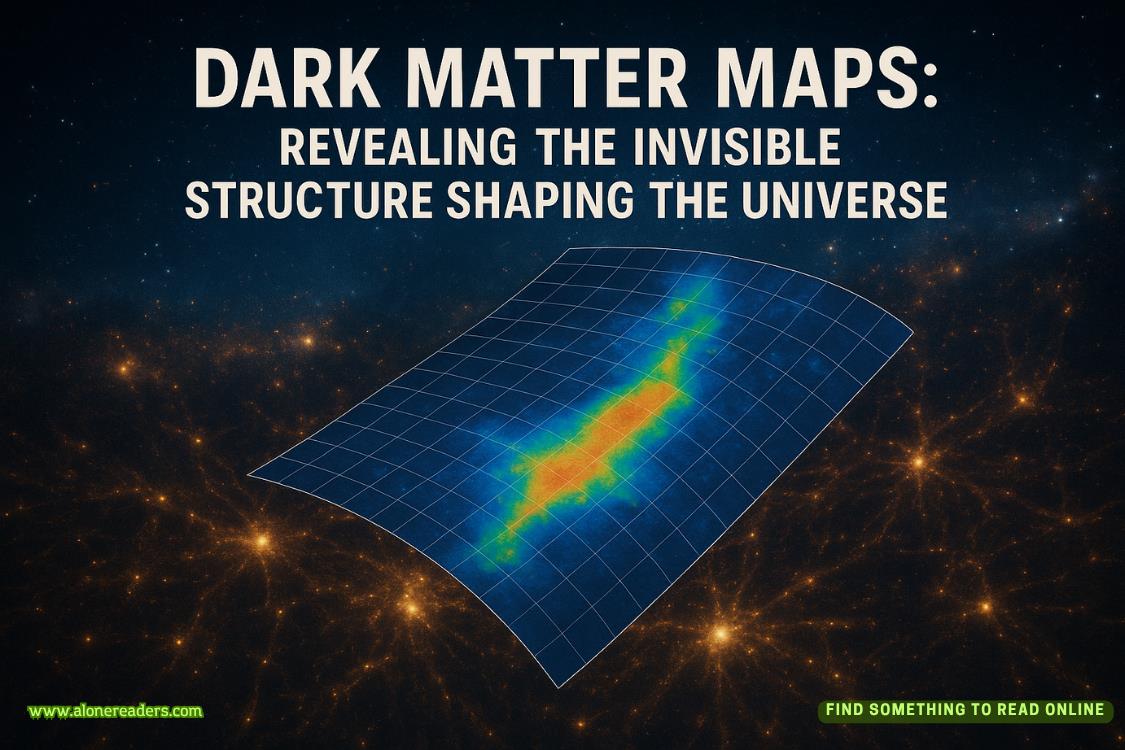
In the vast expanse of the cosmos, most of what exists cannot be seen. The stars, galaxies, and luminous gas that paint our telescopic images represent only about 5% of the total cosmic content. The remaining 95% is composed of dark energy and dark matter—mysterious entities that neither emit nor absorb light. Among these, dark matter acts as the scaffolding of the universe, an invisible framework that dictates where galaxies form and how the large-scale structure evolves. Understanding this elusive component has become one of the most profound quests in modern astrophysics. Through the creation of dark matter maps, scientists are now tracing the unseen skeleton of the cosmos with unprecedented precision.
Invisible yet influential
Dark matter does not interact with electromagnetic radiation, making it invisible across all wavelengths—from radio to gamma rays. Yet, its gravitational effects are unmistakable. It influences how galaxies rotate, how clusters of galaxies bind together, and how light bends as it travels through space.
Historical hints
The story of dark matter began in the 1930s, when Swiss astronomer Fritz Zwicky observed that galaxies in the Coma Cluster moved faster than visible mass could explain. Later, in the 1970s, Vera Rubin’s studies of galactic rotation curves confirmed that stars on the outskirts of galaxies were orbiting too quickly to be held by visible matter alone. Something unseen—dark matter—was adding gravitational weight.
Because dark matter does not emit light, mapping it requires indirect observation. Astrophysicists use several sophisticated techniques, the most powerful of which is gravitational lensing.
Gravitational lensing as a cosmic magnifier
According to Einstein’s theory of general relativity, massive objects warp spacetime, bending the path of light passing nearby. When light from distant galaxies travels through regions rich in dark matter, it is subtly distorted. By studying these distortions—known as weak gravitational lensing—scientists can infer how dark matter is distributed along the line of sight.
Statistical reconstruction
Mapping dark matter is not a direct process. Astronomers analyze millions of background galaxies, measuring tiny distortions in their shapes to reconstruct the mass distribution between the observer and the distant light sources. This statistical approach has been refined through massive surveys, such as the Dark Energy Survey (DES), the Hyper Suprime-Cam (HSC) Survey, and the Kilo-Degree Survey (KiDS).
The cosmic web revealed
The most striking result of dark matter mapping is the emergence of the “cosmic web.” On the largest scales, matter in the universe is not evenly distributed. Instead, it forms a vast network of filaments and nodes where dark matter is densest, with galaxies clustering along these invisible strands. The spaces between—cosmic voids—are relatively empty. These dark matter maps act as blueprints, revealing how the visible universe hangs upon this unseen structure.
Euclid and the future of precision mapping
With the 2023 launch of the European Space Agency’s Euclid mission and NASA’s Nancy Grace Roman Telescope (planned for later this decade), astronomers are entering a new era of high-resolution dark matter cartography. Euclid aims to observe billions of galaxies across a third of the sky, using weak lensing and galaxy clustering to build a 3D map of dark matter over time. This will not only trace its distribution but also help measure how it evolves, potentially unlocking insights into the nature of dark energy as well.
Cosmic microwave background (CMB) lensing
The oldest light in the universe—the cosmic microwave background—also serves as a canvas for mapping dark matter. Slight distortions in the CMB caused by intervening mass can be used to trace dark matter between us and the last scattering surface, roughly 380,000 years after the Big Bang. The Planck satellite and the Atacama Cosmology Telescope have both produced all-sky dark matter maps using this method.
Galaxy clustering and simulations
Another powerful approach is to compare large-scale galaxy surveys with cosmological simulations. Because galaxies form in regions of high dark matter density, their distribution offers indirect clues to dark matter’s structure. Modern simulations like IllustrisTNG and Millennium-XXL integrate gravitational physics and hydrodynamics to predict how dark matter halos form, merge, and shape galaxy evolution. Comparing these predictions with observational data refines our understanding of dark matter’s properties.
The skeleton of structure formation
Dark matter maps show that galaxies form preferentially along dark matter filaments, where density fluctuations in the early universe were greatest. These filaments guide the flow of baryonic matter—ordinary matter—into dense nodes where galaxies and clusters eventually form. Without dark matter’s gravitational influence, the universe would lack the structure we see today; stars and galaxies might never have formed at all.
Void regions and cosmic balance
Equally fascinating are the cosmic voids—vast, dark matter-poor regions stretching tens of millions of light-years. Studying these voids helps researchers understand how cosmic expansion and dark energy operate in low-density environments. They also serve as sensitive probes of modified gravity theories that could explain cosmic acceleration without invoking dark energy.
Shape noise and measurement limits
Gravitational lensing relies on measuring incredibly small distortions—often less than one percent—in galaxy shapes. Atmospheric interference, telescope optics, and intrinsic galaxy alignments introduce noise that complicates the analysis. Sophisticated statistical models and machine learning techniques are now used to isolate genuine lensing signals from systematic errors.
Cosmic variance and survey limitations
Even with large surveys, coverage is finite. Cosmic variance—the statistical uncertainty from observing only one universe—means that results may differ slightly depending on which region of the sky is studied. Upcoming missions with larger sky coverage aim to mitigate this by sampling a greater fraction of the cosmos.
The unknown particle nature
Mapping dark matter distribution tells us where it is, but not what it is. Whether it is composed of weakly interacting massive particles (WIMPs), axions, sterile neutrinos, or something yet undiscovered remains one of physics’ most profound mysteries. Laboratory searches and collider experiments complement cosmic mapping by hunting for direct evidence of these particles.
Modern dark matter research combines data across multiple scales and wavelengths. From galaxy cluster lensing to cosmic microwave background distortions, each probe contributes a piece of the puzzle. Supercomputing facilities now allow the integration of these datasets into coherent 3D reconstructions of the universe’s dark scaffolding. This approach not only clarifies how dark matter shapes the visible cosmos but also provides constraints on fundamental physics parameters such as neutrino masses and the curvature of space.
Haloes as cosmic cradles
Every galaxy is enveloped in a dark matter halo—an extended region of gravitational influence that far exceeds the luminous disk. These halos merge over time, pulling gas and dust into their centers, where stars and black holes form. Mapping their growth provides clues to galaxy assembly histories and the role of feedback from supernovae and quasars.
Cluster collisions and cosmic laboratories
Events like the Bullet Cluster collision have become key observational laboratories for dark matter physics. By comparing the distribution of visible matter (hot gas observed in X-rays) with dark matter (inferred from lensing), astronomers have shown that dark matter does not strongly interact with itself—suggesting it is “collisionless.” This finding rules out many alternative gravity theories and supports the particle nature of dark matter.
Dark matter mapping is entering a dynamic phase. Upcoming instruments will not just capture static snapshots but chronicle how the cosmic web evolves over billions of years. Time-domain cosmology, powered by observatories like the Vera Rubin Observatory’s Legacy Survey of Space and Time (LSST), will observe the same regions repeatedly to detect changes in gravitational lensing signals and cosmic structure growth.
Combining this with spectroscopic data will yield 4D maps—three spatial dimensions plus time—showing how dark matter concentrations evolve, merge, and dissipate. This time evolution is key to understanding not only the universe’s geometry but also the physics driving its accelerated expansion.
Dark matter maps have transformed cosmology from a field of speculation to one of detailed structure tracing. They reveal that the visible universe—galaxies, stars, and nebulae—is only the glowing embroidery on a vast, invisible framework. As technology advances and surveys expand, these maps will continue to sharpen, offering clues to both cosmic origins and the ultimate fate of the universe.
The quest to chart the unseen has become a testament to human ingenuity—a pursuit that transcends light itself. Through these dark matter maps, we are not merely observing the cosmos; we are decoding its very architecture, tracing the silent threads that hold existence together.



 Château de Vincennes: France’s Forgotten Royal Fortress and Medieval Stronghold
 Château de Carcassonne: Europe’s Greatest Medieval Citadel and Fortress
 Château de Chenonceau: The Castle Built by Remarkable Women
 Château de Chambord: France’s Magnificent Renaissance Castle and Architectural Wonder
 Tehri Dam: India's Tallest Dam and the Debate Behind It
 Bhakra Nangal Dam: India's Temple of Modern Development