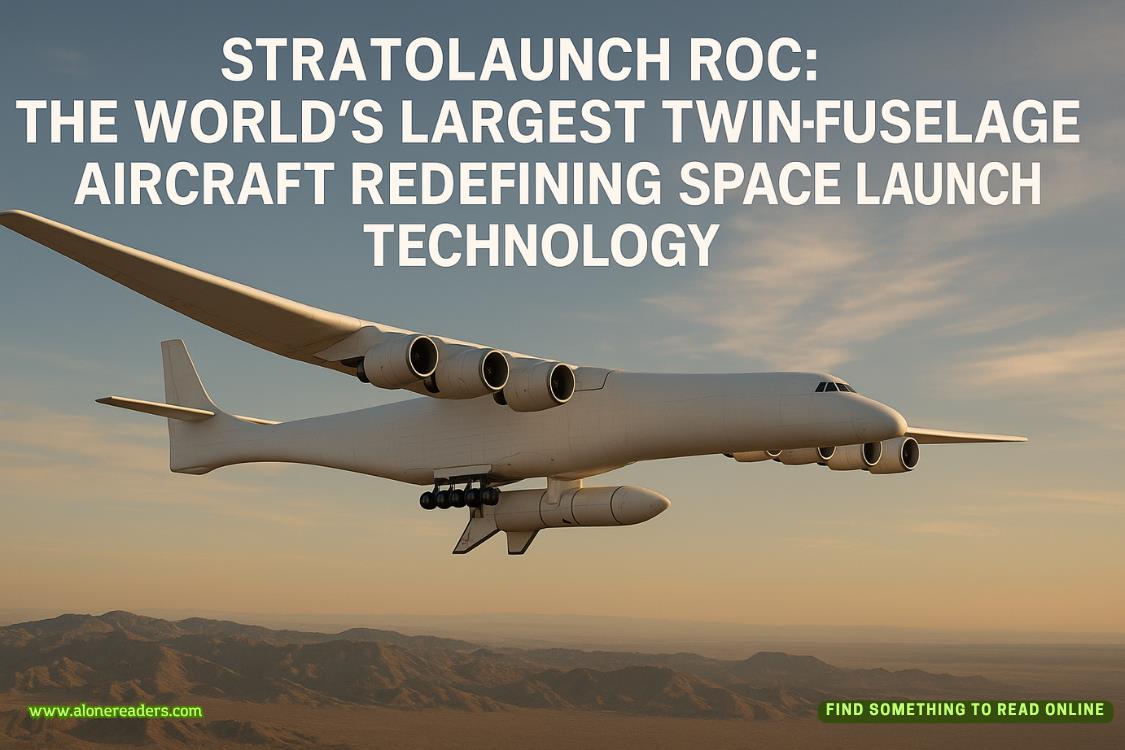
The Stratolaunch Roc represents one of the most ambitious aerospace engineering projects of the 21st century—a colossal aircraft designed to launch rockets from the sky rather than the ground. Conceived as part of a bold vision to revolutionize access to space, Roc is unlike any other airplane ever built. With its distinctive twin-fuselage design and record-breaking wingspan, it bridges aviation and rocketry in a way that pushes the limits of physics, design, and human ingenuity.
At first glance, Roc looks more like a mechanical behemoth from a science fiction movie than a conventional airplane. Measuring 385 feet (117 meters) from wingtip to wingtip, it holds the record for the world’s largest wingspan of any aircraft ever flown, surpassing even the Hughes H-4 Hercules “Spruce Goose.” It stands 50 feet tall and weighs approximately 500,000 pounds empty, capable of carrying payloads exceeding 500,000 pounds when fully loaded. The aircraft is powered by six Pratt & Whitney PW4056 engines—commercial jet engines also used in Boeing 747s—which together provide the immense thrust necessary to lift such a massive machine off the ground.
Stratolaunch was founded in 2011 by Paul Allen, the co-founder of Microsoft, who envisioned creating a reusable, flexible launch platform that could carry rockets to high altitudes and release them above most of Earth’s atmosphere. This approach was intended to make launching satellites more efficient, less weather-dependent, and significantly cheaper than traditional ground-based rocket launches. The idea was both simple and revolutionary: by launching rockets from an aircraft already flying at around 35,000 feet, the rocket could skip the densest parts of the atmosphere, saving fuel and cost.
The twin-fuselage structure is one of the Roc’s defining features, giving it the appearance of two aircraft joined by a single massive wing. Each fuselage contains its own cockpit, with the right one serving as the active pilot station while the left remains unoccupied during flight. Between the fuselages, the aircraft’s central wing section serves as the rocket-mounting platform—a strong, reinforced truss capable of carrying rockets or hypersonic test vehicles under the wing. This central position ensures that payloads remain balanced during flight and can be cleanly released for rocket ignition once the aircraft reaches its designated launch altitude.
Roc’s enormous wings are constructed from advanced composite materials—lightweight yet strong enough to withstand the aerodynamic forces of flight and the stresses of carrying heavy payloads. The aircraft uses 28 wheels on its landing gear, distributing its immense weight evenly across the runway surface. Its control surfaces are massive, too, with ailerons, elevators, and rudders sized to maintain stability and maneuverability at low speeds, given that the aircraft’s cruise speed is around 530 miles per hour.
The first flight of Stratolaunch Roc took place on April 13, 2019, over the Mojave Air and Space Port in California. Pilots reported that the aircraft performed flawlessly, reaching an altitude of 17,000 feet and a speed of 189 miles per hour. This marked a historic moment in aerospace history—not only because of Roc’s size but also because it demonstrated the feasibility of using a twin-fuselage, air-launch system for large-scale space operations. Since then, the aircraft has undergone a series of test flights and engineering validations to prepare it for operational use.
After Paul Allen’s death in 2018, Stratolaunch faced uncertainty about its future. The company paused operations temporarily, and its original vision of launching orbital rockets was reconsidered. However, in 2019, the company was acquired by Cerberus Capital Management, which revived the program with a new focus on hypersonic research and testing. The Roc aircraft was repurposed to serve as a reusable launch platform for hypersonic vehicles—aircraft capable of flying at speeds above Mach 5, five times the speed of sound.
Under its new direction, Stratolaunch shifted from commercial satellite launches to national defense and research applications. Its primary mission now involves carrying and launching the Talon-A, a reusable hypersonic test vehicle developed by Stratolaunch itself. The Talon-A is designed to detach from Roc at high altitude, ignite its rocket engine, and achieve speeds up to Mach 6, gathering critical aerodynamic and thermal data before gliding back for recovery and reuse. This shift placed Stratolaunch at the forefront of hypersonic technology, an area of immense strategic importance to the United States military and aerospace industry.
Roc’s hypersonic testing capability represents a major advancement for defense research and commercial aerospace. Traditionally, hypersonic testing has relied on expensive, limited-use rockets or specialized wind tunnels that can only simulate short bursts of hypersonic conditions. By launching vehicles like Talon-A from Roc, researchers can conduct longer, more realistic flight tests at a fraction of the cost, accelerating development cycles and reducing risk. This flexibility also allows Stratolaunch to serve as a commercial service provider to government agencies, research institutions, and private aerospace firms seeking access to high-speed testing environments.
In 2023, Stratolaunch achieved another milestone by completing a successful captive-carry flight with the Talon-A test vehicle attached beneath Roc’s wing. Later, in 2024, Stratolaunch completed a separation test—demonstrating that Roc could safely release Talon-A mid-flight, paving the way for powered hypersonic missions. These flights validated the complex mechanical systems responsible for mounting, releasing, and tracking hypersonic vehicles—key steps toward full operational capability.
Technically, Roc’s avionics and flight systems are state-of-the-art, integrating advanced fly-by-wire controls and redundant safety systems to manage its unique twin-body configuration. Each fuselage has its own independent hydraulic, electrical, and fuel systems, allowing one side to back up the other in case of malfunction. The centralized wing structure houses the fuel tanks and control cabling that synchronize the two fuselages during flight. Communication and telemetry systems allow the onboard crew to monitor vehicle parameters in real time, particularly during hypersonic launch sequences.
Beyond its technical capabilities, Stratolaunch Roc is a symbol of a new era in aerospace innovation. The concept of air-launch platforms dates back decades, but Roc’s scale and purpose represent a paradigm shift in how engineers think about launching payloads into space and testing new flight technologies. By bringing launch operations into the air, it bypasses many of the logistical constraints of ground-based launches, such as limited launch windows, weather delays, and costly infrastructure. Roc can take off from any suitably long runway, fly to optimal launch points, and deliver its payloads into desired trajectories—all while maintaining a high degree of reusability and operational flexibility.
Moreover, Roc embodies a modular philosophy. Future configurations could enable it to carry different payload types beyond hypersonic vehicles—potentially including air-launched satellites, reusable rocket boosters, or even high-altitude research equipment. This adaptability means Stratolaunch’s platform could evolve alongside the aerospace industry’s changing priorities, offering scalable access to near-space and orbital regimes.
From a design standpoint, Roc also pushes the boundaries of what’s possible in composite manufacturing and structural engineering. Its 385-foot wingspan was assembled in sections within enormous hangars at the Mojave Air and Space Port, requiring precision alignment techniques to ensure aerodynamic balance. Each joint, truss, and panel was meticulously designed to withstand both aerodynamic stress and the torque induced by asymmetric loads—a challenge unique to twin-fuselage aircraft.
Today, Stratolaunch continues to refine its flight and testing program, with plans to expand its hypersonic testing services to include multiple Talon-A vehicles flying within short intervals. This operational tempo aims to create a sustained cadence of hypersonic research, offering clients rapid iteration cycles similar to what SpaceX achieved with reusable rocketry. In this way, Stratolaunch could become the hypersonic equivalent of a commercial spaceport in the sky.
In essence, the Stratolaunch Roc is far more than just the world’s largest airplane—it is a technological bridge between aviation and spaceflight, a tool for unlocking faster, cheaper, and more flexible access to near-space environments. It embodies the spirit of exploration that has always driven aerospace progress: to go higher, faster, and further than before. Even after Paul Allen’s passing, his vision lives on through Roc, soaring across the desert skies of Mojave—a testament to human ambition and the relentless pursuit of the future of flight.



 Château de Vincennes: France’s Forgotten Royal Fortress and Medieval Stronghold
 Château de Carcassonne: Europe’s Greatest Medieval Citadel and Fortress
 Château de Chenonceau: The Castle Built by Remarkable Women
 Château de Chambord: France’s Magnificent Renaissance Castle and Architectural Wonder
 Tehri Dam: India's Tallest Dam and the Debate Behind It
 Bhakra Nangal Dam: India's Temple of Modern Development