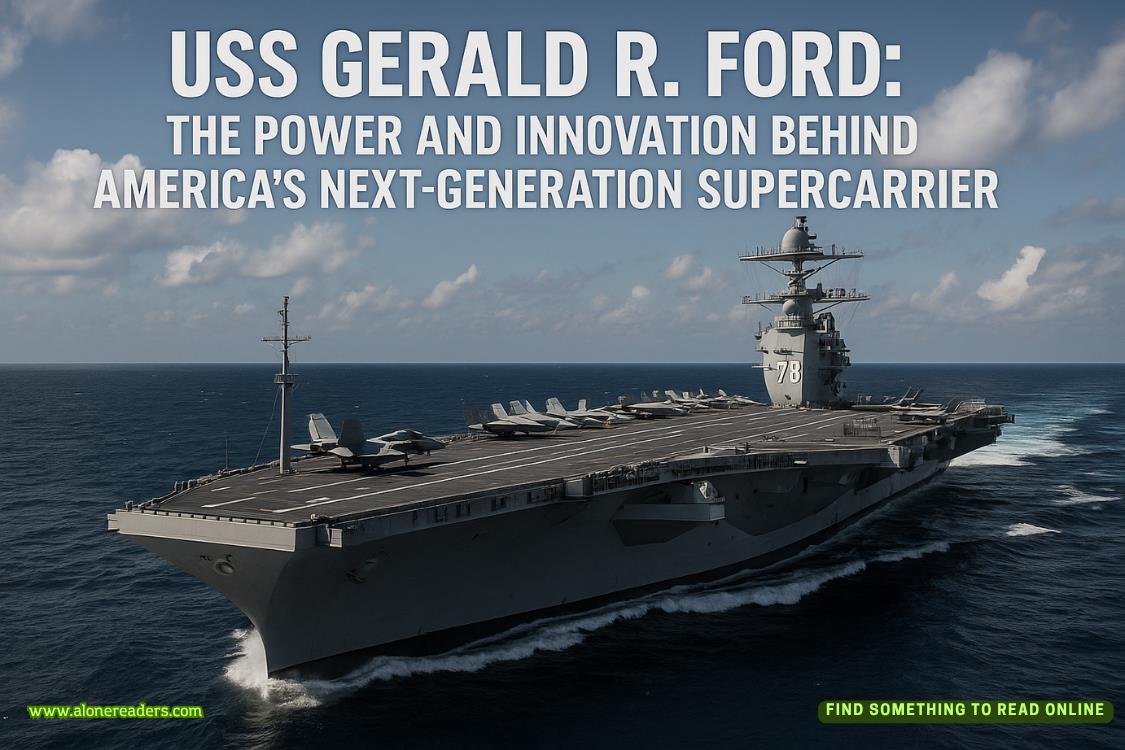
The USS Gerald R. Ford (CVN-78) represents the pinnacle of American naval engineering—a vessel that redefines what a modern aircraft carrier can be. As the lead ship of the Ford-class carriers, it is the first new U.S. carrier design in over four decades, built to serve well into the mid-21st century. Commissioned in 2017 and named after the 38th President of the United States, the Gerald R. Ford is more than a floating airbase—it is a symbol of technological evolution, operational efficiency, and strategic dominance on the world’s oceans.
At over 1,092 feet in length and displacing about 100,000 tons, the Gerald R. Ford shares the massive dimensions of the earlier Nimitz-class carriers but differs profoundly in its internal systems and capabilities. Designed for efficiency and power, it integrates over 23 new or significantly modified technologies, making it the most sophisticated warship ever constructed. It carries a complement of around 2,600 sailors—about 600 fewer than its predecessors—thanks to extensive automation and smarter systems. The ship’s design philosophy centers on reduced crew workload, lower lifetime operating costs, and greater sortie generation, enabling it to project force faster and more effectively than any previous carrier.
At the heart of the Gerald R. Ford’s technological revolution lies its propulsion system. The ship is powered by two Bechtel A1B nuclear reactors, each capable of producing 700 megawatts of thermal energy—three times the output of the Nimitz-class A4W reactors. This immense power not only drives the ship but also supports the carrier’s advanced energy-hungry systems, such as electromagnetic catapults and directed-energy weapons planned for the future. These reactors are designed to last for 50 years without refueling, ensuring continuous service and strategic mobility across the globe.
Perhaps the most talked-about innovation on the Gerald R. Ford is the Electromagnetic Aircraft Launch System (EMALS). Replacing the traditional steam catapults used for decades, EMALS uses linear induction motors powered by electromagnetic energy to launch aircraft. This system provides smoother acceleration, reducing stress on both aircraft and pilots, and allows for a wider range of aircraft types to be launched—from heavy fighters like the F/A-18 Super Hornet to lighter unmanned aerial vehicles. EMALS also significantly enhances sortie generation, meaning more aircraft can take off in shorter periods—a crucial advantage in combat operations.
Complementing EMALS is the Advanced Arresting Gear (AAG), which safely recovers incoming aircraft. Instead of relying on traditional hydraulic systems, the AAG uses energy-absorbing water turbines and electromagnetic motors for greater control and reliability. Together, EMALS and AAG redefine carrier aviation operations by reducing maintenance, improving safety, and increasing the carrier’s operational tempo. These systems mark a transformative shift toward an all-electric flight deck, minimizing mechanical complexity while boosting precision and responsiveness.
The Gerald R. Ford’s island structure—the command and control tower on the flight deck—has been completely redesigned. Positioned further aft and slightly taller, the island offers improved visibility for flight operations while freeing up valuable deck space for aircraft movement. Its internal arrangement integrates advanced radar and communication systems, including the Dual Band Radar (DBR), which combines two frequencies to provide simultaneous air and surface search capabilities. The DBR allows the ship to detect, track, and engage threats with unprecedented accuracy while streamlining radar maintenance and reducing the number of operators required.
Flight deck operations on the Gerald R. Ford have also been reimagined to improve efficiency. The ship features larger and more powerful aircraft elevators capable of handling heavier payloads, and their placement has been optimized to minimize aircraft taxiing time. With three advanced weapons elevators powered magnetically rather than hydraulically, ordnance can be transferred from magazines deep within the ship to the flight deck faster and more safely. This innovation contributes to the Ford-class’s ability to generate 25 percent more sorties per day than a Nimitz-class carrier—a crucial advantage during high-intensity operations.
Crew comfort and survivability were also major design priorities. The Gerald R. Ford offers improved living quarters, better noise insulation, and more modern facilities for sailors compared to older carriers. Automation in maintenance, fueling, and logistics systems has reduced manual labor, allowing sailors to focus on higher-value tasks. In addition, the carrier’s internal layout emphasizes compartmentalization and redundancy, ensuring resilience against damage from combat or accidents. The integration of advanced fire suppression, flood control, and monitoring systems enhances both safety and readiness.
Strategically, the Gerald R. Ford represents a cornerstone of U.S. naval power projection. Its air wing is expected to include around 75 aircraft, comprising F/A-18 Super Hornets, F-35C Lightning IIs, EA-18G Growlers, E-2D Hawkeyes, and MH-60 helicopters, with the capacity to adapt for future unmanned aerial systems. These aircraft enable the carrier to conduct a full spectrum of missions—air superiority, strike warfare, electronic attack, intelligence, surveillance, reconnaissance, and search and rescue. As part of a Carrier Strike Group, the Gerald R. Ford can operate anywhere in the world, supported by cruisers, destroyers, and submarines, forming the backbone of American maritime dominance.
Operational testing of the Gerald R. Ford has been extensive and challenging. Early sea trials and “shock trials”—controlled underwater explosions to test the ship’s resilience—revealed areas for improvement, particularly with new systems like EMALS and AAG. Over time, engineering refinements and software updates have addressed most of these issues, and the ship has since achieved full deployment readiness. Its first operational deployment in 2023 demonstrated its ability to integrate seamlessly with NATO allies, conduct complex air operations, and sustain prolonged missions, validating its design and capability.
From a cost perspective, the Gerald R. Ford has been one of the most expensive warships ever built, with an estimated price tag exceeding $13 billion. However, the Navy argues that its long-term efficiencies—such as lower crew requirements, reduced maintenance, and higher sortie rates—will yield significant savings over its 50-year lifespan. Moreover, the lessons learned from building the Gerald R. Ford are being applied directly to future Ford-class carriers like the John F. Kennedy (CVN-79), Enterprise (CVN-80), and Doris Miller (CVN-81), ensuring improved cost control and faster construction timelines.
Beyond its material features, the Gerald R. Ford embodies the Navy’s strategic vision for the future. In an era of evolving threats—from hypersonic missiles to cyber warfare—the ship’s design emphasizes adaptability and power capacity for future upgrades. Its massive electrical output and modular systems can support next-generation weapons such as laser-based defenses and advanced sensors, keeping it relevant in an unpredictable security landscape. The carrier’s integration with advanced data networks and AI-assisted logistics further aligns it with the Navy’s push toward a more connected, technology-driven fleet.
Symbolically, the Gerald R. Ford also carries the legacy of President Gerald R. Ford, who served in the Navy during World War II. The ship’s motto, “Integrity at the Helm,” reflects both his leadership and the crew’s commitment to excellence. Every deployment of this carrier underscores America’s enduring commitment to maintaining freedom of navigation, deterrence, and rapid response across global theaters.
In the final analysis, the USS Gerald R. Ford stands as a triumph of engineering and ambition. It is not merely an evolution of the aircraft carrier—it is a redefinition of what maritime power can achieve in the modern age. From its electromagnetic launch systems to its nuclear propulsion and digital command centers, every component of this vessel signals a future where efficiency, precision, and adaptability are the benchmarks of naval superiority. The Gerald R. Ford is more than a warship—it is the floating embodiment of American innovation and resolve, designed to dominate the seas for generations to come.



 Château de Vincennes: France’s Forgotten Royal Fortress and Medieval Stronghold
 Château de Carcassonne: Europe’s Greatest Medieval Citadel and Fortress
 Château de Chenonceau: The Castle Built by Remarkable Women
 Château de Chambord: France’s Magnificent Renaissance Castle and Architectural Wonder
 Tehri Dam: India's Tallest Dam and the Debate Behind It
 Bhakra Nangal Dam: India's Temple of Modern Development










