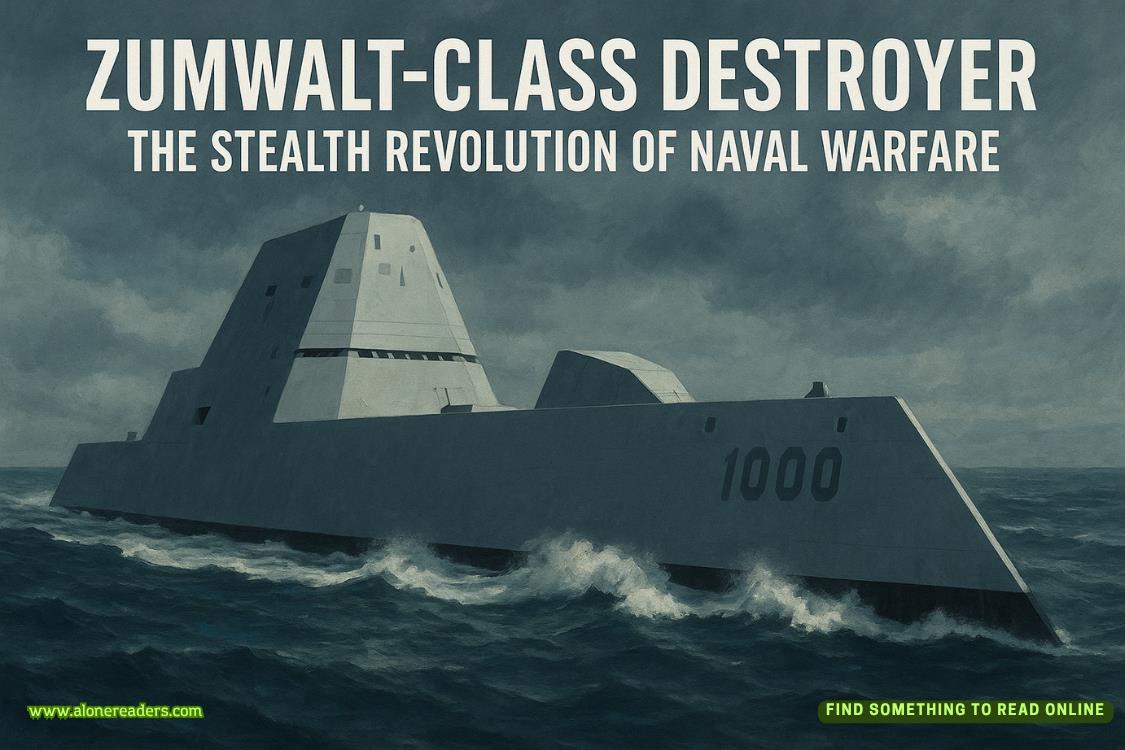
The Zumwalt-class destroyer stands as one of the most ambitious and futuristic warships ever conceived by the United States Navy. Designed to embody stealth, power, and multi-mission capability, it redefined the concept of surface warfare at sea. Officially designated as DDG-1000, the Zumwalt-class represents the Navy’s effort to push the boundaries of maritime engineering—melding advanced radar-evading technology, integrated weapon systems, and digital automation into a single, cohesive vessel. While its development has been marked by cost overruns and changing military priorities, the ship remains a symbol of what naval warfare could look like in the twenty-first century.
The vision for the Zumwalt-class began in the 1990s, during the end of the Cold War era. The U.S. Navy sought a next-generation surface combatant that could dominate both in coastal and open-ocean environments. The objective was not merely to build another destroyer, but to create a platform that could operate undetected, strike with precision, and serve as a flexible backbone for future naval missions. The design that emerged was unlike any warship before it—a sleek, angular vessel that looked more like a vessel from science fiction than a traditional destroyer. Named after Admiral Elmo Zumwalt, a reform-minded Chief of Naval Operations known for his innovative leadership, the DDG-1000 was envisioned as a ship that would embody the same spirit of transformation he brought to the Navy.
The Zumwalt-class destroyer’s most striking feature is its stealth capability, achieved through an unconventional hull shape known as the “tumblehome” design. Unlike conventional destroyers that have outward-sloping sides, the Zumwalt’s hull angles inward above the waterline. This geometry dramatically reduces its radar cross-section, making it appear on enemy radars as a much smaller vessel—comparable to a fishing boat or small patrol craft. The ship’s superstructure is enclosed and smooth, with radar and communication arrays embedded within composite materials that minimize radar reflection. Every aspect of the ship’s design—from the exhaust outlets to the deck railings—was engineered to avoid giving away its position. Even the ship’s anchor and lifeboats are hidden behind panels that retract when needed, ensuring that no protruding elements compromise its radar invisibility.
Powering the Zumwalt is another leap forward in naval engineering: an Integrated Power System (IPS) that generates a massive 78 megawatts of electricity. This all-electric propulsion system can allocate power dynamically between propulsion, sensors, and weapons. It not only drives the ship but also provides a foundation for future weapon systems that demand enormous electrical output, such as railguns and high-energy lasers. In essence, the Zumwalt is a floating power plant capable of supporting technologies that traditional destroyers could never accommodate. Its electric drive system also contributes to stealth by reducing the ship’s acoustic signature, making it quieter and harder to detect by sonar.
Automation is another hallmark of the Zumwalt-class design. The ship operates with a crew of only about 140 sailors—half the complement of an Arleigh Burke-class destroyer. This reduction is made possible through extensive use of computer-controlled systems for navigation, damage control, and weapons management. The crew quarters and bridge are designed with ergonomic efficiency in mind, while the internal systems are monitored by advanced AI-assisted diagnostics that alert the crew to potential malfunctions before they become critical. This level of digital integration was unprecedented in a warship of its size and complexity, marking a fundamental shift toward what some naval analysts describe as a “smart ship.”
When it comes to armament, the Zumwalt was initially envisioned as a land-attack platform capable of supporting amphibious operations. Its centerpiece weapon system was the Advanced Gun System (AGS), a pair of 155mm naval guns designed to fire Long Range Land Attack Projectiles (LRLAP) over distances of up to 100 miles with pinpoint accuracy. However, the program faced a major setback when the cost of each LRLAP round ballooned to nearly $800,000, leading to the cancellation of the ammunition’s production. Without its primary ammunition, the AGS became largely obsolete, and the Navy began re-evaluating the Zumwalt’s mission profile. As a result, the class is being reconfigured to carry hypersonic missiles, transforming it into a long-range strike platform capable of projecting power deep into contested regions.
In addition to the AGS, the Zumwalt is equipped with 80 advanced Vertical Launch System (VLS) cells distributed along the periphery of the hull, each capable of housing a variety of missiles including Tomahawk cruise missiles, SM-series surface-to-air interceptors, and ASROC anti-submarine weapons. The ship also carries advanced radar and sonar systems, including the AN/SPY-3 multifunction radar, optimized for low-altitude tracking and precision targeting. Combined, these systems make the Zumwalt not only a stealthy vessel but also a formidable multi-role combatant that can adapt to diverse mission profiles—from surface warfare and anti-air defense to deep-strike missions and sea control.
The construction of the Zumwalt-class destroyers took place at Bath Iron Works in Maine, one of the most storied shipyards in American naval history. The first ship, USS Zumwalt (DDG-1000), was commissioned in 2016, followed by USS Michael Monsoor (DDG-1001) and USS Lyndon B. Johnson (DDG-1002). Initially, the Navy planned to build 32 of these destroyers, but escalating costs—each ship exceeding $4 billion—led to a drastic reduction in the program. Ultimately, only three vessels were completed, making the Zumwalt-class one of the most expensive warship programs ever undertaken. Critics argued that the limited fleet size undermined the class’s intended impact, while proponents countered that the technological lessons learned would inform future ship designs for decades to come.
Despite its challenges, the Zumwalt-class represents a significant technological leap in naval architecture and warfare design. Its stealth, automation, and power systems set new benchmarks for what a surface combatant could achieve. Moreover, its ongoing transformation into a hypersonic strike platform illustrates the adaptability of its core design. The Navy plans to retrofit the Zumwalt-class with the Conventional Prompt Strike (CPS) weapon system—a hypersonic missile capable of traveling at speeds exceeding Mach 5 and hitting targets over 1,700 miles away. This would give the U.S. Navy an unparalleled ability to deliver rapid precision strikes from stealthy, sea-based platforms, extending American military reach far beyond traditional carrier strike groups.
Operationally, the Zumwalt-class has also served as a testbed for next-generation naval concepts. Its data integration and cybersecurity systems provide a blueprint for future ships designed to operate in networked battle environments. The destroyer’s ability to silently approach coastlines, relay intelligence, and strike before detection aligns perfectly with modern doctrines emphasizing distributed lethality and electronic warfare dominance. Even as only three Zumwalts sail the seas, their role in shaping the Navy’s transition toward more flexible, stealth-driven fleets is undeniable.
In the end, the Zumwalt-class destroyer is both a triumph and a cautionary tale. It demonstrates the remarkable potential of advanced engineering and visionary design, while also underscoring the risks of pushing technology to its limits without a clear strategic foundation. Its silhouette—a faceted, ghostlike presence on the horizon—symbolizes the future of naval warfare: quiet, intelligent, and unseen. Whether as a weapon of deterrence, a platform for innovation, or a monument to ambition, the Zumwalt-class will continue to capture the imagination of military strategists and engineers alike for generations to come.



 Château de Vincennes: France’s Forgotten Royal Fortress and Medieval Stronghold
 Château de Carcassonne: Europe’s Greatest Medieval Citadel and Fortress
 Château de Chenonceau: The Castle Built by Remarkable Women
 Château de Chambord: France’s Magnificent Renaissance Castle and Architectural Wonder
 Tehri Dam: India's Tallest Dam and the Debate Behind It
 Bhakra Nangal Dam: India's Temple of Modern Development










