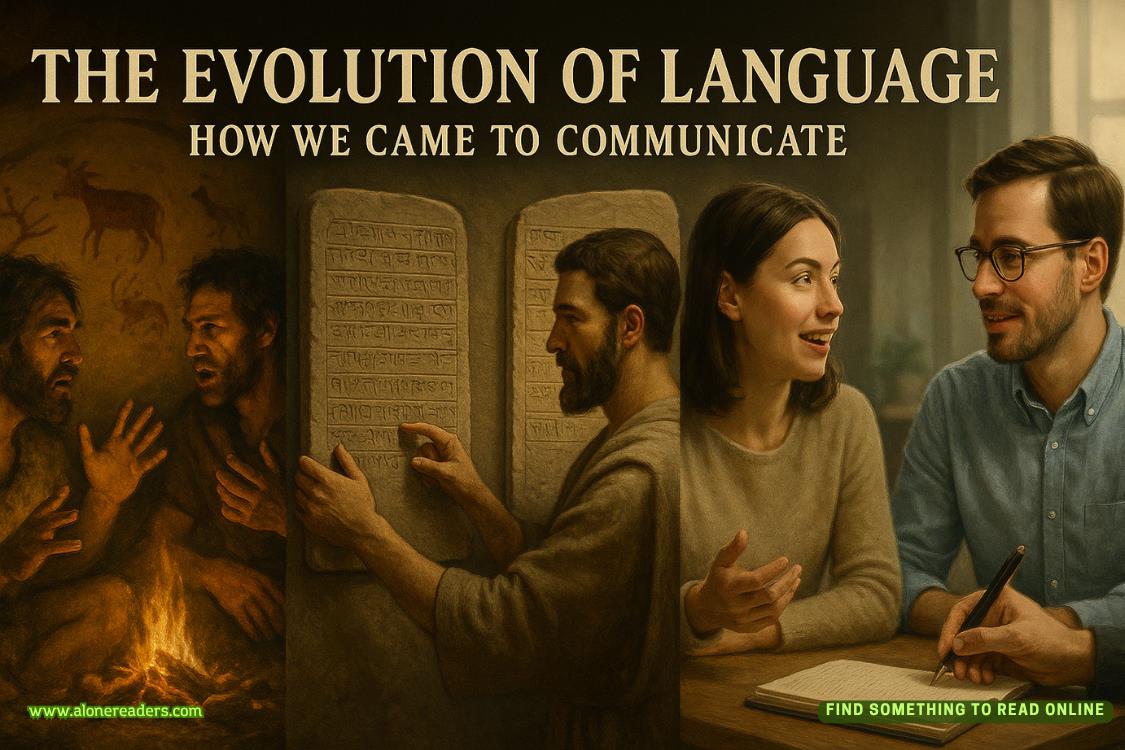
Language is the defining feature of human civilization. It is not merely a tool for expression but the foundation of thought, culture, and identity. The ability to communicate abstract ideas, share emotions, and transmit knowledge across generations is what propelled humankind from primitive survival to complex social structures. Yet, the question of how language emerged—how humans first began to speak, gesture, and reason through words—remains one of the most fascinating mysteries in anthropology, linguistics, and cognitive science.
The story of language begins long before the first words were spoken. Early hominins, the ancestors of modern humans, already exhibited the seeds of communication in their social behavior. Vocalizations, facial expressions, and body movements served as the earliest forms of signaling danger, dominance, or affection. These proto-linguistic gestures were essential for survival in groups, helping individuals coordinate hunts, care for offspring, and navigate social hierarchies. Over time, these instinctive signals evolved into structured patterns of communication as brain complexity and social needs increased.
The roots in gesture and sound
Before speech, gesture was likely the dominant mode of communication. Studies of modern primates suggest that hand movements and facial expressions are more flexible and intentional than their vocal calls. Early humans may have used hand signs to convey specific meanings, particularly when hunting or maintaining silence. This gestural system would eventually merge with vocal sounds as our ancestors developed greater control over breathing and vocalization. The transition from gesture to speech marks a pivotal shift in human evolution—the moment when communication became detached from immediate physical expression and entered the realm of abstraction.
Anatomical evolution and the birth of speech
The evolution of language is closely tied to changes in human anatomy. The lowering of the larynx, the reshaping of the vocal tract, and the fine motor control of the tongue and lips were biological innovations that allowed a vast range of sounds to be produced. The brain, too, underwent dramatic changes. The expansion of Broca’s area and Wernicke’s area—regions responsible for speech production and comprehension—suggests that communication was not just a physical adaptation but also a cognitive revolution. These neural developments enabled early humans to form words, remember complex sound patterns, and combine them into structured expressions—what we now recognize as syntax and grammar.
From imitation to invention
Language did not appear suddenly but evolved gradually as humans began associating sounds with objects and actions. The earliest words may have been imitative, echoing natural sounds like the calls of animals or environmental noises—the “bow-wow theory” of linguistic origins. Others may have emerged from spontaneous emotional exclamations—the “pooh-pooh theory.” Over generations, these sounds became standardized within communities, forming the first vocabularies. With the development of shared symbols, humans could refer not only to tangible things but also to abstract ideas, emotions, and future events. This ability to name and describe transformed human cognition itself, giving rise to storytelling, teaching, and the transmission of collective knowledge.
Social evolution and the rise of grammar
Once humans began living in larger groups, language became essential for maintaining social cohesion. Simple naming systems were no longer enough; communication required more complex structures to express relationships, intentions, and hierarchies. Grammar emerged as a natural response to this need. Word order, verb conjugations, and tenses allowed for precise description of actions and actors, enabling people to coordinate tasks and negotiate cooperation. The structure of language mirrored the structure of society—hierarchical, organized, and rule-governed. As linguistic complexity increased, so did the capacity for abstract thought, leading to the birth of myths, laws, and philosophy.
Language as a mirror of the mind
Language does more than reflect thought; it shapes it. Different linguistic systems emphasize different aspects of experience. For example, languages that lack tense markers may perceive time less rigidly, while those with numerous words for color or spatial orientation perceive the world differently. This phenomenon, known as linguistic relativity, suggests that the evolution of language also guided the evolution of consciousness. The human ability to conceptualize the future, imagine hypotheticals, and reason symbolically depends heavily on the scaffolding of language.
The diversification of languages
As human populations migrated and settled across continents, languages diversified. Isolation led to the development of unique linguistic systems, each shaped by environment, culture, and social organization. The click consonants of Khoisan speakers in Africa, the tonal variations in Chinese, and the agglutinative structure of Turkish or Finnish represent distinct evolutionary solutions to the same communicative challenge. These differences illustrate how flexible and adaptive human language is, capable of infinite variation yet rooted in shared cognitive foundations. Over time, linguistic families emerged—Indo-European, Afro-Asiatic, Sino-Tibetan—each branching into hundreds of dialects and languages that continue to evolve today.
The invention of writing
The next monumental leap in linguistic evolution was the invention of writing. Around 3200 BCE, Sumerians in Mesopotamia began recording information with cuneiform symbols on clay tablets. Soon after, Egyptian hieroglyphs and Chinese logograms appeared, turning spoken language into a visual medium. Writing freed communication from the limits of memory and speech, enabling knowledge to persist beyond the lifespan of individuals. It gave rise to bureaucracy, literature, and recorded history—transforming language into the backbone of civilization. Alphabets like the Phoenician and Greek scripts further democratized writing, allowing complex ideas to be transmitted more efficiently. Through written language, humans could reflect, critique, and build upon their own ideas across generations.
Language, power, and identity
As societies grew, language became a tool of power. Ruling classes used language to unify empires or to differentiate themselves from conquered peoples. Religious texts, legal codes, and educational systems were crafted in dominant languages, often suppressing minority tongues. Yet language also became a means of resistance and cultural identity. Throughout history, linguistic preservation has symbolized survival—whether it be the revival of Hebrew in the modern state of Israel or the protection of Indigenous languages worldwide. Language thus embodies both political authority and personal belonging, carrying the emotional and cultural DNA of its speakers.
The digital age and linguistic transformation
In the modern era, technology is reshaping how humans communicate. The rise of digital media, social networks, and artificial intelligence has created new forms of expression and altered linguistic norms. Emoji, abbreviations, and memes represent a return to symbolic, hybrid communication—where text, image, and emotion merge. At the same time, translation software and global connectivity are blurring linguistic boundaries, allowing people to communicate across languages instantly. While some fear this leads to linguistic homogenization, others see it as the next phase of evolution: a collective, adaptive, and hybrid global language shaped by technology.
The future of human communication
As artificial intelligence begins to interpret, generate, and even predict human language, the boundary between human and machine communication is fading. Yet, at its core, language remains profoundly human. It reflects not just information but intention, emotion, and creativity—qualities that define consciousness itself. The story of language is the story of humanity’s quest to understand and connect with one another. From the first gestures by firelight to digital conversations across continents, every word spoken is a thread in the tapestry of human evolution.
Language is not static; it lives, changes, and grows with us. It carries our past, defines our present, and shapes our future. In understanding how we came to communicate, we glimpse the very essence of what it means to be human—a species bound together by the invisible architecture of words.



 Château de Vincennes: France’s Forgotten Royal Fortress and Medieval Stronghold
 Château de Carcassonne: Europe’s Greatest Medieval Citadel and Fortress
 Château de Chenonceau: The Castle Built by Remarkable Women
 Château de Chambord: France’s Magnificent Renaissance Castle and Architectural Wonder
 Tehri Dam: India's Tallest Dam and the Debate Behind It
 Bhakra Nangal Dam: India's Temple of Modern Development