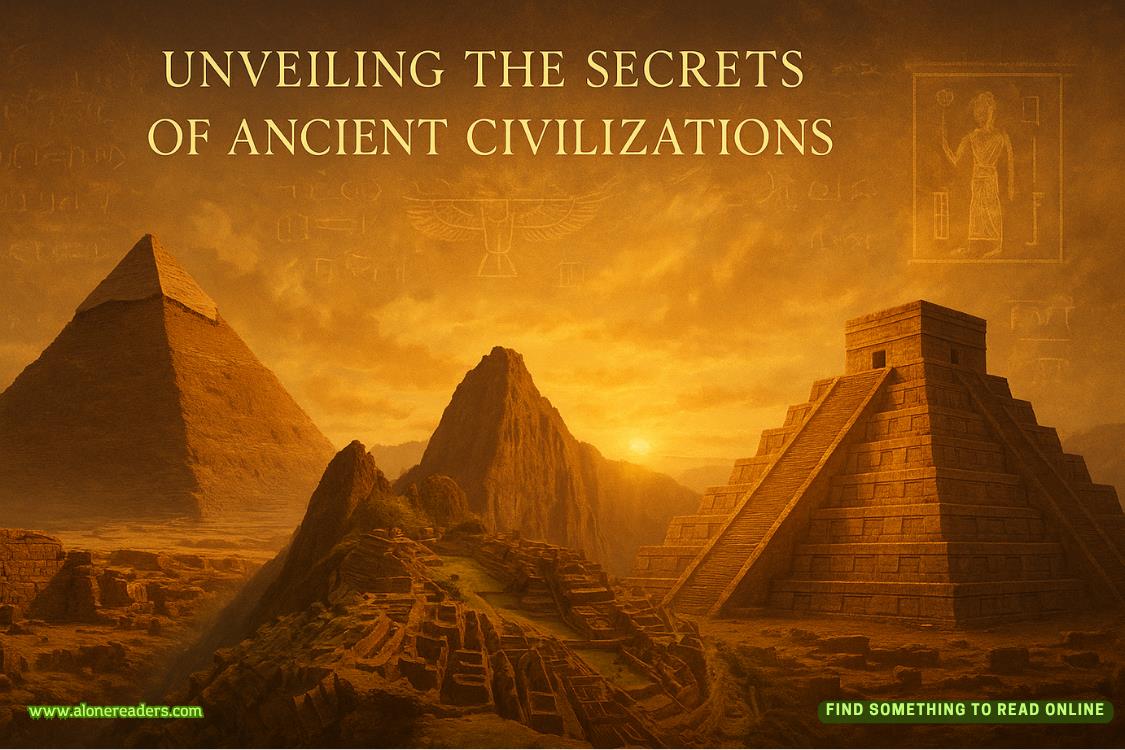
Human civilization did not emerge in isolation. Across the deserts, valleys, and mountains of the ancient world, societies rose and fell, leaving behind monumental achievements and enigmas that continue to puzzle scholars today. From the mathematical genius of the Mayans to the astronomical precision of the Egyptians, these ancient peoples shaped the foundation of science, architecture, governance, and belief. Yet much of their knowledge remains hidden, lost beneath layers of time and myth.
This exploration delves deeply into the secrets of these early civilizations—how they advanced beyond their era, how they interacted with their environment, and why so much of their brilliance faded into obscurity.
The Cradle of Urban Society
In the fertile valleys of the Tigris and Euphrates, humanity first learned to live in organized cities. Mesopotamia, the so-called “Cradle of Civilization,” gave birth to urban planning, codified laws, and written language. The Sumerians developed cuneiform not merely as a tool for record-keeping but as an early form of storytelling, trade documentation, and even astronomy.
Engineering the Impossible
What is often overlooked is their advanced understanding of hydraulic systems. The Mesopotamians built canals and levees with mathematical precision, ensuring controlled irrigation in an unpredictable environment. Their ziggurats, massive stepped temples, reflected not only architectural mastery but also a cosmological view that connected heaven and earth—a symbolic axis of divine order.
Mathematics of Immortality
The Egyptians’ mastery of geometry and measurement remains one of history’s most astonishing achievements. The Great Pyramid of Giza aligns almost perfectly with the cardinal points of the Earth, an alignment that would require advanced astronomical calculation even today. Their understanding of proportion and angle was so precise that modern engineers continue to study how these colossal structures were constructed with such accuracy using simple tools.
Medicine, Anatomy, and Preservation
Egyptian knowledge extended beyond architecture. Through mummification, they gained unparalleled insight into human anatomy. Their medical papyri reveal diagnoses and surgical procedures that predate Greek medicine by millennia. The intertwining of spirituality and science created a civilization that viewed death not as an end, but as a transformation—a belief so powerful it shaped their entire material culture.
Order Through Design
Unlike Egypt or Mesopotamia, the Indus Valley Civilization thrived without grand monuments or obvious rulers. Yet their cities, such as Mohenjo-Daro and Harappa, display a level of urban organization unmatched in the ancient world. Each city featured grid layouts, standardized bricks, and sophisticated drainage systems—suggesting a collective form of governance focused on efficiency and equality.
Silent Script and Hidden Wisdom
Their still-undeciphered script remains one of archaeology’s greatest mysteries. Without it, we are left to infer their beliefs and social systems through architecture and artifacts. Their absence of royal iconography and warfare scenes suggests a society that prioritized trade, hygiene, and civic responsibility—traits remarkably modern in outlook.
Timekeepers of the Universe
Far across the ocean, the Mayans were decoding the heavens. Their calendar was not merely a method of tracking days—it was a cosmological system linking time, creation, and human destiny. Their astronomical observatories, such as El Caracol in Chichen Itza, aligned with planetary movements, enabling them to predict solar and lunar eclipses centuries in advance.
Written Knowledge and Cultural Continuity
Unlike many other civilizations, the Mayans recorded their achievements in codices—folded books of bark paper filled with hieroglyphs. Though most were destroyed during the Spanish conquest, the surviving texts reveal an astonishingly advanced mathematical system that included the concept of zero—an innovation long before it appeared in Europe. Their fusion of spirituality, mathematics, and agriculture created a civilization deeply attuned to both the cosmos and the earth.
Philosophy and Invention
While the West often credits Greece with the birth of philosophy, ancient China had already developed intricate systems of logic, ethics, and metaphysics. The teachings of Confucius, Laozi, and Mozi shaped not only moral philosophy but governance and science. Meanwhile, their practical innovations—paper, compasses, and gunpowder—reshaped the trajectory of global civilization.
Cosmic Governance
What truly set Chinese civilization apart was the concept of the “Mandate of Heaven,” linking political legitimacy to cosmic balance. This idea integrated morality with statecraft, ensuring rulers were seen as custodians of both order and natural harmony. The ancient Chinese did not merely seek technological progress—they sought balance between human ambition and universal law.
From Myth to Rationality
Ancient Greece marked a turning point in how humanity perceived itself. While earlier civilizations expressed cosmic order through divine symbolism, the Greeks sought rational explanation. Philosophy became a science of the soul and nature alike. Thinkers such as Pythagoras, Aristotle, and Archimedes transformed mathematics and physics into systematic inquiry, setting the groundwork for modern reasoning.
Architecture and the Pursuit of Beauty
Greek architecture embodied balance and proportion—mathematical precision serving aesthetic harmony. The Parthenon’s subtle curvature, designed to correct optical illusion, reveals a profound understanding of visual psychology. Their art, politics, and science all revolved around one principle: human excellence through knowledge and form.
Atlantis, Lemuria, and the Forgotten Peoples
While the known civilizations reveal much, there are persistent legends of societies erased by cataclysm. Whether mythical or real, tales of Atlantis or Lemuria represent humanity’s memory of advanced cultures lost to time. Some underwater structures off Japan and India have reignited debates about prehistoric civilizations that predate recorded history.
Shared Patterns Across Continents
Even without direct contact, early societies across continents displayed uncanny similarities—pyramidal architecture, astronomical alignments, and flood myths. These parallels suggest either shared human intuition or remnants of a forgotten global exchange of ideas.
DNA, Satellites, and Artificial Intelligence
Modern archaeology is no longer confined to excavation. Satellite imaging reveals lost cities beneath jungles and deserts, while DNA analysis reconstructs ancient migrations. Artificial intelligence now helps decode long-forgotten scripts and predict the locations of undiscovered settlements. The secrets once locked in stone are being reopened through technology that bridges past and present.
What We Still Don’t Know
Despite all progress, much remains elusive—the full language of the Indus script, the construction methods of the pyramids, the astronomical logic of Stonehenge. Each discovery reminds us that ancient civilizations were not primitive precursors but creative pioneers who understood the world in ways we are only beginning to rediscover.
The story of ancient civilizations is not just a chronicle of ruins—it is the ongoing dialogue between the past and the present. Their wisdom endures in the geometry of our buildings, the ethics of our laws, the rhythm of our calendars, and the stories that shape our identity. Every new archaeological revelation is a reminder that humanity’s progress is not linear—it is cyclical, built on rediscovering what was once known and lost.
To unveil the secrets of ancient civilizations is to uncover ourselves—the architects of memory, meaning, and timeless curiosity.



 Château de Vincennes: France’s Forgotten Royal Fortress and Medieval Stronghold
 Château de Carcassonne: Europe’s Greatest Medieval Citadel and Fortress
 Château de Chenonceau: The Castle Built by Remarkable Women
 Château de Chambord: France’s Magnificent Renaissance Castle and Architectural Wonder
 Tehri Dam: India's Tallest Dam and the Debate Behind It
 Bhakra Nangal Dam: India's Temple of Modern Development