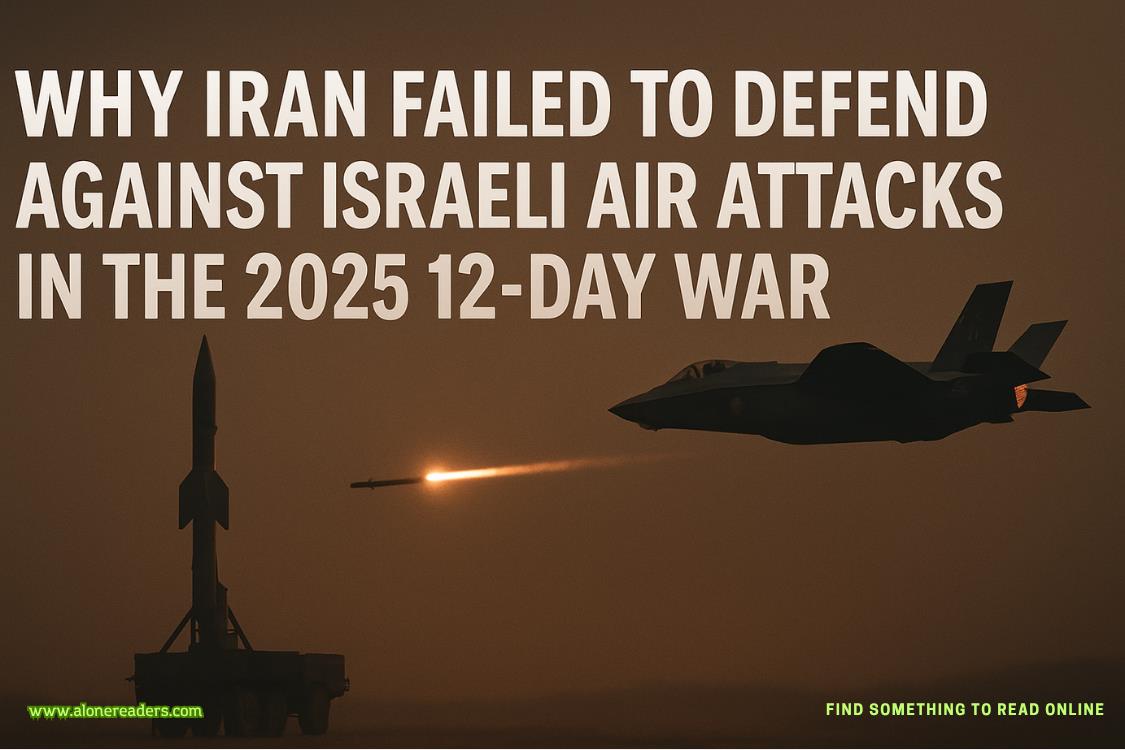
The 12-day war between Iran and Israel in 2025 marked one of the most technologically advanced short conflicts in Middle Eastern history. The most striking feature of the war was Israel’s near-total air superiority, and, more specifically, Iran’s inability to intercept, defend against, or sometimes even detect Israeli fighter aircraft during repeated high-intensity air raids. While many analysts have described this as simply “Israeli air dominance,” the reality is far more complex and rooted in a combination of Israeli technological superiority, Iranian systemic weaknesses, intelligence gaps, electronic warfare, and the changing nature of modern aerial warfare. This article explores these factors in depth, providing a specialist’s insight into the why and how of Iran’s failures in air defense during the 2025 war.
Israeli multi-layered stealth and stand-off strike capabilities
In the decade leading up to the 2025 war, Israel had systematically modernized its air force, with significant investments in stealth technology, networked warfare, and stand-off munitions. The Israeli Air Force (IAF) not only operated American-made F-35I Adir stealth fighters but also integrated domestically upgraded legacy F-15 and F-16 platforms with advanced jamming pods and sensor fusion suites. This created an air fleet capable of deep penetration missions, even in heavily contested airspace.
Doctrine of ‘First Look, First Shot, First Kill’
The IAF’s operational doctrine prioritized the ability to detect, engage, and destroy enemy air defenses before Iran’s military could even register the incursion. Decades of simulation and real-world engagement in Syria honed these capabilities. By 2025, Israel could coordinate large-scale airstrikes using swarming drones, electronic warfare platforms, and multi-domain coordination, often operating in radio silence or with decoy signatures.
Fragmented and aging air defense network
Despite periodic upgrades, Iran’s integrated air defense system (IADS) was fundamentally based on technologies from the 1970s to early 2000s. Although Iran boasted a mix of Russian S-300, indigenous Bavar-373 systems, and older American Hawk batteries, these were not seamlessly integrated into a unified command-and-control network.
Over-reliance on static, radar-dependent SAM sites
Iranian strategy still relied heavily on fixed, radar-guided surface-to-air missile (SAM) batteries, with slow reaction times and little redundancy. These sites, once their locations were mapped (often through open-source intelligence and Israeli SIGINT), were vulnerable to precision stand-off munitions and decoys.
Weak mobile and distributed defense
Efforts to deploy mobile air defense units were hampered by poor logistics, limited operator training, and communication issues under electronic jamming. As a result, these assets were slow to redeploy in response to Israeli attacks, leading to critical coverage gaps.
Advanced stealth and radar-absorbent materials
The F-35I Adir and other Israeli strike platforms incorporated radar-absorbent coatings and airframe designs specifically tuned to defeat X-band and L-band radars. Iranian early warning and fire control radars, even the more modern Russian-imported models, could not reliably detect these aircraft at operational ranges.
Low-altitude penetration and terrain masking
Israeli pilots frequently flew at ultra-low altitudes, using Iran’s mountainous terrain to mask their radar signatures. Even if detected momentarily, these blips often appeared as “ground clutter” on Iranian radar screens and were dismissed as non-threats.
Use of stand-off weapons and decoys
The majority of Israeli munitions were launched from well outside the effective range of Iranian SAMs. These included the Rampage supersonic missile, Delilah cruise missiles, and glide bombs, often accompanied by decoy drones or electronic spoofers that triggered false alarms or overwhelmed local radar operators.
Sophisticated Israeli EW platforms
A critical, often invisible, aspect of the air campaign was Israel’s use of dedicated electronic warfare aircraft, such as the Gulfstream G550 “Shavit” and “Eitam.” These platforms could jam, spoof, and even take control of enemy radar and communication frequencies in real time.
Suppression of enemy air defenses (SEAD) missions
Every Israeli air operation was preceded by waves of electronic suppression, targeting known Iranian radar sites. In many cases, Iranian radars were blinded at the crucial moment—sometimes mere seconds before Israeli strike packages entered their engagement envelope.
Network disruption and cyber attacks
Reports indicate that, during key phases of the conflict, Iran’s air defense command network suffered intermittent blackouts and data corruption, possibly from Israeli cyber operations. This crippled the ability to track and intercept multiple targets simultaneously.
Comprehensive ISR (Intelligence, Surveillance, Reconnaissance)
Israel’s intelligence community, with its extensive network of satellites, drones, and cyber assets, had mapped the disposition of nearly all Iranian air defense assets in advance. This allowed precision targeting and “softening up” attacks that neutralized critical nodes early in the war.
Deceptive operations and “false flag” strikes
Some Israeli operations reportedly used decoy formations or UAV swarms to draw Iranian defenses away from real targets. In other cases, Iranian radar operators were subjected to cyber-injected “phantom targets” and fake communications, causing confusion and diluting response effectiveness.
Lack of network-centric warfare capability
Unlike Israel, Iran’s air defense network was not truly “networked” in the Western sense. Communications between disparate air defense sectors were often slow, manually relayed, and vulnerable to jamming. In rapidly evolving air battles, this lag meant critical threats went unreported or unengaged.
Over-centralization and poor training
Iran’s air defense relied on a handful of centralized command nodes, which became primary targets for Israeli air and cyber strikes. Training for decentralized, autonomous response to air threats was inadequate, and local commanders hesitated to engage without top-down orders, wasting precious seconds.
Obsolete friend-or-foe identification systems
Iran’s IFF (Identification Friend or Foe) infrastructure lagged behind. In the fog of electronic warfare, there were cases where Iranian units hesitated to fire, unsure if incoming aircraft were Israeli or from their own air force.
Radar technology lag
Even the much-touted Iranian Bavar-373 system, based on the Russian S-300, struggled to track low-RCS (radar cross section) targets in a dense EW environment. Critical radar frequencies were jammed or spoofed, rendering missile batteries useless at decisive moments.
Limited indigenous electronic warfare
Iran had made strides in developing indigenous EW systems, but these were limited in both power and sophistication compared to Israeli platforms. Attempts to jam incoming munitions or aircraft often failed, and in some cases, Iranian jammers were “burned through” by Israeli counter-countermeasures.
Psychological impact of undetectable threats
Iranian radar operators and SAM crews, facing repeated “ghost” attacks and unexplained failures, reported high levels of stress and confusion. The knowledge that Israeli aircraft could strike undetected at will eroded morale and led to operational mistakes.
Command paralysis and communication breakdown
As the Israeli campaign intensified, communication networks came under sustained electronic and kinetic attack. Orders were delayed, contradictory, or simply failed to arrive. In several instances, Iranian units simply abandoned their posts during intense EW barrages, further degrading defense.
The primacy of stealth, EW, and networked operations
The 2025 war demonstrated that, in modern high-intensity conflict, traditional radar-dependent air defense systems are insufficient against a technologically superior, highly networked adversary with robust electronic warfare capabilities.
Need for distributed, AI-driven defense
Experts argue that Iran’s greatest weakness was its failure to adopt distributed, semi-autonomous air defense nodes, empowered by artificial intelligence and real-time data fusion, to react independently under EW assault.
Rapid modernization and integration imperative
For any state facing a potential adversary with Israel’s capabilities, the war highlighted the urgent need to move beyond static, doctrine-bound defense and toward highly mobile, integrated, and resilient multi-domain defense architectures.
The 12-day war between Iran and Israel in 2025 set a new benchmark for air warfare in the region. Iran’s inability to detect, track, or intercept Israeli fighters was not simply the result of technological inferiority, but a reflection of deeper systemic, doctrinal, and organizational weaknesses. The conflict illustrated the brutal efficiency of stealth, electronic warfare, and intelligence-driven air operations—and underscored the existential risk faced by any military force clinging to outdated methods in the age of fifth-generation warfare. As both nations analyze and learn from this short, devastating conflict, the future of air defense in the region will depend on rapid adaptation and a willingness to rethink everything once considered foundational in military strategy.



 Top 10 Highest-Paid Professions in the United States (2025): Salaries, Roles, and Career Paths
 Top 10 Largest U.S. Companies by Revenue in 2025 (Fortune 500 Analysis)
 Top 10 Highest-Earning Global Tech Companies in 2025: Revenue, Strategy, and Market Power
 Top 10 Highest-Earning Mobile Apps in 2025: Revenue, Monetization, and Market Dominance
 ZombieAgent: Inside the Zero-Click AI Attack That Turns ChatGPT Agents into Persistent Data-Leaking Zombies
 China’s Urban Air Is a Hidden Plastic Reservoir: Inside the Microplastic Clouds Over Megacities