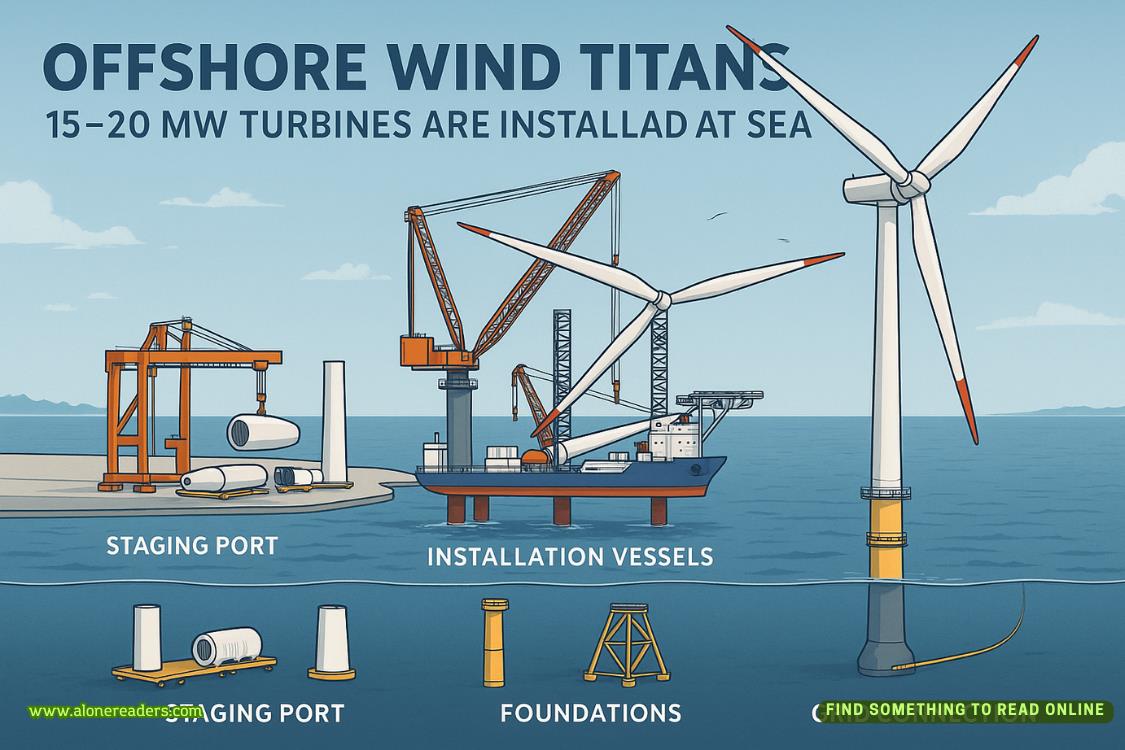
The scale of offshore wind energy has grown dramatically over the past two decades, moving from modest three-megawatt machines to colossal turbines in the 15 to 20 MW range. These giants, each blade longer than a football field and towers stretching more than 260 meters above the sea, are the latest evolution of renewable energy technology. Their installation at sea represents one of the most complex engineering challenges in the world, blending precision engineering, heavy logistics, and maritime expertise. The task of installing such machines is no longer comparable to onshore projects or even smaller offshore projects of the past; it requires bespoke vessels, massive foundations, and specialized strategies that push the limits of current marine construction capabilities.
The journey begins onshore, where components are manufactured under controlled conditions. Turbine blades of 115 meters or more, nacelles the size of small houses, and tower sections weighing hundreds of tonnes are fabricated at highly specialized facilities near deep-water ports. These ports must be upgraded with reinforced quaysides and heavy-duty cranes to handle such enormous loads. Once components are ready, logistics operators face the challenge of moving them from factories to staging ports, sometimes involving weeks of planning for transport clearances, specialized trailers, and escort operations.
The staging port is the nerve center of turbine installation, acting as the hub where turbine parts are pre-assembled and loaded onto installation vessels. Modern jack-up vessels, designed explicitly for offshore wind, are capable of carrying multiple complete sets of turbines. These vessels are equipped with cranes reaching over 150 meters and capable of lifting more than 3,000 tonnes—sufficient to hoist the nacelles of 20 MW machines into position. However, even these specialized ships face limitations, and many of the latest turbine models challenge the very upper limits of their capacity. Shipbuilders are now racing to produce new generations of even larger vessels, anticipating the continuous growth of turbine size.
Before a turbine can be erected, the seabed must be prepared. For fixed-bottom projects, engineers conduct geotechnical surveys to assess soil conditions and choose appropriate foundations. The most common types are monopiles, jackets, and gravity-based structures. Monopiles, which resemble giant steel cylinders up to 12 meters in diameter and 120 meters long, are hammered or drilled into the seabed using hydraulic hammers and drilling rigs. These monopiles can weigh over 3,000 tonnes, requiring specialized transport and lifting equipment. Jacket structures, used in deeper waters, are welded steel frameworks anchored with piles at each leg, offering stability in harsher environments. The latest challenge is installing floating foundations for turbines in waters beyond 60 meters deep, where fixed-bottom solutions become impractical. Floating platforms, stabilized by ballast and mooring lines, must be assembled in sheltered ports and towed into position before turbines are mounted.
Installation of the turbines themselves is a highly choreographed process. First, the tower base is lifted and secured to the foundation, aligned with precise tolerances to ensure vertical stability. Subsequent tower sections are stacked on top, each bolted and welded to withstand decades of stress from wind and waves. The nacelle, housing the generator, gearbox, and control systems, is then hoisted hundreds of meters above the sea and carefully placed onto the tower. Finally, the blades are attached either individually using blade yokes and specialized lifting tools, or in a “rotor lift” where the fully assembled rotor is raised in one maneuver. Each lift can only occur in weather windows with low wind and calm seas, as even slight movements can jeopardize safety and alignment. This means installation teams are constantly at the mercy of weather forecasts, with delays costing millions of dollars per day.
Cable installation is another critical element of offshore wind farm construction. Once turbines are installed, subsea cables connect them in strings, transmitting electricity to an offshore substation. These cables, often up to 66 kV or 132 kV, are buried under the seabed using ploughs or jetting tools to protect them from fishing activities and anchors. The offshore substation collects and converts the electricity before sending it via high-voltage export cables to the onshore grid connection point. Installing these cables requires separate vessels, often working in tandem with the turbine installation teams, and involves navigating seabed obstacles, protecting cables with rock dumping or concrete mattresses, and ensuring redundancy against failures.
Health and safety considerations dominate every stage of offshore wind installation. Workers operate in some of the harshest conditions on earth, often dozens of kilometers offshore and in environments where heavy lifts, high winds, and unpredictable seas can create life-threatening hazards. Safety protocols, training, and emergency response capabilities are therefore deeply embedded in every aspect of operations. Helicopters and crew transfer vessels provide personnel access, while offshore living quarters accommodate teams for weeks at a time. The complexity of coordinating dozens of vessels, hundreds of workers, and thousands of components underscores why offshore wind projects now resemble major oil and gas developments in their scale and risk management.
The economic stakes are equally high. A single 15 to 20 MW turbine can produce enough electricity to power more than 20,000 European households, and offshore wind farms can span hundreds of square kilometers with dozens of turbines. Each project costs billions of dollars, but the economies of scale gained from larger turbines reduce the overall cost of electricity. Fewer turbines mean fewer foundations, fewer cables, and less maintenance over the lifespan of a project. This is one reason why developers are racing to adopt the largest machines as soon as they become commercially available. The installation phase, however, remains the bottleneck—dependent on limited vessel availability, weather windows, and the readiness of supply chains.
The future of offshore wind installation is increasingly tied to floating wind farms, which promise access to deeper waters and stronger, more consistent wind resources. Floating installations allow pre-assembly in sheltered harbors, where turbines can be mounted on floating platforms and then towed to site, reducing offshore construction time. However, anchoring floating platforms, handling dynamic cables, and ensuring stability against powerful waves present new engineering frontiers. Already, demonstration projects in Europe and Asia are proving that floating wind can work at commercial scale, and installing 15–20 MW turbines on floating foundations is expected to become routine within the next decade.
Beyond the technical achievements, these offshore giants are symbols of the transition to a cleaner energy system. Installing a 20 MW turbine at sea is not just about building a machine; it is about reshaping the global energy infrastructure. Each successful installation represents a leap forward in engineering, a reduction in carbon emissions, and a step toward energy security. The process is daunting, requiring years of planning, vast financial commitments, and cooperation across industries ranging from shipping and steelmaking to electrical engineering and environmental science. Yet the payoff is immense: a future where wind, harnessed from the open sea, powers cities, industries, and transportation without reliance on fossil fuels.
The installation of 15 to 20 MW offshore wind turbines is therefore both a technical marvel and a societal milestone. It blends precision, power, and perseverance in the pursuit of clean energy. These machines are not just titans of steel and carbon fiber; they are monuments to human ingenuity and determination, standing tall against the horizon, silently spinning to capture the energy of the wind and transform it into the lifeblood of modern civilization. The challenge of installing them is monumental, but the vision they represent is even greater—the promise of a sustainable future fueled by the vast, untapped energy of the seas.

October 25, 2023

January 02, 2025



 Tsunami Stones of the Deep: Reading the Seafloor's Geological Memory
 Storegga Slides: Mega-Landslides That Shaped Coastlines and Changed Prehistoric Europe
 Submarine Canyons: The Grand Canyons of the Continental Shelf and Their Hidden Ocean Worlds
 Seamount Oases: Biodiversity Hotspots in the Blue Desert | Hidden Mountains of the Deep Ocean
 Jeddah Light: One of the Tallest Modern Lighthouses in the World and a Gateway to the Red Sea
 Inisheer Lighthouse: Ireland's Quiet Island Beacon Guarding the Edge of the Atlantic
 The Abu Ghraib Scandal, Iraq, 2004: A Human Rights Disaster That Shook the World
 The Disbanding of the CNRP, Cambodia, 2017: Hun Sen's Clampdown on Democracy and the Reshaping of Cambodian Politics
 The Firing of James Comey, United States, 2017: Trump's Controversial Decision Amid FBI Investigation
 The Rwandan Refugee Crisis, Central Africa, 1994: Aftermath of Genocide and the Humanitarian Catastrophe
 The Most Important Turning Points of the Battle of Hastings (1066)
 Why William Won the Battle of Hastings and Harold Lost: Strategy, Leadership and Fate in 1066
 How King Harold II Died: Facts, Myths, and Historical Debate
 The Battle of Hastings: A Complete Timeline of the Fighting
 High-End Talent Category A Work Permit China 2026: Complete Eligibility, Benefits, Application Process, and Expert Guide
 Cultural Activities Visa Japan 2026 Guide: Complete Eligibility, Requirements, Application Process, and Expert Tips