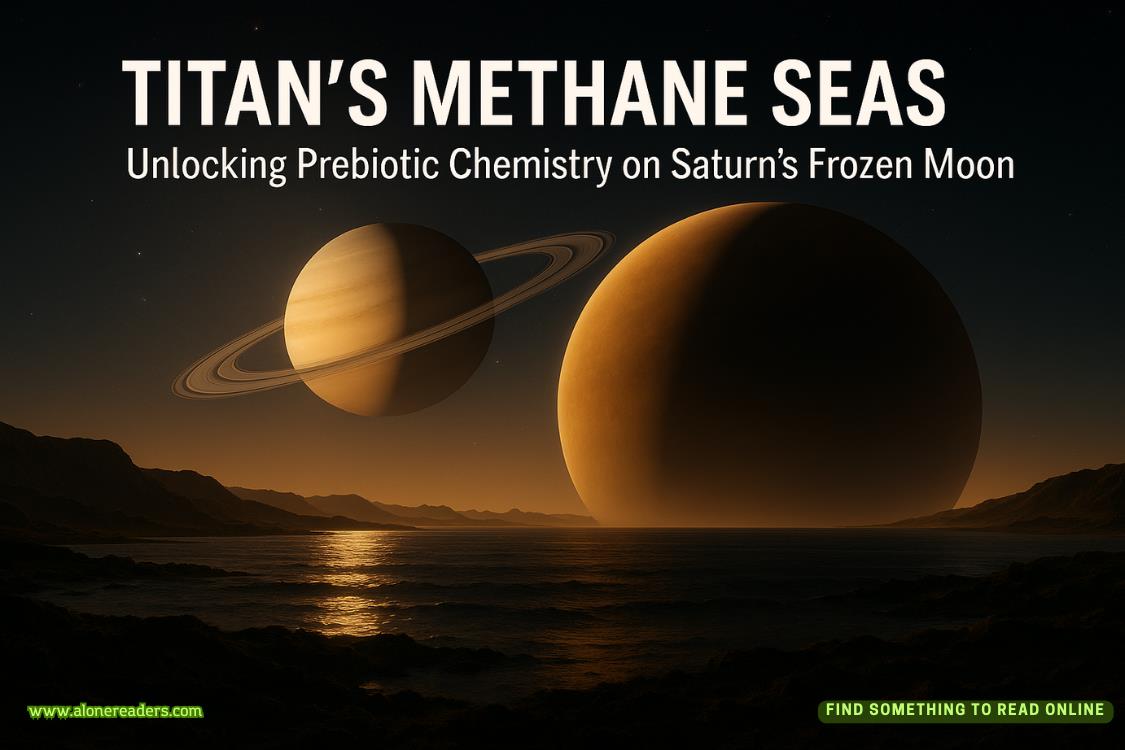
Saturn’s largest moon, Titan, has long fascinated scientists as one of the most Earth-like bodies in the solar system. While its frigid temperatures, nitrogen-rich atmosphere, and hydrocarbon-based seas seem hostile by terrestrial standards, Titan represents one of the most intriguing laboratories for exploring prebiotic chemistry. Instead of liquid water oceans, Titan possesses vast seas of methane and ethane, which behave like Earth’s water cycle in a parallel chemical universe. The prospect that these alien seas may harbor the chemical building blocks of life has transformed Titan into a prime target for astrobiology, planetary science, and the study of life’s origins in environments radically different from Earth.
Discovered in 1655 by Christiaan Huygens, Titan remained enigmatic for centuries until spacecraft exploration provided a closer look. NASA’s Voyager flybys in the early 1980s hinted at a dense atmosphere, but it was the Cassini-Huygens mission, arriving at Saturn in 2004, that revolutionized our understanding. The Huygens probe’s descent through Titan’s atmosphere in 2005 revealed a landscape sculpted by rivers and lakes of liquid methane, eerily resembling terrestrial hydrology. Cassini’s radar mapping later confirmed the existence of Kraken Mare, Ligeia Mare, and Punga Mare—seas larger than some of Earth’s great lakes. These findings established Titan as the only body other than Earth with stable surface liquids, albeit with a chemistry dominated by hydrocarbons.
The prebiotic potential of Titan’s seas lies in their complex organic chemistry. Titan’s atmosphere, composed mostly of nitrogen with a few percent methane, is constantly bombarded by solar ultraviolet radiation and cosmic rays. This energy input triggers photochemical reactions that generate a haze of organic compounds, including tholins, which settle onto the surface. These organics may accumulate in the methane seas, providing the raw ingredients for prebiotic chemistry. Although Titan’s surface is far too cold for liquid water, with average temperatures around –179 °C, transient melting events caused by cryovolcanism or impact heating may allow interaction between organics and subsurface water-ammonia reservoirs. Such interactions could resemble the early chemistry that preceded life on Earth, albeit under radically different conditions.
Unlike Earth’s water-based biochemistry, life on Titan—if it exists—would need to adapt to solvents of methane and ethane. This has inspired theories of “alternative biochemistries” where membranes could form not from phospholipids but from acrylonitrile-based structures, sometimes called “azotosomes.” Laboratory simulations have shown that such cell-like membranes could be stable in Titan’s liquid methane environment. Although speculative, these models demonstrate that biochemistry is not strictly confined to water; other solvents may provide viable alternatives for life in the cosmos. Titan thus challenges our Earth-centric definitions of habitability, forcing scientists to broaden their perspectives.
The study of Titan’s methane seas also has implications for understanding Earth’s own prebiotic past. Before life emerged, our planet’s early atmosphere may have contained methane and nitrogen in abundance. Some researchers argue that Titan represents a frozen analog of primordial Earth, allowing us to observe chemical processes that may have once unfolded on our young planet. By studying Titan’s chemistry, scientists hope to unravel how simple molecules evolve into complex polymers capable of replication and metabolism—the essential features of life.
In addition to its methane seas, Titan hides another potential habitat: a vast internal ocean of liquid water mixed with ammonia, located beneath its icy crust. Evidence from Cassini’s gravity measurements and radar data suggests that this subsurface ocean may persist due to tidal heating generated by Saturn’s gravitational pull. If organic compounds from the surface were transported to this internal ocean through cracks or cryovolcanic activity, Titan could host two distinct chemical laboratories—one based on methane and another based on water. This duality makes Titan a unique natural experiment, capable of informing us about the possibilities of both Earth-like and exotic forms of life.
Future exploration of Titan aims to answer these profound questions. NASA’s Dragonfly mission, set to launch in 2028, will deliver a rotorcraft lander to Titan’s equatorial regions in the mid-2030s. Dragonfly will investigate Titan’s surface chemistry, study potential prebiotic molecules, and assess habitability. Although it will not land directly in the methane seas, Dragonfly’s instruments are designed to analyze surface organics and atmospheric processes that contribute to Titan’s complex chemistry. Complementary missions proposed by international teams include floating probes that could directly sample the hydrocarbon seas, measuring their composition and searching for chemical disequilibria that might indicate active processes.
The challenges of exploring Titan are immense. Temperatures nearly 200 degrees below freezing complicate electronics and instrument design. Methane seas pose navigational hazards for any floating or submersible probe, and the dense, hazy atmosphere interferes with communications and imaging. Yet the scientific rewards justify the effort. Titan offers an unparalleled opportunity to test theories about the universality of life, the diversity of chemical systems, and the adaptability of biology in alien environments.
Titan’s role in the search for life extends beyond astrobiology into philosophy. If Titan’s methane seas support even the simplest prebiotic processes, it would imply that the universe is teeming with diverse chemical experiments, many of which may evolve toward life under the right conditions. Such a discovery would underscore the idea that life is not a singular phenomenon tied exclusively to Earth but a cosmic inevitability emerging wherever chemistry and energy coexist in dynamic balance. On the other hand, if Titan’s seas are chemically rich but biologically sterile, they still offer critical lessons about the limits of prebiotic chemistry, refining our search for habitable worlds across the galaxy.
The fascination with Titan lies in its duality: it is both alien and familiar. Its methane seas mirror Earth’s oceans, yet their chemical composition reflects a world where life, if it arises, must be profoundly different. Its atmosphere resembles early Earth’s, yet its surface is locked in deep freeze. Titan embodies the paradox of being one of the most inhospitable yet potentially life-revealing places in the solar system. In the frozen stillness of Saturn’s largest moon, scientists see not only the story of Titan but also a reflection of Earth’s past and a hint of life’s possibilities elsewhere.
In the coming decades, as missions like Dragonfly probe Titan’s mysteries and as laboratory simulations refine our understanding of hydrocarbon chemistry, the question of whether Titan’s methane seas harbor prebiotic processes will move closer to an answer. Whether Titan ultimately reveals life or not, its role as a natural experiment in chemistry ensures its importance in humanity’s search for origins and companions in the universe. For now, Titan remains a frozen enigma, an alien world where seas of methane ripple under an orange sky, carrying within them the secrets of life’s potential on a frozen world.



 Château de Vincennes: France’s Forgotten Royal Fortress and Medieval Stronghold
 Château de Carcassonne: Europe’s Greatest Medieval Citadel and Fortress
 Château de Chenonceau: The Castle Built by Remarkable Women
 Château de Chambord: France’s Magnificent Renaissance Castle and Architectural Wonder
 Tehri Dam: India's Tallest Dam and the Debate Behind It
 Bhakra Nangal Dam: India's Temple of Modern Development