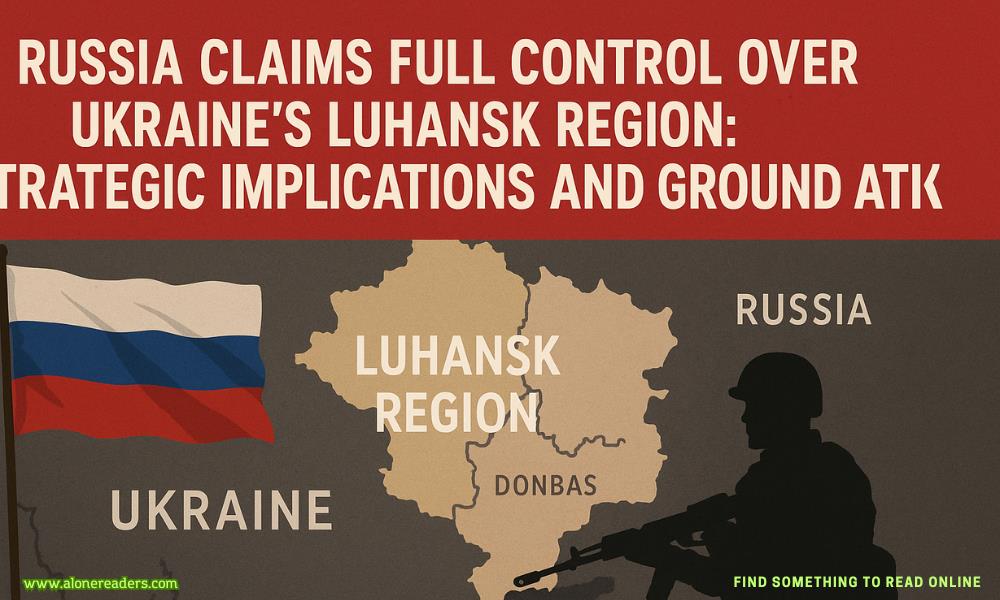
In a major development in the ongoing Russia-Ukraine conflict, Russian forces have declared full control over the entire Luhansk region in eastern Ukraine. This announcement, made by Russia’s Ministry of Defense, marks a critical milestone in Moscow’s long-term objective of dominating the Donbas region — an industrial heartland comprising Luhansk and Donetsk.
The claim follows a prolonged and brutal campaign that saw sustained artillery barrages, urban combat, and systematic pressure on Ukrainian defensive positions over several months. If confirmed, this development would mark one of the most extensive territorial acquisitions by Russia since the full-scale invasion began in 2022.
Geopolitical and military significance
Luhansk’s significance lies not only in geography but also in narrative. Capturing it gives Moscow an opportunity to declare success in its self-declared objective of "liberating" the Donbas. The region has been a focal point of separatist activity since 2014, and its full control allows Russia to:
This move also deepens Russia’s physical buffer zone, pushing the frontlines farther west, giving Russian artillery and missile units expanded operational depth.
A war of attrition and encirclement
Russia’s campaign for Luhansk was far from swift. Ukrainian forces, deeply entrenched and backed by Western intelligence and weaponry, managed to hold key strongholds such as Kreminna, Svatove, and the outskirts of Lysychansk for months. However, a mix of Russian air superiority, relentless ground assaults, and drone reconnaissance gradually shifted the balance.
The final push involved:
The Ukrainian army was eventually compelled to withdraw to avoid encirclement, choosing to conserve manpower for future counter-offensives rather than risk mass casualties.
Strategic withdrawals and preparation for a counter-offensive
Ukrainian military officials acknowledged the withdrawal from the last remaining pockets in Luhansk but emphasized it as a tactical decision rather than a collapse. Kyiv has shifted its defense lines westward into Donetsk and Kharkiv, where terrain and infrastructure offer better defensive advantages.
Ukrainian command is now:
President Zelenskyy has vowed that Luhansk will not remain under occupation indefinitely, framing the loss as temporary and “a call to arms” for continued Western support.
A humanitarian toll beneath the battlefield
With over two years of active warfare, Luhansk has been turned into a devastated landscape. Key cities like Sievierodonetsk and Lysychansk have suffered catastrophic damage, with residential blocks reduced to rubble and critical infrastructure — water, electricity, and hospitals — either destroyed or barely functional.
Civilians who remained have faced:
Humanitarian corridors remain inconsistent and unreliable, and many international aid groups report restricted access to the region.
How Moscow is presenting the capture
Russia is using its claimed control over Luhansk to consolidate domestic support and distract from battlefield losses elsewhere. State-controlled media channels are celebrating the “liberation” of Luhansk, portraying it as a triumph of Russian resilience against NATO-backed aggression.
Kremlin messaging emphasizes:
This is part of a broader strategy to maintain internal political control and suppress anti-war sentiment, especially as conscription continues and sanctions tighten their grip on Russia’s economy.
Concerns of escalation and recalibration of aid
The announcement has prompted immediate responses from Western governments, with concerns about the momentum of Russian forces and the possible targeting of further regions such as Sloviansk and Kramatorsk.
Key developments include:
The loss of Luhansk is likely to energize Western efforts to prevent further Ukrainian territorial losses, especially in the politically symbolic Donetsk region.
Military challenges and possibilities
While the loss is a blow, Ukrainian military experts argue that the region is not irretrievable. Several factors could eventually enable a counteroffensive:
However, any counteroffensive would likely be delayed until Ukraine amasses enough strength, possibly in early 2026, and only if Western support remains steady.
No clear victory, just evolving lines
Russia’s claim of full control over Luhansk represents a pivotal, though not decisive, moment in the war. While it solidifies Russia’s hold over one of its key objectives, it also galvanizes Ukraine and its allies into action.
The situation remains fluid. The war has become one of endurance, logistics, and political will — not just firepower. The question now is not only how Ukraine will respond but how long the international community can sustain the resolve to support its fight.
As winter approaches and new fronts possibly emerge in the south and northeast, the fall of Luhansk may be remembered either as a turning point for Russian success — or the spark that reignited Ukrainian resurgence.



 Top 10 Highest-Paid Professions in the United States (2025): Salaries, Roles, and Career Paths
 Top 10 Largest U.S. Companies by Revenue in 2025 (Fortune 500 Analysis)
 Top 10 Highest-Earning Global Tech Companies in 2025: Revenue, Strategy, and Market Power
 Top 10 Highest-Earning Mobile Apps in 2025: Revenue, Monetization, and Market Dominance
 ZombieAgent: Inside the Zero-Click AI Attack That Turns ChatGPT Agents into Persistent Data-Leaking Zombies
 China’s Urban Air Is a Hidden Plastic Reservoir: Inside the Microplastic Clouds Over Megacities